

Neuroathletic training & performance
Does your golf swing feel restricted even though you can rotate freely without the ball?
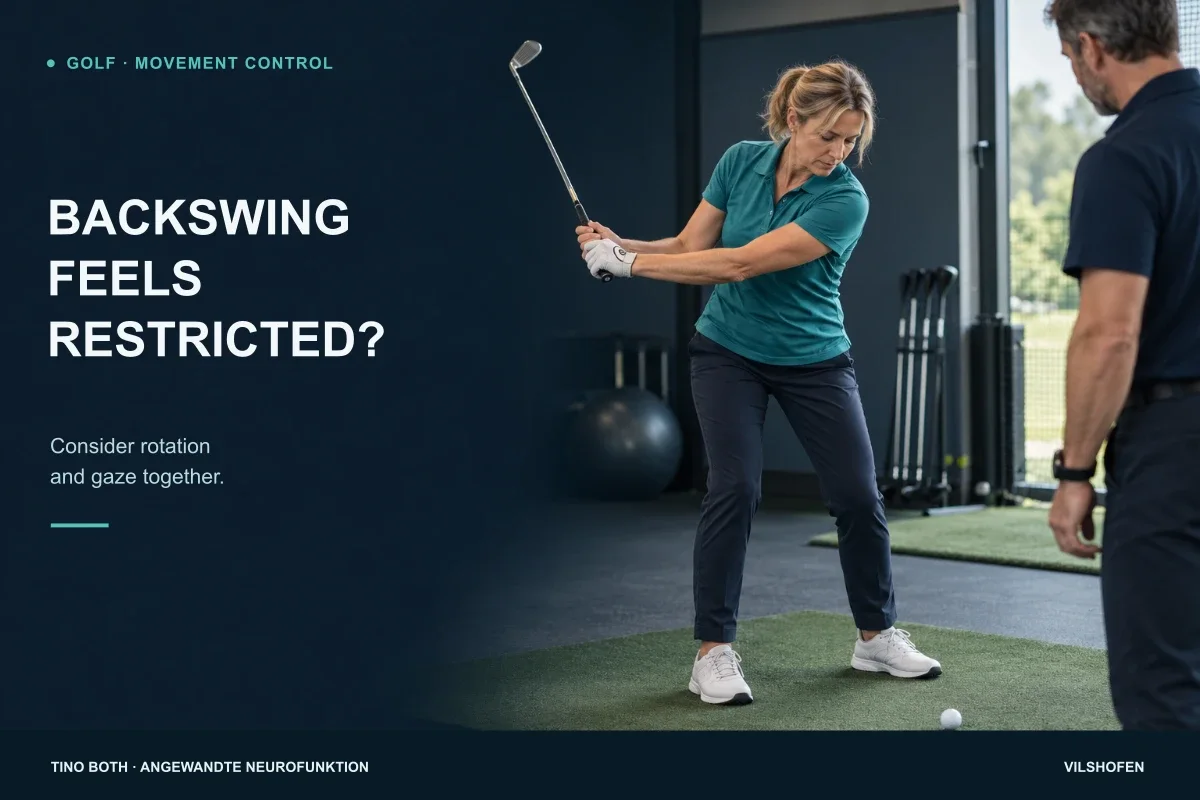
During the warm-up, your upper body turns comfortably. As soon as you pick up the club and look at the ball, the backswing becomes tight. A shoulder rises, rhythm disappears or the movement feels held back. That difference provides a useful starting point for functional assessment.
In Vilshofen, Tino Both uses Angewandte Neurofunktion and neuroathletic training to examine the foundations of sporting movement. For golf, he considers how rotation, gaze, stance and club movement fit together. This helps identify which part of the task deserves targeted attention.
Distinguishing mobility from its use in the golf swing
Turning the trunk while standing upright presents different demands from swinging in the address position. Hip flexion, arm position, head position and gaze target change. The hands also guide a club.
A precise description is therefore useful: is rotation generally limited? Does it become restricted only in the golf position? Or does the difficulty appear when gaze remains directed towards the ball?
These differences lead to different next steps. Someone who already rotates freely can work on connecting that ability to the actual swing task. Technique, loading and any previous symptoms are considered together.
A possible comparison in three stages
Tino starts with a slow, comfortable movement. Trunk rotation is first observed under a simple starting condition. A similar turn is then performed in the address position, initially without a complete shot.
The gaze target is introduced next. What changes when the eyes can follow a target? How does the same movement feel when gaze remains directed at a set point?
Stance, range and speed are kept as comparable as possible. This helps show which additional demand changes the pattern. A small head movement and an eye movement can also be assessed separately.
The key question is which combination restricts the movement. A general wish for more mobility becomes a specific task to work on.
Why gaze can be part of the movement question
During golf, the body organises orientation and rotation at the same time. The eyes provide information about the ball, club area and surroundings. Feedback from the neck, trunk and feet helps establish body position.
A focused comparison can show whether movement is difficult without an additional visual demand or whether the pattern changes only with a particular eye-head combination. This guides the choice of approach.
Tino might select a short, suitable eye-head task and then compare the same slow turn again. If the sequence changes favourably, the assessment returns to the address position and swing movement.
This gives a visual exercise a clear sporting purpose: it is evaluated against the movement that needs to become easier and more controlled.
Examining a specific connection more closely
Where a pattern is reproducible, Tino can also examine it within the NeuroFI model. A reliably testable indicator muscle provides feedback in response to the precisely defined condition.
Its ability to hold reliably is established first. The selected input is then added. If the previously stable muscle repeatedly gives way under that condition, a suitable resolving input is sought and compared with the original condition.
A useful resolving input is combined with a targeted integration stimulus. In the working model, this stores the functioning connection within the network. The original condition is then tested again without continuing to hold the additional resolving contact.
The original movement follows: the same address position, slow rotation and gaze target. This allows the method to be related directly to the sporting concern.
Taking the assessment back to the club
A helpful approach is first used in a manageable swing variation. A short pendulum movement may be enough before adding a larger range, ball contact and greater speed.
The technical focus of golf practice remains relevant. Functional assessment complements the question of which movement is available under the required conditions. Existing observations from the golf coach can make the baseline task more precise.
Movement feel, control and repeatability guide progress. A longer backswing is not a goal in itself. What matters is whether the selected movement suits the sporting task and can be performed under appropriate loading.
Useful details for the introductory call
Describe when the restriction appears: without the club, in the address position, during the backswing or only during an actual shot. A clear difference between sides, gaze targets or speeds is useful too.
An existing short recording and observations from previous assessments or golf lessons can add context. New significant pain or symptoms following an injury call for the medical situation to be clarified first.
Neuroathletic training for golfers in Vilshofen
Tino Both works in Vilshofen an der Donau, serving athletes from the Passau and Deggendorf area. Golfers from the Rottal area may also find the combination of functional assessment and a sporting task relevant.
Does rotation work during the warm-up but feel restricted at the ball? Describe that difference during a free introductory call and discuss where a focused assessment could begin.
Book your free initial conversation
Frequently asked questions
Does a full golf swing need to be performed at the appointment?
A small, controlled component is often enough for an initial comparison. The task is selected according to the concern, available space and current capacity.
Can this be relevant when general mobility is good?
Yes. A difference between free rotation and a particular golf condition can provide a specific question for functional assessment.
Can observations from the golf coach be included?
A clear description of the movement pattern helps select the baseline task. Functional work and technical practice can be directed towards a shared sporting goal.