

Neuroathletic training & sport
Your game works outdoors – why do you lose track when training moves indoors?
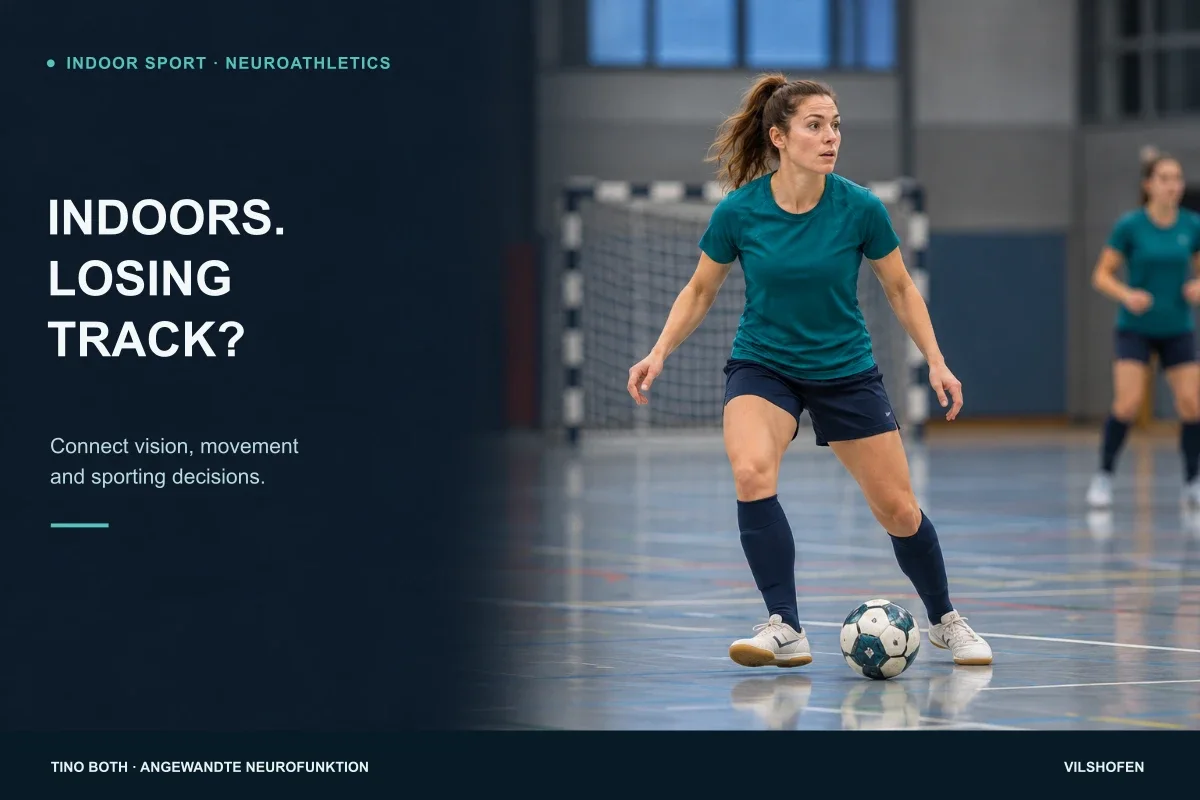
A pass is almost at your feet before you properly pick up its direction. During the next attack, your gaze stays on the ball and you notice an unmarked teammate too late. On the outdoor football pitch, the game felt much easier to read.
Moving into a sports hall changes viewing distances, backgrounds and available space. In Vilshofen, Tino Both helps athletes examine these differences more precisely. His neuroathletic work connects visual tasks with the actual sporting response: recognising, deciding, controlling the ball or moving.
Does this sound like your indoor training? In a free initial conversation with Tino Both, describe the game situation that causes difficulty. This provides a concrete starting point for assessing gaze control, awareness and your sporting response. Book your free initial conversation
What changes when training moves indoors?
The ball now travels against walls, spectator seating or several sets of court markings. The next boundary is closer. Teammates and opponents cross your visual space within a smaller area. Indoor lighting creates conditions that differ from those encountered outdoors.
The ball, floor grip and pace of play may also change. These factors need to be separated first. Labelling the change as a concentration problem can overlook a specific visual or movement demand.
The useful question is: which change makes the familiar task more difficult?
Separate seeing, deciding and responding
Being “too slow” can mean different things. A target may be detected late. The gaze may remain fixed on the ball for too long. Alternatively, the situation is understood promptly but the appropriate step follows late.
Tino begins by distinguishing simpler components. Is a stationary target recognised reliably? Can the eyes shift accurately between two targets? Is a side signal noticed while the gaze remains directed forwards? What changes when movement is added?
If vision is blurred, appropriate correction is the foundation. The subsequent functional comparison considers how the visual system performs under the demands of the sport.
A possible indoor-football example
A player reliably controls a gently played ground pass with her foot against a quiet background. Against a wall with several markings, the ball more often runs away from her on the first touch. Distance, delivery speed and the ball stay unchanged. This makes the background a useful comparison variable.
Tino can then look more closely at contrast detection, gaze control and awareness beside the ball. Does receiving remain reliable against the quiet background when she also has to identify a side signal? Or does the difficulty already appear when tracking the rolling ball alone?
The distinction guides the next step. Unsteady tracking calls for a different starting task from reliable tracking combined with late peripheral detection.
Turning the findings into focused work
Tino selects a small task that matches the observed difference. This could involve controlled tracking, precise gaze shifts or peripheral recognition. Distance, speed, direction and duration are chosen so that the response can be clearly observed.
The original receiving comparison is then repeated. Is the ball's direction recognised earlier? Is the gaze steadier? Is the first touch more controlled without simply slowing the delivery?
A useful component is connected to the sporting task. Initially, the player might control the ball while identifying a signal beside her. A pass towards an indicated target can follow. Other players, varied passes and greater speed are added once this combination is dependable.
This creates a practical connection between visual work and the game situation.
More stimulation does not automatically mean better preparation
Multiple balls, flashing signals and simultaneous instructions make a task demanding. They do not establish whether the relevant limitation is being addressed. When a situation already feels confusing, a clearer component task can provide a more useful starting point.
Tino therefore considers accuracy and decision quality as well as speed. A faster first step helps only when it goes in the appropriate direction. A controlled first touch matters more than completing an extra instruction in a rush.
Demand increases once the component is stable. That makes it easier to identify the point at which performance changes and choose a useful progression.
What to bring from your club training
Three observations are particularly helpful for an initial conversation:
- When do you lose track indoors: receiving a pass, changing from defence to attack, or dealing with several players in view?
- What already works against a quiet background or at a lower pace?
- Does the difficulty differ between practice and matches, or between the beginning and end of a session?
A short description from your coach may also help. It can inform a specific target task that can later be revisited in club training.
Prepare for the move indoors
Whether you move from an outdoor football pitch into a sports hall or from an outdoor tennis court to an indoor court, the starting point is your sport and the situation in which you lose time or awareness. In Vilshofen, Tino Both combines functional assessment with an understandable training approach for athletes from Passau, Deggendorf and the surrounding area.
Use the move indoors as a starting point for focused preparation. Bring the game situation in which you lose track. A free initial conversation with Tino Both helps define an assessment that connects seeing, deciding and responding with your sport.
Book your free initial conversation
Learn more about neuroathletic training in Bavaria.