

Neuroathletic training & performance
Looking for sports osteopathy? A neurofunctional approach to movement problems
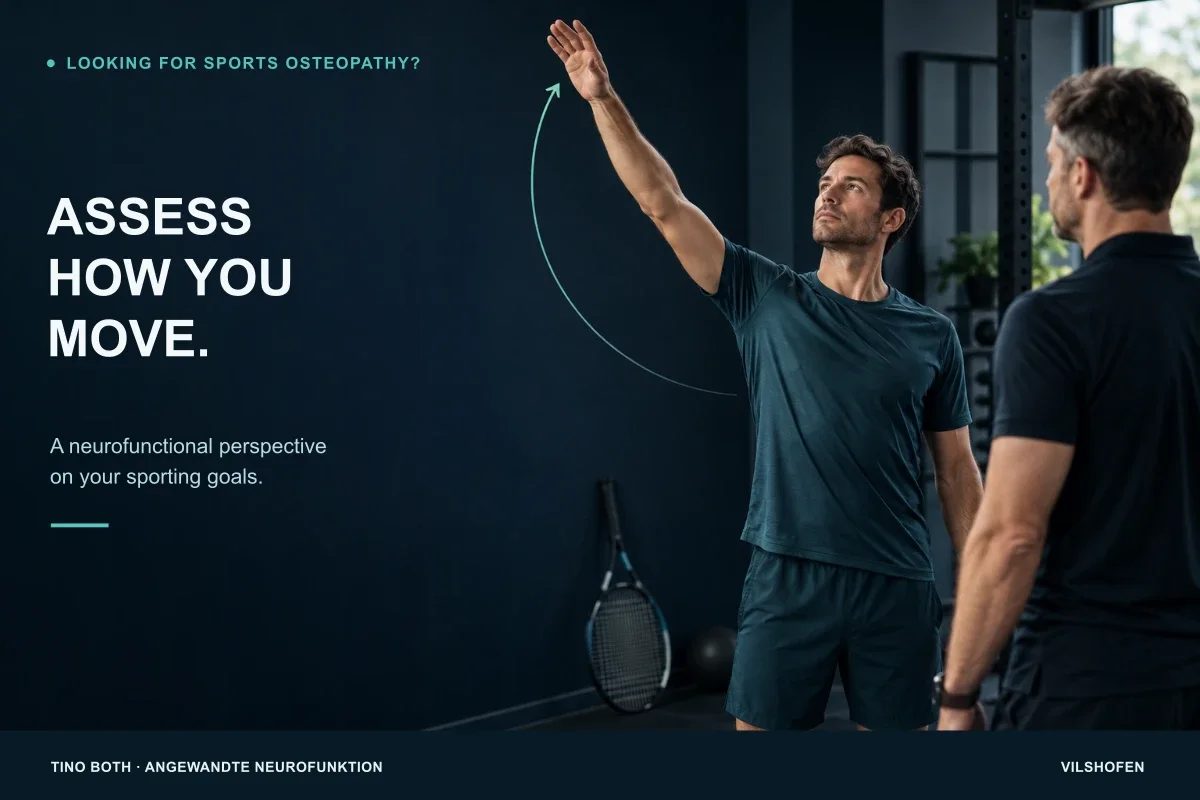
Your shoulder aches during a tennis serve. One side is harder to engage during strength training. After a turn, your leg feels less secure. People searching for “sports osteopathy near me” often want to address precisely these difficulties: moving more freely, with better control and greater confidence in their training.
In Vilshofen, Tino Both works with Angewandte Neurofunktion, NeuroFI and neuroathletic training. His approach combines a close assessment of movement with the question of how sensory feedback and muscular control work together. Connections that show an unusual response are assessed and addressed specifically. Repeating the same movement then shows what has changed.
The idea behind neuro-osteopathy provides a useful link: tissues, mobility and nervous system control work together during a sporting movement. The practical question is where that interaction becomes difficult and how it can be improved.
When the same movement keeps becoming difficult
Sometimes a limitation can be clearly identified. In other situations, a difference between tasks stands out: the arm has a good range of movement, but lifting it actively feels heavy. The knee supports you when standing still, but control is lacking during a change of direction. An exercise works while looking straight ahead and becomes uncertain after looking over your shoulder.
These differences provide specific starting points. Tino Both examines the task that is actually difficult: how does the affected side move? When does the pulling sensation begin? Which additional movement changes control? What level of loading is manageable?
This leads to a focused assessment question. With a shoulder, for example, the question may be whether the difficulty appears during a simple arm raise or only when a wrist, shoulder blade or head movement is added. This helps clarify which connection deserves closer attention.
Neuro-osteopathy: considering tissues and nervous system control together
Muscles, tendons, joints and skin continuously provide information about position, movement and loading. The nervous system processes this feedback and coordinates muscle activity for the task at hand. Manual contact also provides sensory information and can change the response to a movement.
The term neuro-osteopathy brings together physical structures and their nervous system control. Within the neurofunctional working model, mobility and load capacity are therefore considered alongside another question: How does the system process the information involved, and how does that show up in movement?
Neurofunctional Integration, developed by Dr Philip Eckardt, provides a specific assessment and integration process for this work. It examines precisely defined functional connections and looks for an input that changes an unusual response. Neuroathletic training complements this process with targeted training inputs and their application to sporting tasks.
Tino Both brings these areas together through his Angewandte Neurofunktion service. As a NeuroFI Master and Z-Health Master Practitioner, he draws on both perspectives. Together with Dr Eckardt, he published a professional article in Osteopathie Welt 03/26 exploring the combination of neuroathletic training and Neurofunctional Integration.
An example: the shoulder is mobile, but the serve feels restricted
Consider a tennis player whose shoulder has already been assessed. The arm can be moved well overhead. Yet actively raising it and preparing the serve still feel heavy, effortful or poorly controlled on one side.
Tino Both starts with a manageable baseline movement. He records how far the active arm raise is possible, when it becomes difficult and whether compensatory movements appear. Stance, direction and speed are kept the same for the later comparison.
Selected parts of the movement chain are then examined individually. What happens when the hand moves? Does changing the wrist position make a difference? Can the shoulder blade actively move in each required direction? How does the shoulder respond to head movement?
Suppose the arm raise becomes particularly difficult when a specific wrist movement is added. This identifies a connection that can be examined further. The shoulder remains the focus of the person's concern; the additional movement helps narrow down the functional relationship.
The benefit is a more precise choice of approach: the assessment helps identify which component makes the movement difficult and which connection can be addressed specifically.
Turning an unusual response into a focused approach
A consistently testable indicator muscle can be used for further neurofunctional assessment. Within the NeuroFI model, it provides feedback in response to a clearly defined test condition. First, its ability to hold reliably without the additional input is established.
The selected movement or combination of inputs is then added. If the previously stable muscle repeatedly gives way under that specific condition, this is interpreted within the method as a functional disturbance in the connection being tested. This defines the question for the next stage more precisely.
Tino Both then looks for a suitable resolving input. A specifically selected contact, for example, can provide additional sensory information that influences the interaction between feedback and motor control. Its selection is guided by the connection being examined and the actual test response.
The comparison makes that choice understandable: the condition that produced the unusual response is tested on its own and then together with the selected resolving input. If the response becomes consistently stable, an appropriate integration stimulus follows. In the working model, this stores the newly functioning connection within the network.
The same test condition is then repeated without continuing to hold the additional resolving contact. This is followed by the original sporting movement: in the example, the tennis player raises the arm again under the same conditions as at the start.
This links the method directly to the person's concern. The relevant question is whether lifting the arm becomes easier, better controlled or possible through a greater range, and how preparing the serve feels afterwards.
From easier movement back to training
A helpful change is then carried into an appropriate level of loading. For the tennis player, the active arm raise may be followed by slow preparation of the stroke. Depending on current capacity, the racket, greater speed and normal training demands can then be introduced.
Neuroathletic tasks involving gaze control, orientation, balance or movement coordination may support this progression. They are selected according to the difficulties identified and the response to each training input.
The immediate re-test helps identify a useful starting point. Repetition, training sessions and follow-up show how well the change holds up under load. This connects functional assessment, targeted integration and sporting practice.
Which sporting difficulties may suit this approach?
Angewandte Neurofunktion may be of interest when a particular movement repeatedly causes difficulty, for example:
- One side of the body is harder to engage during strength training.
- The shoulder has mobility but feels restricted during lifting, throwing or striking.
- Control is lost during turns, gaze shifts or changes of direction.
- A particular situation still feels uncertain after an injury that has already been medically assessed.
- A specific sporting task remains difficult or restricted despite previous treatment.
A precise description is useful: which sport, which movement, what already works and when does it become difficult? Existing findings and loading recommendations are taken into account.
Following a recent accident, a marked new loss of strength or new changes in sensation, medical assessment comes first. Where treatment is ongoing, functional work can be adapted to the person's progress and agreed loading limits.
Angewandte Neurofunktion in Vilshofen, serving the Passau and Deggendorf area
Tino Both's practice is in Vilshofen an der Donau. Athletes from the Passau and Deggendorf area can use a free introductory phone call to discuss their concerns and explore a suitable next step.
The focus is the movement they want to improve. Tino Both clarifies which assessments have already taken place, what the sport demands and where a targeted functional assessment could begin.
Does the same sporting movement keep holding you back? Describe the situation during a free introductory call and discuss how Tino Both's approach could support you.
Book your free initial conversation
Frequently asked questions
How are neuro-osteopathy and Angewandte Neurofunktion connected?
The connection lies in the interaction between tissues, sensory feedback and movement control. Tino Both's Angewandte Neurofunktion service combines functional assessment, NeuroFI and neuroathletic training. During an appointment, specific connections are assessed, addressed and compared again using the original task.
Can this complement osteopathic treatment or physiotherapy?
Yes, for example when a specific sporting task remains difficult or when the return to training needs more focused support. Existing findings, loading recommendations and progress to date are taken into account.
Does the required method need to be decided before the appointment?
The specific difficulty and sporting goal provide a starting point. The conversation and functional assessment guide the choice of assessment, integration or training task.
What can be compared during an appointment?
A specific baseline task is established first. After targeted work, the same task is repeated. This allows a direct comparison of changes in mobility, control or how the movement feels.