

Children, concentration & learning
My child mixes up left and right: Where does orientation become difficult?
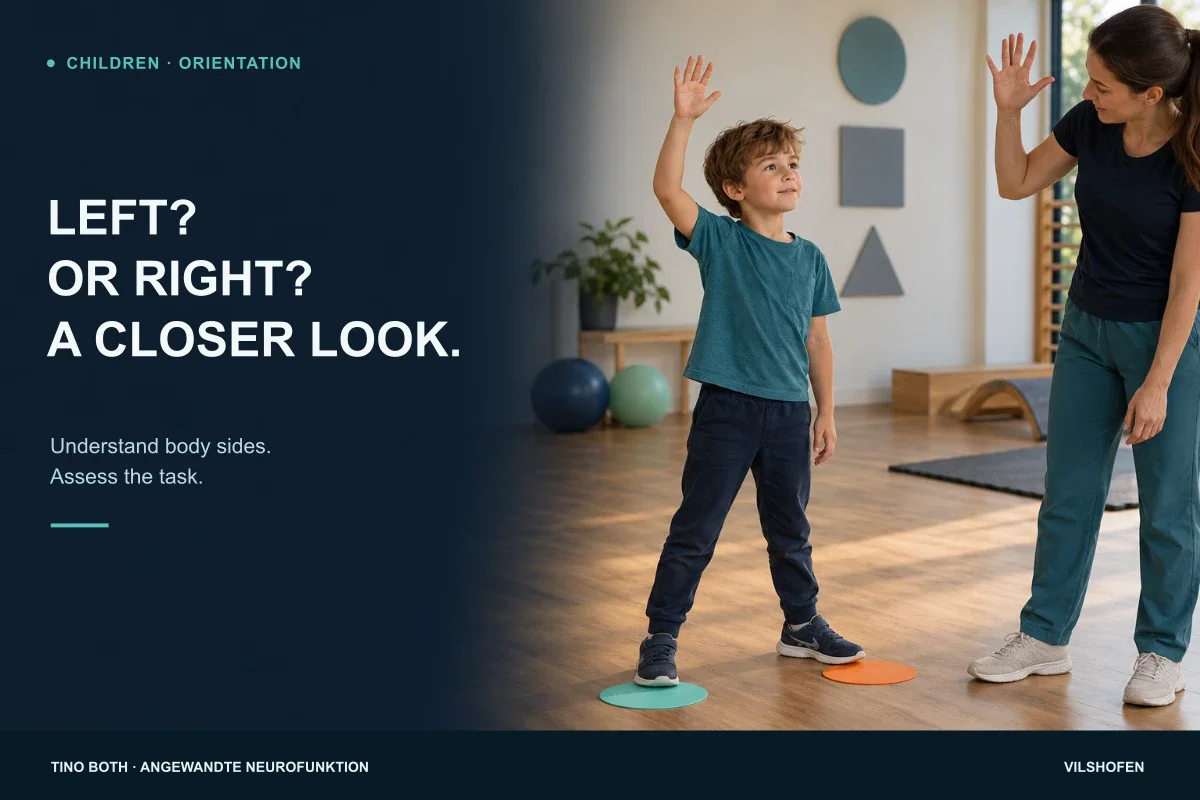
“Use your left hand” works straight away on one occasion and not on the next. When copying a movement, the other side goes up. A directional instruction on a worksheet is carried out differently from expected. For parents, the distinction can seem to disappear repeatedly.
In Vilshofen, Tino Both uses Angewandte Neurofunktion to examine specific perception and movement tasks. With these observations, the useful question is what gets mixed up: the word, the child's own body side, a direction in space or another person's perspective.
Left and right involve several tasks
Naming one's own hand makes different demands from choosing a direction at a junction. When someone stands opposite, a perspective shift is added. When copying a movement, it may also be unclear whether to mirror it or use the same body side.
These abilities develop gradually. A precise comparison therefore helps select appropriate support. What can the child already do reliably, and which change makes it difficult?
The response format matters too. Pointing, naming, copying and carrying out a movement after a spoken instruction are different ways of answering.
Separating understanding of the words from body awareness
Tino might compare whether a child copies a demonstrated hand movement and whether the same movement works after a short verbal instruction.
If copying is reliable while the words still get mixed up, the learning task differs from a movement that is also difficult without a spoken directional cue.
The child can also be asked to notice a light touch on one hand and indicate the corresponding side. This connects simple body-related information with a clear action.
This distinction makes support more specific: it helps show whether the next task should address the word, body orientation or their connection.
An example: side by side works, face to face does not
Consider a child who copies a movement reliably when both people stand alongside each other facing forward. When the other person stands opposite, the choice becomes uncertain.
The easier condition is retained initially. One side is clearly indicated, the child performs a short action and gives feedback. A small perspective change is then introduced.
Tino changes one demand where possible. The instruction remains short and the response clear. This allows comparison of whether the difficulty appears during side selection or only when the viewpoint changes.
The outcome guides the next step. Adding another complicated movement sequence would mix several demands together.
What a focused sensory task can look like
A brief body-awareness task can be included according to the observation. For example, the child feels a light contact on one hand and then points to or moves that hand.
The original task is compared again afterwards: the same viewing direction, instruction and response format. This helps show whether orientation becomes easier and the movement more secure.
A clear spatial marker may be more useful for another child. Someone else may first need one understandable instruction before several steps are combined.
The observed difficulty guides the choice. Tino connects perception and movement with the task that needs to work better in everyday life.
Linking the work to school and everyday tasks
Directional terms appear in sport, dressing, games and worksheets. A familiar situation is chosen for useful transfer.
This might be a short instruction about the child's own body or placing one object beside another. Further information or a different perspective is added once the basic task is clear.
The child's ability to understand the task independently and return to it after a short break is considered. This creates an understandable learning progression with an achievable next stage.
Specific observations matter during the discussion. “It works when both people face forward” offers more information than a broad judgment about orientation.
What parents can usefully observe at home
Choose an ordinary situation and notice what kind of response is required. Does the child need to name, point, copy or move through space?
Perspective is useful to consider too: does the distinction work on the child's own body? What changes when someone stands opposite? Does the task become clearer with a single instruction?
The observation should include the child and allow questions. Persistent substantial everyday difficulties or additional developmental concerns call for paediatric assessment. Functional work can take existing assessments and recommendations into account.
Angewandte Neurofunktion for children in Vilshofen
Tino Both works in Vilshofen an der Donau with children and families from the Passau and Deggendorf area. The concern is first narrowed down to a specific task. Relevant sensory and movement conditions are then compared.
During a free introductory phone call, parents can describe where side or direction selection becomes difficult. The child can then be included in establishing an understandable starting point for practical work.
Do left and right keep getting mixed up during particular tasks? Describe a typical situation to Tino and discuss whether a functional look at body awareness and orientation suits your concern.
Book a free initial conversation for your child
Frequently asked questions
Why can it be easier on the child's own body than on someone else's?
Someone standing opposite adds a perspective change. It is therefore useful to consider the tasks separately and build from a clear basic condition.
Which details help during the introductory call?
A specific description of the instruction, where the other person stood and how the child responded makes the difficulty concrete.
Does the child need lots of additional exercises?
The next task is adapted to the observation, developmental stage and family routine. A short, understandable comparison can help identify an appropriate direction.