

Orient
The child needs to find the relevant cue and direct the eyes, head and attention towards it precisely. Assessment includes visual search, orientation time and target accuracy.
Area of focus · Children & learning
Concentration is not a single switch in the brain. It emerges when a child can select relevant information, process it consistently and respond appropriately.
This involves, among other things, eye control, orientation, body awareness, filtering input and regulation . These relationships can be considered in detail without prematurely questioning motivation, behaviour or ability.
Children with concentration difficulties do not all have the same functional background. A useful assessment therefore begins with a precise question rather than a standard exercise: Which demand becomes difficult, and when?
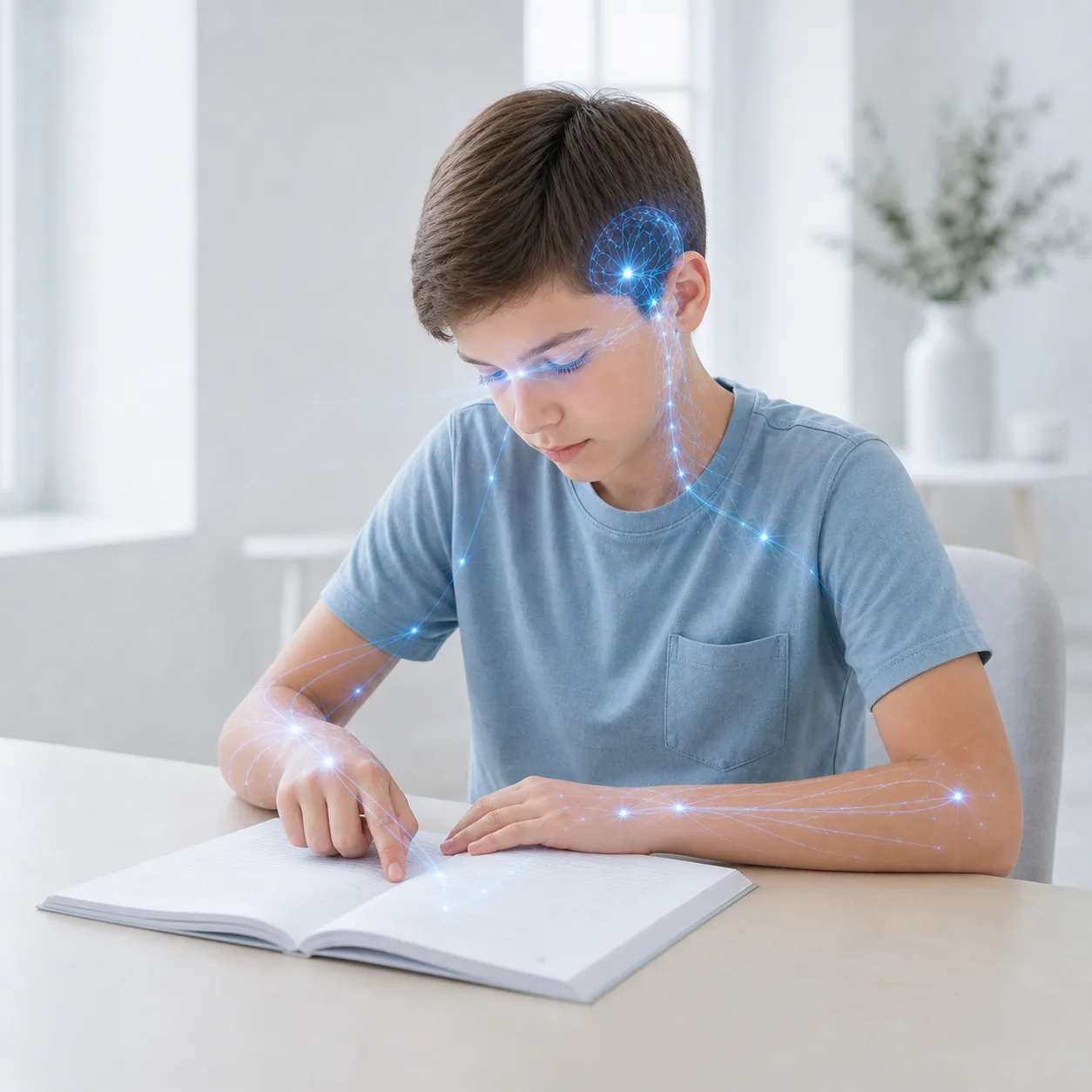
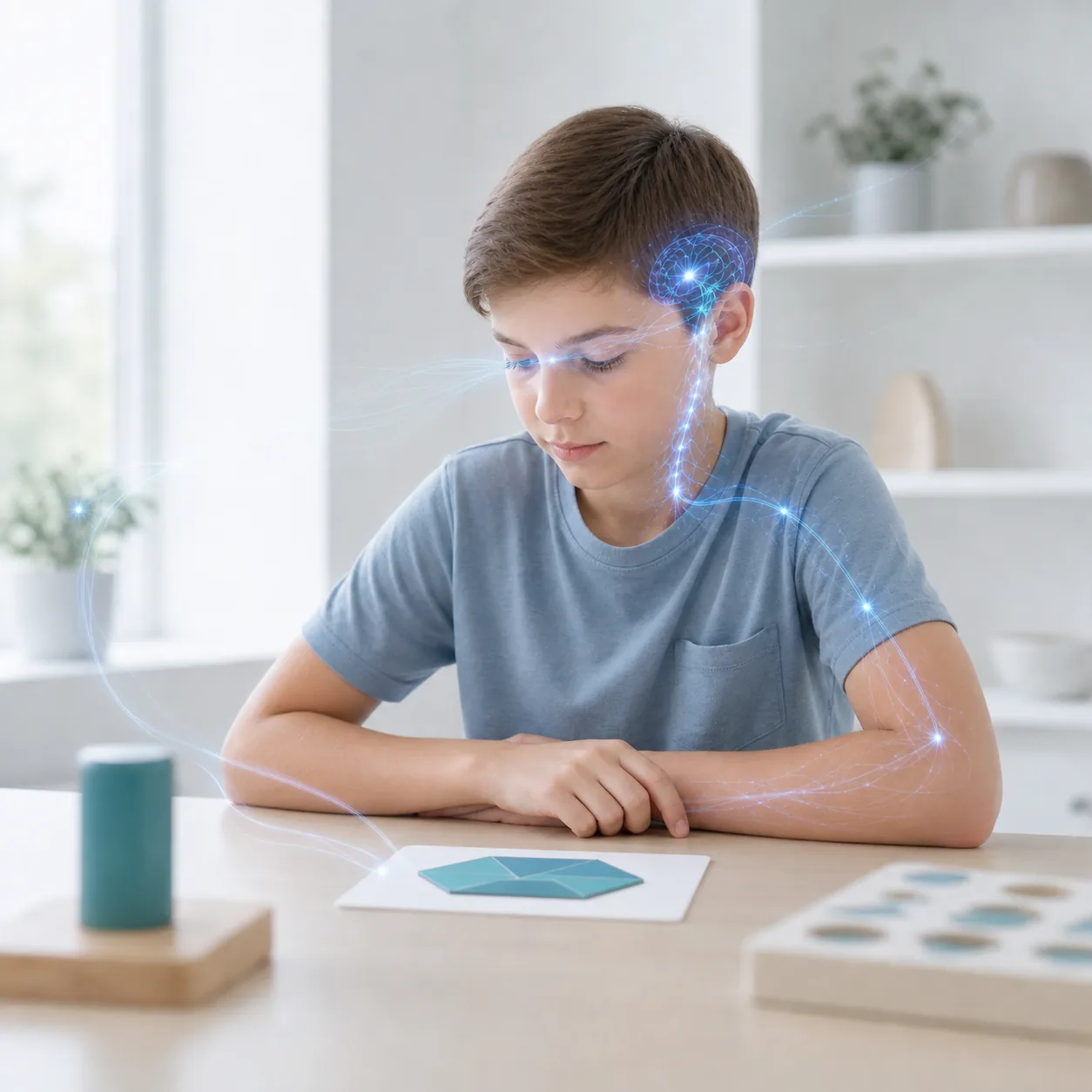
About the images: The scene images on this page are AI-generated illustrations. They do not show real clients or document actual sessions in the practice.
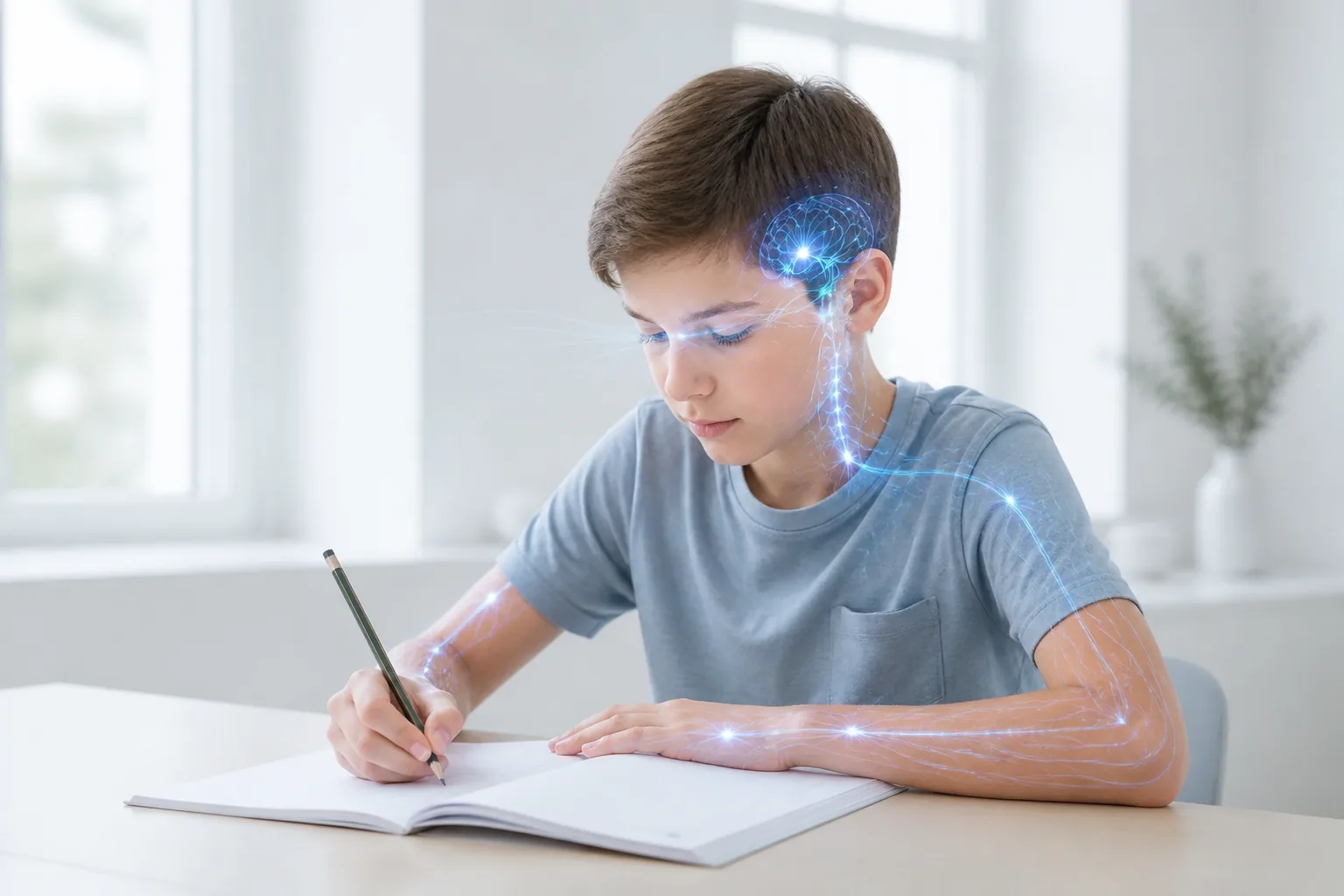
Understanding concentration
A learning task is a processing sequence. The nervous system needs to find a target, inhibit irrelevant input, keep information available and organise an appropriate response. Each step can be assessed separately, turning “poor concentration” into a specific functional profile.
The child needs to find the relevant cue and direct the eyes, head and attention towards it precisely. Assessment includes visual search, orientation time and target accuracy.
Selective attention prioritises what matters. Go/No-Go, Stroop and rule-switching tasks show how consistently distracting input and premature responses are inhibited.
Digit spans, memory sequences and task switching show how much information remains available and whether it is reliably updated while the task is performed.
Simple and choice reactions separate perception, decision-making and the motor response. This shows whether time is lost, errors occur or the response declines under additional demands.
Speed, accuracy and endurance are recorded separately. A child may start quickly and decline after ten minutes, work accurately but noticeably slowly or make errors only when distracted. These differences determine which function is assessed and trained next.
A specific assessment map
The visible difficulty is the starting point. The task is then broken down into functions that can be assessed. Rather than a general label, this produces a precise profile of direction, side, distance, speed, accuracy, endurance and how several systems work together.
Assessment considers holding a target, blinking, accompanying head movement and clarity during fixation; jerking and corrective movements during smooth pursuit; and latency, target accuracy and fixation after horizontal, vertical and diagonal saccades.
Near–far changes show how quickly a detail becomes clear again. Convergence, divergence, fusion, eye alignment and distance-dependent eye dominance add to the picture, particularly when switching between exercise book, textbook and board.
Eyes-first, head-first and combined eye–head movements are compared directly. Gaze stability during head movement, dynamic visual acuity and whether clarity, balance or target accuracy are maintained are also considered.
Walking, tandem walking, single-leg stance and trunk stability are combined with rapid alternating movement tests (RAMs), finger-to-nose, hand and foot tapping or heel-to-shin tasks. Rhythm, speed, movement path, target accuracy, fatigue and stabilisation along the spine are observed.
Comparison between sides, joint position sense, touch localisation, pressure and vibration show how accurately the body reports where it is and how much force is needed. This underpins sitting, writing pressure and finely controlled movement.
Reaction time, Go/No-Go, Stroop, visual search, Trail Making, digit spans and cognitive–motor dual tasks show whether performance declines with rule changes, distraction, additional movement or increasing duration.
The difference lies in the level of detail. Rather than “the eyes show a difficulty”, the finding may be: horizontal saccades reach the target, but fixation then drifts. Rather than “posture is poor”, it may be: axial stabilisation is insufficient during walking but still works while standing. This precision guides targeted integration and a suitable training plan.
The nervous system gives information different weight depending on the task. Reading places emphasis on visual precision; sitting also involves body and balance information. If a system has to compensate continuously, energy demands rise. This is why individual functions are first isolated and then connected in the real learning task.
Distinguish functions rather than label
From the outside, we see the result: a child loses their place, becomes restless or takes a long time. Applied Neurofunction breaks down this result until the demanding function can be measured. Each observation therefore leads to specific comparison tests.
This produces an individual assessment plan. Functions that stand out are integrated or trained individually and then connected again with the same reading, writing, posture or concentration task. The change determines the next step.
Visual demands
Reading begins before a word is recognised. The eyes need to fixate a group of letters steadily, calculate the next target, move there and immediately establish a steady fixation again. Only then can language processing access the information reliably.
This sequence is broken down during functional assessment. Direction, distance, target size, speed, duration and coordination of both eyes are varied specifically. This shows at which step reading fluency, accuracy or endurance is lost.
Visual acuity and reading ability are not the same thing. Text size, distance, contrast, lighting, duration and head position are therefore standardised. Only then are the eye functions that stand out integrated or trained and assessed again using the same reading text.
Individual support for ADHD and inattentive ADHD
Two children with ADHD or its predominantly inattentive presentation may show completely different functional profiles. In one child, gaze stability declines; in another, response inhibition, working memory or posture during a dual task stands out.
Visual search, Go/No-Go, rule switching, digit spans, response selection and cognitive–motor dual tasks are therefore assessed separately. Eye control, balance, body mapping and regulation under demands are also included when relevant to the particular school situation.
The practical value: Training is not selected according to a label. It follows the functions that actually stand out in the individual child and can be improved through targeted work.
From a finding to a suitable input
Assessment does not end with a list of findings. Each identified function is connected with a suitable sensory, motor or neurofunctional intervention and checked directly against the original task.
For example, following a line, copying from the board, remembering an instruction, sitting calmly or still working accurately after ten minutes.
Fixation, saccades, near–far changes, posture, walking, rapid alternating movement tests (RAMs), working memory or inhibition are assessed individually under clear conditions.
Depending on the finding, targeted eye movements, balance and coordination tasks, sensory inputs, joint and body-map work or cognitive tasks may be used.
Reading ability, target accuracy, posture, walking, speed, errors and perceived effort are checked again immediately. A clear improvement supports the chosen direction.
Successful integrations become short, specific exercises. We then assess whether sitting, reading, writing, attention and resilience also become more consistent in everyday school life.
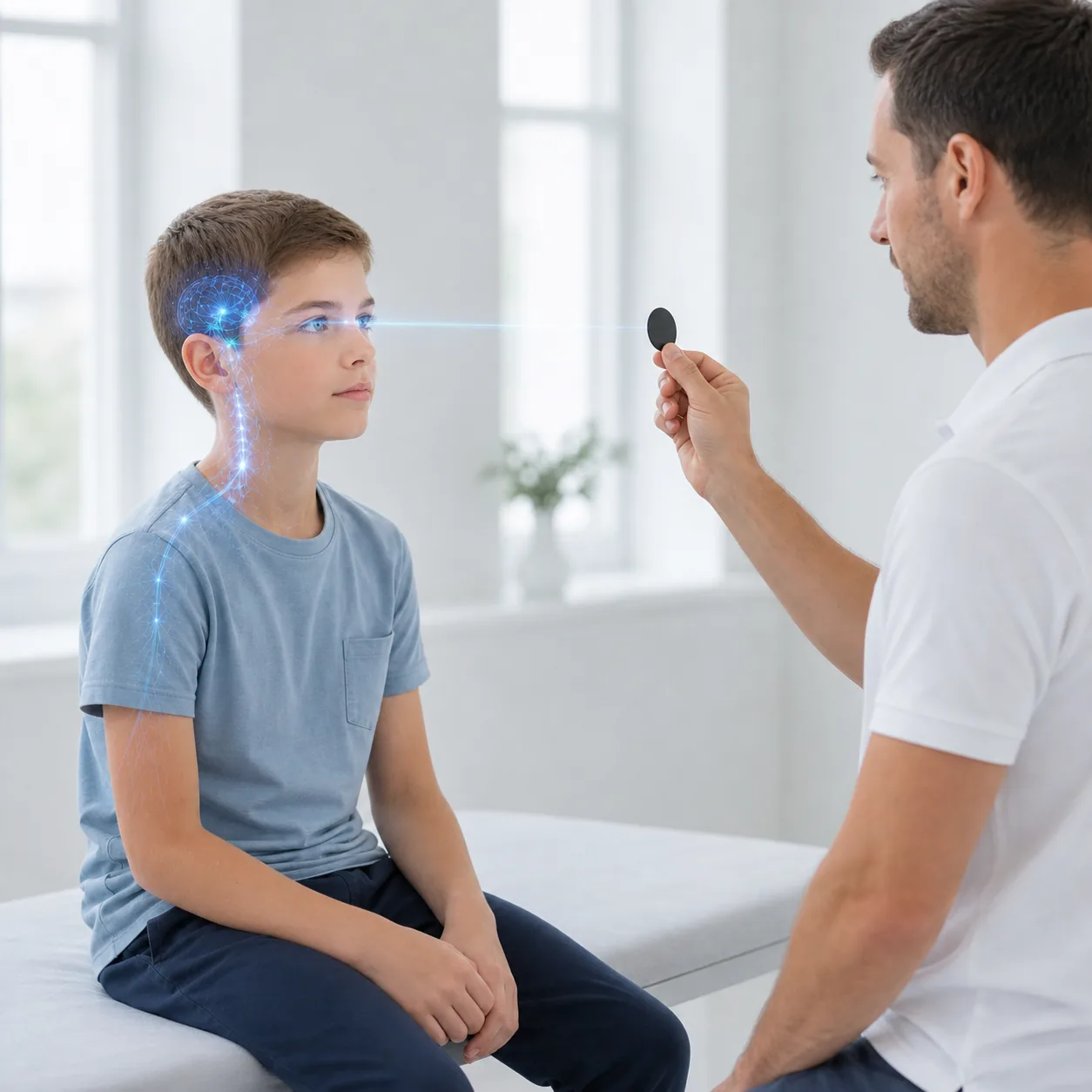
The re-test determines the plan. If the target task becomes easier, more accurate, more stable or less tiring, the identified integration is continued and trained. If there is no change, the next function is assessed.
The identical starting measure immediately shows whether the chosen integration fits the function that stood out.
The successful direction is repeated, appropriately dosed and trained until the improved function can be accessed reliably.
The function is combined with reading, writing, sitting, movement and increasing distraction so that the benefit reaches everyday life.
Anonymised examples from the practice
These three cases illustrate the detailed work of Applied Neurofunction: a school difficulty is broken down into individual functions, findings are addressed through targeted integration and then connected again with reading, posture, movement and concentration.
A boy in early adolescence was regularly completely exhausted after school and often distracted in class. The question was therefore not only how long he could concentrate, but how much energy his nervous system already needed for posture and movement.
Upper-body stabilisation stood out clearly in the initial neurofunctional screening. Walking showed a shaky, unstable organisation along the entire spine. All rapid alternating movement tests (RAMs) of the upper and lower limbs were markedly below expectations for his age in rhythm, speed and coordination.
The combination of walking pattern, axial instability and consistently unusual RAM findings strongly pointed towards the cerebellum as the affected functional area. Individual areas were explored in detail through testing and re-testing. An experience-based assessment of inflow, outflow and oxygen supply to the cerebellum showed further findings. All identified difficulties were integrated one after another, followed by targeted cerebellar exercises for everyday life.
At the final check, the stability that stood out in the initial screening was immediately much improved. The spine was organised considerably more calmly during walking and posture. Sitting and posture therefore required less effort from the nervous system, leaving more energy available for concentration and participation at school.
A child suddenly developed distance-dependent reading difficulties: reading was still possible nearby but no longer at medium or greater distances. Prior medical assessment found no indication of a structural problem.
The reading process was broken down step by step: fixating a word, moving to the next target, landing accurately and establishing stable fixation again. Fixation and saccades stood out clearly; functional difficulties also appeared during slow smooth pursuit. Distance further changed the results.
Fixation, saccades, fixation after landing and smooth pursuit were integrated individually and then assessed again in the complete reading process. Different visual conditions were also compared. While wearing glasses with red lenses, the distance-dependent reading difficulty disappeared immediately.
Reading ability improved considerably. Medium and greater distances, which had previously become unreadable, were accessible again; the difference with the red lenses was immediately visible.
A schoolchild had severe concentration difficulties. The parents reported a fall involving a head impact in early childhood. This history led to a particularly detailed assessment of eye control, head movement, skull receptors and cranial functional relationships.
Head movement when switching from reading at the desk to looking at the board, and the change from near to distant vision, stood out. Further findings appeared at different receptors on the skull: tapping individual bones, pressure on bones and vibration over a cranial suture. Cranial supply relationships and other functional connections were also involved.
Eye–head coordination, near–far changes, individual skull receptors, cranial supply assessments and other functional relationships were examined in detail through testing and re-testing. Each identified difficulty was integrated and checked directly against the original task. Training was then developed from the successful integrations.
Switching gaze between desk and board and changing focus between near and far improved. Concentration difficulties decreased considerably; some previously troublesome symptoms resolved completely.
Why the history matters: Accidents, infections and persistent stress are key sources of strain that I specifically record in Applied Neurofunction. Their effects may extend across several connected functional areas, from eye control and balance to body stabilisation, concentration and resilience.
In these three cases, changes ranged from considerable improvements to complete resolution of individual symptoms.
Everyday school life
If homework, reading, writing or prolonged sitting regularly lead to exhaustion, conflict or self-doubt, the separate page “When school is difficult” offers parents a practical explanation, with typical observations and the possible course of support.
Explore the relationships
Depending on the main demand, other topics may be useful. The following pages explain individual relationships in more detail.
FAQ
Here you can find the main answers about functional assessment and individual training for concentration and learning difficulties.
Yes. Regardless of the label, functional assessment considers which functions stand out in the individual child. These may include gaze stability, response inhibition, working memory, balance, body stabilisation or performance under distraction and dual-task demands. An individual training plan is developed from these findings.
Depending on the everyday difficulty, assessment may include fixation, saccades, smooth pursuit, near–far changes, eye–head coordination, walking, balance, trunk stabilisation, rapid alternating movement tests (RAMs), body mapping, reaction time, Go/No-Go, rule switching, working memory and dual task. Not every child needs every test; the starting situation determines the order.
For each word, the nervous system needs stable fixation, an accurate saccade and steady fixation on the next target. Smooth pursuit, convergence and rapid changes between near and far also contribute. If a step stands out, the child may lose their place, read slowly, skip words or tire very quickly.
A function that stands out is first addressed through targeted integration, then re-tested under the same conditions. If reading ability, posture, walking, accuracy, speed or perceived effort improves, a short everyday exercise is developed. The function is then gradually connected with the actual school task.
This focus page explains the functional relationships behind concentration and learning. “When school is difficult” is aimed at parents for whom homework, reading, writing or everyday school life has already become a concrete source of strain, and describes the support in more practical terms.