

← All articles
Neuroathletic training & performance
Neuroathletic exercises: How to find what suits you
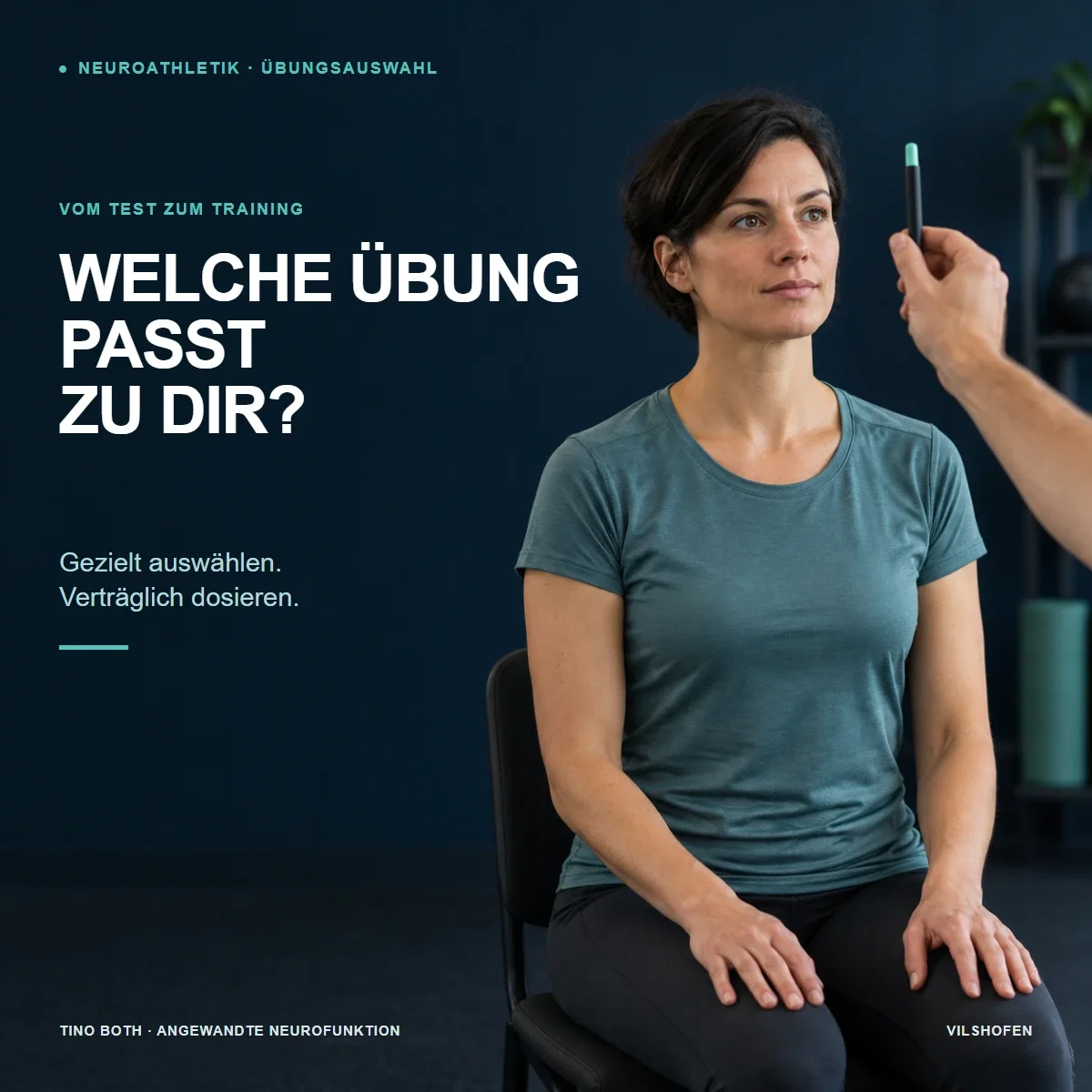
Briefly explained: Neuroathletic exercises work with gaze control, balance and body awareness, among other things. Which task is useful depends on your goal, your starting function and the dose. A comparable test before and after the exercise helps with selection; subsequent progress shows whether it proves useful in everyday life or sport.
Have you tried lots of exercises but do not know which ones actually help you?During the free initial consultation, you describe your goal and previous experiences. We discuss whether an individual selection of exercises with functional testing in Vilshofen is the appropriate next step.
Discuss your exercise selection →
The initial telephone consultation is free of charge.
Discuss your exercise selection →
The initial telephone consultation is free of charge.
Save another exercise — or finally choose one that fits?
Following a tip with your eyes, standing on one leg, catching a ball: At first glance, neuroathletic exercises look simple. The next video adds another recommendation. In the end, you practise a lot but do not know what each task is intended for or whether the problem you want to address changes at all.
An exercise collection can provide ideas. A training plan also needs a decision: What do we want to improve, how will we recognise it and what level of demand is appropriate now? A task does not have to be spectacular or difficult for this. It needs to fit a specific question.
Three exercise families — and the question behind each one
Gaze controlLooking steadily at a target, switching between two targets or following a slow movement are different tasks. The question might be: Does a particular gaze task become tiring, and does appropriate preparation change the movement that matters afterwards? The same eye exercise cannot usefully address every visual task.
Balance and head movementThis may involve orientation during movement or the combination of head movement and a stable gaze. Position, speed and range change the demand. A simple, secure standing position is a different starting point from walking or stopping abruptly in sport.
Body awareness and joint movementA small, controlled joint movement or a targeted touch stimulus can be used to perceive a region more precisely and compare the subsequent movement. The movement remains pain-free or within the individually agreed tolerable range.
You do not need to train all these areas at once. Particularly at the beginning, it is often easier to understand one selected component well. Specific instructions and doses are adapted to the individual; vision, balance and tolerance of exertion are not interchangeable standard measures.
A useful baseline test needs clear conditions
“Do I feel better?” can be part of the feedback. A specific task also helps with selection: A particular gaze shift when reading, a controlled shoulder movement or a small step followed by a stop. It needs to be safe, repeatable and relevant to your goal.
The task is assessed more than once beforehand. Otherwise, the second attempt could improve simply through familiarity. Speed, starting position and instructions also remain the same. If you suddenly test faster, further or with a different technique after the exercise, you are no longer comparing the same demand.
No immediate effect does not automatically mean “ineffective”An immediate comparison can help with selection. Some training goals, however, develop only through repeated practice. A neutral response is therefore assessed alongside the goal, tolerability and progress, rather than being taken to rule out every possible long-term effect.
A possible example: A gaze task before a movement
You want to move your head more easily when looking around. We first choose a comfortable, defined turning movement for comparison. A small visual task is then assessed, such as calmly switching between two clearly visible targets while seated. Distance, speed and amount are chosen so that the task remains manageable.
You then repeat exactly the baseline movement. How does it feel, how far can you comfortably move and how smoothly does it go? If a difference appears, the comparison is repeated under similar conditions. Only then do we decide whether to pursue this variation as a training component.
Four possible responses — four useful decisionsMore comfortable and clearly better: retain it as a candidate and review it over time.
Unchanged: review the goal, the test's sensitivity and the exercise variation.
Worse or uncomfortable: stop, simplify or choose another task.
Inconsistent: simplify the conditions before drawing a broad explanation from it.
Unchanged: review the goal, the test's sensitivity and the exercise variation.
Worse or uncomfortable: stop, simplify or choose another task.
Inconsistent: simplify the conditions before drawing a broad explanation from it.
Where NeuroFI differs from an exercise re-test
A general exercise re-test compares a function before and after a task. Neurofunctional Integration also uses an indicator muscle and a defined stimulus–solution assessment. These two approaches can complement each other, but should not be described as identical.
I begin with a muscle that can be tested reliably and without pain. A targeted stimulus is then applied or a connection assessed. If the muscle response shows a non-physiological weakening, I look within the method for an addition under which it remains stable despite the stimulus. Stimulus alone and stimulus plus solution are repeatedly compared. After integration, the same stimulus is assessed without this addition.
Finally, the actual starting function is assessed again. This keeps the work with the indicator muscle connected to what matters to you: Looking around more easily or moving with greater control, for example. It does not follow that every addition found must become a daily home exercise.
Dosing means more than counting repetitions
Two people can experience the same task very differently. It is not only the number of repetitions that changes the stimulus: Target distance, speed, body position, movement range and background also play a part. A calm gaze shift while seated differs from the same shift while walking in a moving environment.
For a home exercise, the starting position, sequence, duration and stopping criteria should therefore be clear. You should also know which change we want to observe. “Do it as often as possible” is not a sufficient plan. Especially if you respond sensitively, we also ask how you feel later, not only immediately afterwards.
What makes progress more convincing than one good test
An exercise becomes more interesting when it repeatedly helps under comparable conditions and contributes to the everyday activity you want to improve. Theresearch on the specificity of balance training illustrates why improvement in an exercise test does not automatically transfer to other tasks.
A plan is therefore reviewed after a while: Do you still need this component? Can it be simplified? Would technique or strength training now be a more useful priority? The physiological foundations of individual exercises also do not amount to evidence of effectiveness for every overall programme offered as neuroathletic training.
What to avoid at home
Do not practise through increasing dizziness, nausea, double vision or significant pain. Difficult balance tasks should not be performed on stairs without safeguards, and breath-holding is not a general starting exercise. New, persistent symptoms should first be investigated. Sudden neurological deficits or severe acute symptoms require immediate medical help.
You also do not need to constantly test every everyday movement. A small selection with a clear task is usually easier to assess than ten new stimuli on the same day. Training should give you direction and fit into everyday life, rather than become another burden.
Frequently asked questions about neuroathletic exercises
Which neuroathletic exercises are suitable for beginners?Simple, well-tolerated tasks with a clear goal are suitable. The appropriate exercise family and dose depend on your starting situation, not just on how easy a video looks.
Can I practise neuroathletic training at home?Yes. Clear instructions, a safe setting and clear criteria for adaptation or stopping are helpful. If you have symptoms, an individual selection is particularly useful.
Does an exercise have to change something immediately?Not every training goal shows itself immediately. The direct comparison is a selection tool; longer-term progress and tolerability also form part of the assessment.
Is NeuroFI simply another name for eye exercises?No. NeuroFI uses its own stimulus–solution and integration system with functional testing. Eye exercises are possible training tasks and may be used as an addition, depending on the concern.
Collect fewer exercises, practise with more purpose
Would you like a clear plan instead of more exercise tips?In my work in Vilshofen, we connect your goal with a manageable selection and suitable functional comparisons. During the initial consultation, we discuss what you have already tried and whether I can usefully support you.
Arrange an initial consultation about an individual exercise selection →
The initial telephone consultation is free of charge.
Arrange an initial consultation about an individual exercise selection →
The initial telephone consultation is free of charge.
Relevant further pages and articles
Exercises in a sporting contextNeuroathletic training and balance in sport — why balance is more than standing on one leg
Neuroathletic training for runners and endurance athletes — move more efficiently, stay more stable
Neuroathletic training in strength sports: Applying strength and movement with control
Neuroathletic training for runners and endurance athletes — move more efficiently, stay more stable
Neuroathletic training in strength sports: Applying strength and movement with control
Understanding individual functionsUnderstanding oculomotor function: How eye movements guide your everyday life
Gaze fixation: Why looking steadily can become tiring
VOR explained simply — why the vestibulo-ocular reflex keeps your gaze stable
Gaze fixation: Why looking steadily can become tiring
VOR explained simply — why the vestibulo-ocular reflex keeps your gaze stable
Relevant areas of focus in VilshofenNeuroathletic training and performance optimisation
Visual disturbances and visual processing
My approach: Angewandte Neurofunktion
Visual disturbances and visual processing
My approach: Angewandte Neurofunktion
Sources and further reading
Kümmel et al. (2016): Specificity of Balance Training in Healthy Individuals — systematic review and meta-analysis on task specificity.
Grove et al. (2023): Vestibular perceptual testing from lab to clinic — background on distinguishing vestibular perception tasks.
Grove et al. (2023): Vestibular perceptual testing from lab to clinic — background on distinguishing vestibular perception tasks.