

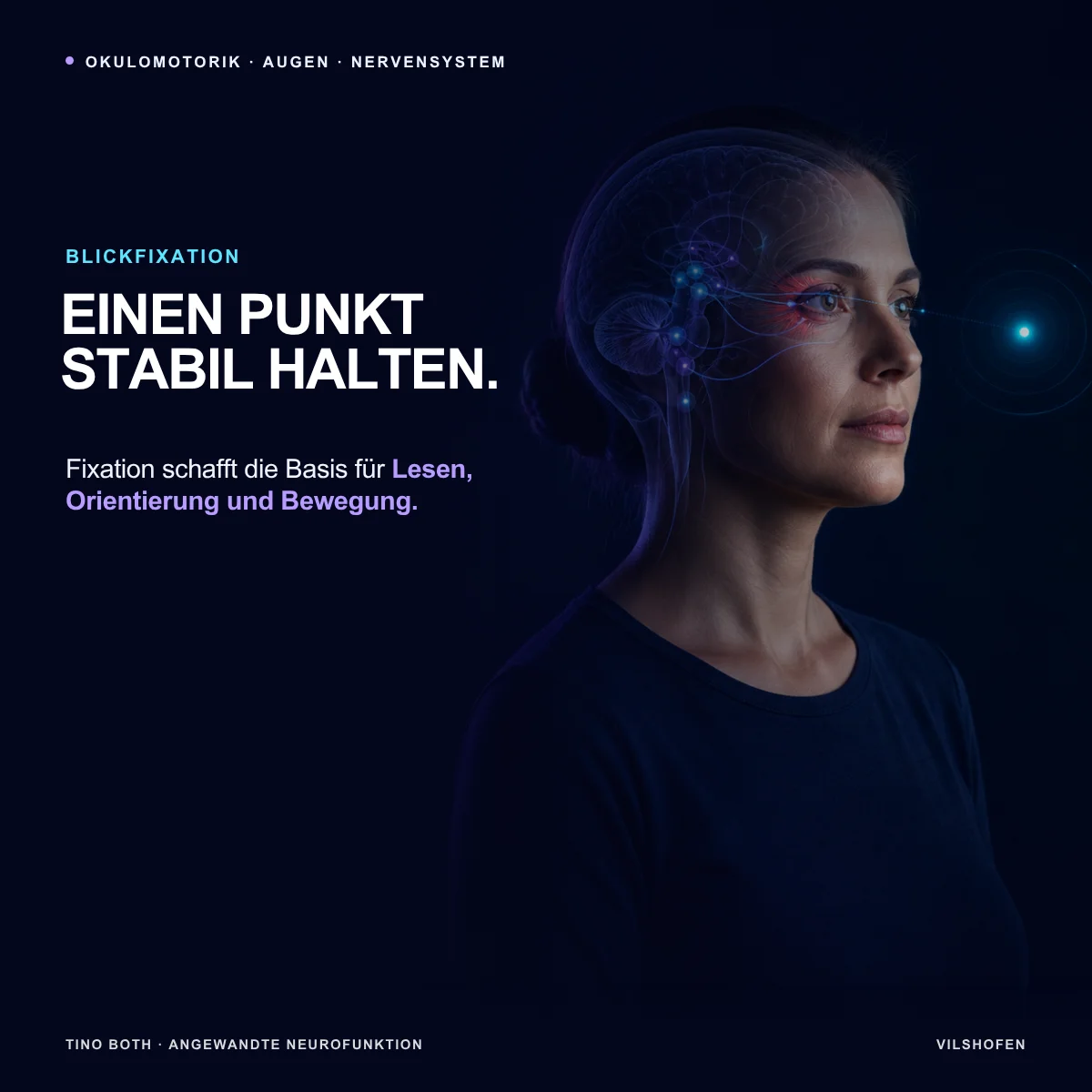
Briefly explained: Gaze fixation means keeping a target in view with the eyes. The eyes still move minimally during this. If looking steadily becomes demanding, it is worth distinguishing: is the target blurred, does it seem unstable or is prolonged looking the main difficulty? Different next steps follow from this.
Seeing sharply – yet looking still takes energy?If reading or screen work remain demanding despite checked vision correction, describe the specific situation to me. We clarify whether a functional perspective on gaze control and capacity fits your concern.
Discuss your visual demands in the initial consultation →
The initial telephone consultation is free.
Discuss your visual demands in the initial consultation →
The initial telephone consultation is free.
You look, but your gaze finds no rest
At first, the line is easy to recognise. After a while, you need to start again, blink or hold your head differently. Perhaps the image is not really double or continuously blurred. Yet seeing feels like work. This exact description is more valuable than the quick assumption that your eyes are simply too weak.
Gaze fixation is one possible component question, rather than the explanation for every reading or screen symptom. Vision correction, dry eyes, lighting, cooperation between the eyes and duration of near work also deserve attention. A functional appointment therefore begins with everyday life and existing findings, rather than the longest possible staring exercise.
What happens during apparently still looking
For you to recognise a letter precisely, the nervous system aligns the eyes so the important detail falls on the region of sharpest vision. Gaze direction is continuously adjusted. Very small rapid movements, microsaccades, and slower shifts are part of this. A completely motionless eye is therefore not the goal.
The specialist review of measuring fixation stability therefore distinguishes different types and measures of gaze stability. These subtle movements cannot be measured reliably by observation alone. In functional comparison, I am initially interested in recognisable task quality and your perception: does the target stay clear? Does it become unpleasant? Do you need to change head position or distance?
Stable is not the same as rigidFixation should enable you to take in information. Tense staring, holding your breath or suppressing blinking makes it a different task.
Distinguishing gaze fixation, gaze holding and head movement
Looking at a targetYou view an easily recognisable point with your head largely still. The focus is how well you can stay on this target. Distance, size, contrast and duration change the demand.
Holding a sideways gaze positionYou look slightly right or left of centre. How well this eye position is held now becomes additionally interesting. Extreme gaze directions are not sensible everyday tests for this.
Looking at a target despite head movementOnce the head moves, head–eye coordination in particular is added. This is gaze stabilisation during movement, rather than still fixation alone. This is precisely why someone can see well while sitting yet notice difficulties looking around.
How I turn the feeling into an assessable question
‘My eyes are unsettled’ is a start. For comparison, we need a sufficiently specific task, such as briefly looking at a large letter at a comfortable distance. Starting position, glasses, lighting and target initially stay the same. We record what you perceive and whether a recognisable compensatory movement occurs.
Only then do we change one condition. Is slightly more distance more comfortable? Does a small change of target position make a difference? Is looking steadily easy while switching to the next target is difficult? These questions prevent different visual tasks being treated too quickly as the same problem.
One possible example: screen work initially goes wellYou recognise a symbol clearly but feel increasingly tense while looking longer. We compare a brief, tolerable gaze task at two distances. We then return to the original task. Clarity, effort and repeatability matter, rather than how long you endure symptoms. A helpful difference can guide selection of the next step.
How I narrow down a demanding fixation position further
If a particular fixation position continues to show a finding, I can consider it additionally through targeted stimulus assessment. First, I choose an indicator muscle reliably testable without pain. It provides feedback within the method; seeing remains the actual target task.
The specific visual demand is then applied as a stimulus, such as a particular fixation position. If the indicator muscle responds unphysiologically weakly in the method’s comparison, I look for an additional stimulus that changes this response. The comparison is: original stimulus alone – unusual response; the same stimulus together with the identified solution – stable response. This alternation is checked again.
Integration follows. I then assess whether the original stimulus receives a stable response without the additional solution stimulus too. Only then do we compare the gaze task and a suitable everyday function again. An immediately more comfortable gaze is a good reason to follow the change further; how it holds up later during your actual demands matters equally for support.
Practice does not mean enduring as long as possible
A selected fixation task can also be used as a neuroathletic training stimulus. This is a separate step: we assess a brief, tolerable variation and afterwards compare the previously defined task. A differentiation method and an exercise programme are not automatically the same.
Dose involves more than seconds. A small near target, sideways gaze, a patterned background or simultaneous body movement can change the load. Not everyone therefore receives the same eye exercise. If a variation leads to increasing pressure, dizziness or blurring, it is adapted or ended. Greater effort is not proof of quality here.
What you can observe for an appointment
Note two or three typical situations: symptom onset and duration, near or far, screen or paper, still or moving background. It also helps to know whether breaks or blinking change anything and when vision correction was last checked. You do not need to provoke anything or hold a gaze direction for minutes.
When ophthalmological examination takes priority
New double vision, marked vision loss, eye pain or new persistent jumping images require prompt assessment, urgently if onset is sudden. With simultaneous speech disturbance, paralysis, marked new walking unsteadiness or severe unfamiliar headache: 112. Persistent near-work symptoms are also a reason to have vision correction and binocular vision checked.
Frequently asked questions about gaze fixation
Are small eye movements during fixation normal?Yes. Very small eye movements belong to normal fixation. What matters is not complete immobility, but whether the visual task works clearly and sufficiently comfortably.
Can I simply train fixation for longer?Not as a blanket rule. Distance, target size, gaze direction and duration need to fit capacity. Increasing symptoms are a reason to adjust, rather than endure.
Is gaze fixation the same as concentration?No. Attention supports looking, but fixation is a component visual function. Concentration or reading problems cannot be reduced to one eye function.
Do I need a vision test before a functional appointment?Suitable vision correction is an important foundation. New or persistent visual symptoms warrant ophthalmological or orthoptic assessment. We include existing findings in planning.
Less visual effort begins with a more precise question
Perhaps you need a better distinction of the task rather than more discipline in looking. In my work in Vilshofen, we consider which conditions make seeing demanding and which next step fits you in practice.
Would you like to assess your specific visual situation?Whether reading, screen work or looking steadily: tell me the situation that restricts you most. Together, we can derive a sensible starting point from it.
Free initial consultation about gaze demands →
The initial telephone consultation is free.
Free initial consultation about gaze demands →
The initial telephone consultation is free.
Related pages and articles
Understanding eye movementsOculomotor function explained simply – why eye movements are more than seeing
Functionally assessing eye movements – why an indicator muscle shows more than observation alone
Saccades: why gaze shifts matter for reading and orientation
Smooth pursuit: how the eyes track moving targets
Vergence and accommodation explained simply – how the eyes adjust for near and far
Functionally assessing eye movements – why an indicator muscle shows more than observation alone
Saccades: why gaze shifts matter for reading and orientation
Smooth pursuit: how the eyes track moving targets
Vergence and accommodation explained simply – how the eyes adjust for near and far
Gaze and spatial orientationVOR explained simply – why the vestibulo-ocular reflex keeps gaze stable
OKN and OKR: how the eyes respond to moving environments
Visual vertical explained simply – how the nervous system recognises ‘upright’
VOR-C and fixation suppression: when gaze moves with the head
OKN and OKR: how the eyes respond to moving environments
Visual vertical explained simply – how the nervous system recognises ‘upright’
VOR-C and fixation suppression: when gaze moves with the head
Relevant areas of focus in VilshofenVisual disturbances and visual processing
Dizziness and balance
My approach: Angewandte Neurofunktion
Dizziness and balance
My approach: Angewandte Neurofunktion
Sources and further reading
Quantifying eye stability during a fixation task: a review of definitions and methods – terminology and measurement of fixation stability.
Purves et al.: Types of Eye Movements and Their Functions – fundamentals of different eye movements.
Purves et al.: Types of Eye Movements and Their Functions – fundamentals of different eye movements.