

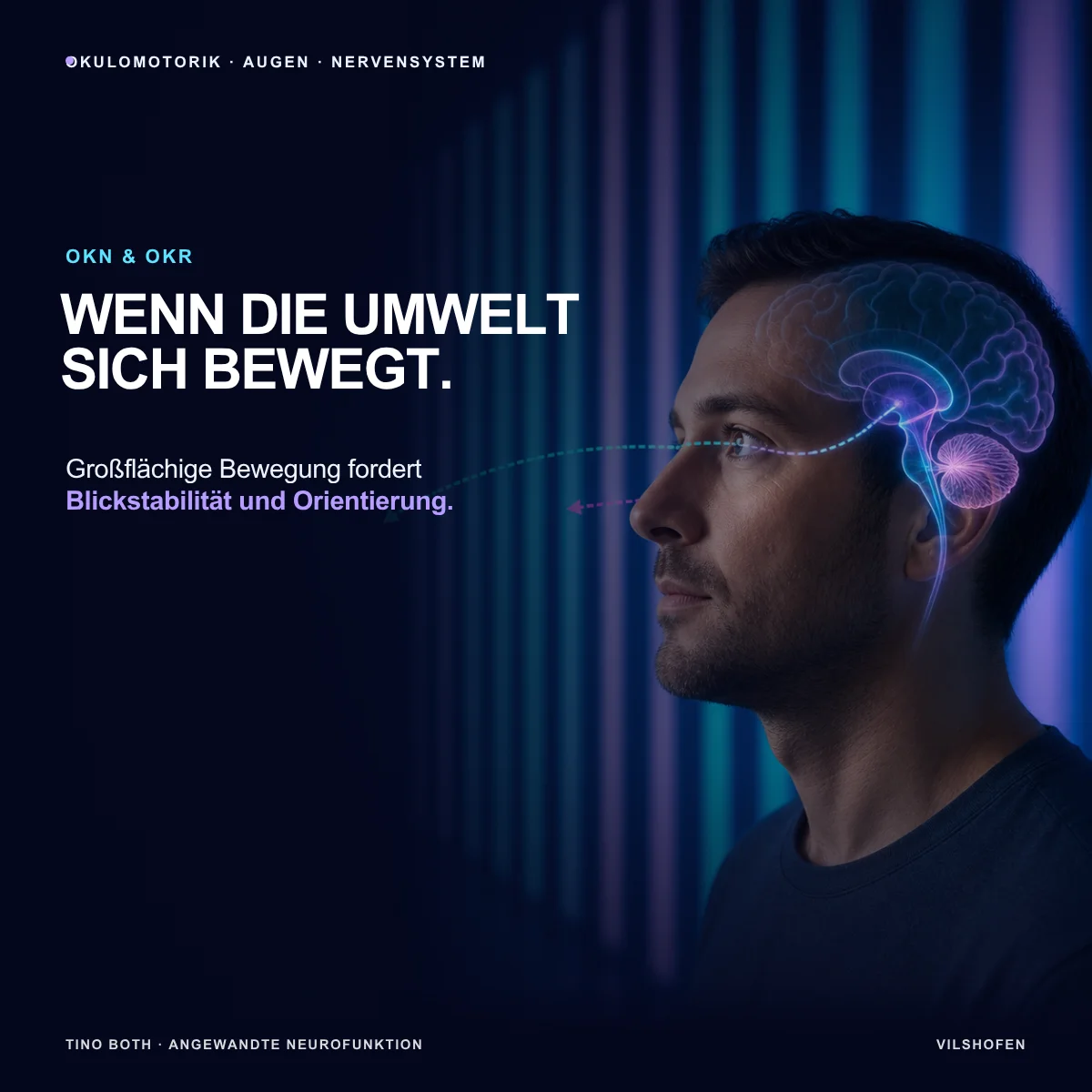
Briefly explained: Optokinetic nystagmus, or OKN, is a normal eye movement pattern in moving visual surroundings: the eyes initially follow and then reset rapidly. OKR refers to the optokinetic response or reflex. However, discomfort with moving images cannot be reduced to this reflex alone.
Do traffic, scrolling or passing patterns quickly become unpleasant?Once recurrent symptoms have been assessed, we can examine more closely which visual movement is difficult and under which conditions it is better tolerated. In the initial consultation, we discuss a possible starting point in Vilshofen.
Discuss visual movement in the initial consultation →
The initial telephone consultation is free.
Discuss visual movement in the initial consultation →
The initial telephone consultation is free.
What your eyes do when looking out of a train
Outside, poles, houses and landscape pass by. When looking at the passing scene, your eyes may initially follow a little and then rapidly reset in the opposite direction. From outside, this looks like recurring twitching. In this situation, it is a normal response to the moving visual impression.
The basic pattern consists of a slower following phase and a rapid resetting phase. The American Academy of Ophthalmology: Reflexes and the Eye describes these two components of the optokinetic reflex. OKR and OKN describe closely related aspects of the same response; they are not two independently trainable ‘switches’.
A moving point is not the same as moving surroundings
Four visual tasks distinguished clearlySaccade: You rapidly switch from one gaze target to the next.
Smooth pursuit: You keep one moving target in view.
VOR: Your head moves while you want to see a fixed target clearly.
Optokinetic response: Larger parts of the visible surroundings move across the visual field.
Several of these demands can combine in natural situations. For functional assessment, it helps to consider them separately first.
Smooth pursuit: You keep one moving target in view.
VOR: Your head moves while you want to see a fixed target clearly.
Optokinetic response: Larger parts of the visible surroundings move across the visual field.
Several of these demands can combine in natural situations. For functional assessment, it helps to consider them separately first.
Walking also produces optic flow: the visible surroundings change their position on the retina while you move through space. Even a stationary shelf then produces a different pattern from when standing still. Perceiving this movement and the visible optokinetic eye response are not the same.
Why moving images can be unpleasant
A large camera-panning video can have a very different effect from a small moving object on a calm background. Movement direction, speed and size of the moving image area help determine the visual demand. Whether you are sitting, standing or moving yourself also matters.
Some people respond to these situations with dizziness or unsteadiness. Sensitivity to complex or moving visual stimuli is, for example, among the features described in the Staab et al. (2017): Bárány consensus on PPPD. It also occurs in other contexts, however. An unpleasant video is not enough to infer a particular illness or a ‘defective OKN’.
Not every nystagmus is the same phenomenonOptokinetic nystagmus during a suitably moving scene is initially physiological. New involuntary eye movements without this situation, particularly together with dizziness or other new symptoms, require their own medical assessment.
What I examine more closely in visual movement
Instead of immediately filling a screen with fast stripes, I begin with the specific everyday situation. Is it scrolling? A passing train? A large projection at the gym? From this, we choose a small, controllable demand. You should be able to describe what changes before the stimulus becomes too much.
One possible example: small movement works, a large image becomes difficultIn a safe sitting position, a slow, clearly directed movement is viewed within a limited image area. If tolerable, the size of that area can be changed later. Speed, direction and viewing distance initially stay the same.
If difficulty appears specifically with the larger field, that helps selection more than the blanket statement ‘moving images do not work’. A selected input is then re-tested against the same starting task. We can also compare an everyday marker, such as comfortably looking around the room.
If difficulty appears specifically with the larger field, that helps selection more than the blanket statement ‘moving images do not work’. A selected input is then re-tested against the same starting task. We can also compare an everyday marker, such as comfortably looking around the room.
How long and to what extent a stimulus is used depends on history, tolerability and response. Particularly with dizziness, ‘enduring more’ is not a sensible quality measure.
Consider direction, speed and area separatelyFor an additional stimulus assessment, I use an indicator muscle that can be tested reliably without pain. It does not have to belong to the symptomatic region. Slow movement in a small image area creates a different demand from a large moving pattern. Direction, speed and area are therefore recorded and not changed simultaneously. The specific question – here, an optokinetic demand with defined direction and dose – is then assessed through a defined stimulus or suitable contacts.
If this shows an unphysiological inhibition according to the criteria of this testing method, I look for an additional input that changes the response. We repeatedly compare stimulus alone and stimulus plus solution input. The method’s integration step only follows when this comparison is understandable. I then reassess the original stimulus without the additional solution input, followed by the visual task and the previously selected orientation or movement marker.
This keeps the internal test response connected to the result you can feel. Repeatability, tolerability and development in everyday life also matter for further support.
If this shows an unphysiological inhibition according to the criteria of this testing method, I look for an additional input that changes the response. We repeatedly compare stimulus alone and stimulus plus solution input. The method’s integration step only follows when this comparison is understandable. I then reassess the original stimulus without the additional solution input, followed by the visual task and the previously selected orientation or movement marker.
This keeps the internal test response connected to the result you can feel. Repeatability, tolerability and development in everyday life also matter for further support.
Why a video is not automatically a suitable exercise
For appropriate dosing, I consider direction, speed, size of the moving image area, distance, body position and duration separately. A faster video is not simply the same exercise with a little more effect. It can create a different demand.
A visible eye response is also insufficient as a success criterion. What matters is whether you tolerate the task and whether a function relevant to you benefits. If the response is unfavourable, we can simplify, choose another starting point or arrange further professional assessment of the question. There is no reason to lead everyone through the same stimulus sequence.
What you can note in everyday life
Notice the relationship without deliberately provoking it: small or large image area, slow or fast movement, screen or real surroundings, sitting or walking. It also helps to note how long you need after a demand that has already occurred to feel as you did before.
New or increasing dizziness warrants medical assessment. Sudden new double vision, marked walking unsteadiness or neurological deficits are warning signs; call 112 for an acute combination. If symptoms occur, do not continue driving or try risky balance tasks.
Frequently asked questions about OKN and OKR
Is optokinetic nystagmus pathological?Not fundamentally. With a moving visual scene, typical following and resetting is a normal response. The situation, accompanying symptoms and particular characteristics determine further assessment.
Does supermarket dizziness automatically mean an OKN disorder?No. Visual searching, near–far switches, your own movement, other people and further stimuli come together there. Everyday life is more complex than one reflex trial.
Should I use fast striped videos to get used to them?Not as a blanket rule. Such a stimulus can be far too intense. If a visual movement task makes sense, it should be suitably selected, dosed and assessed against your response.
Why is more than eye movement observed?Because your concern is probably more comfortable orientation, rather than a prettier test. Visual impression, tolerability and the relevant everyday function are therefore included.
From ‘movement is too much’ to a specific variable
When it becomes clearer whether image size, direction, speed or combination with your own movement makes the difference, an understandable starting point emerges. This is precisely the benefit of a structured functional perspective: the next decision becomes more specific.
Would you like to manage moving surroundings better again?In the initial consultation, you describe the situations that restrict you. Together, we clarify whether a functional assessment of visual processing and balance in Vilshofen is a suitable next step.
Arrange a free initial consultation →
The initial telephone consultation is free.
Arrange a free initial consultation →
The initial telephone consultation is free.
Related pages and articles
Eye movements and visual processingOculomotor function: understanding eye movements
Functionally assessing eye movements
Gaze fixation: looking steadily at a target
Saccades: precise gaze shifts
Smooth pursuit: tracking moving targets
Vergence and accommodation: near and far
Functionally assessing eye movements
Gaze fixation: looking steadily at a target
Saccades: precise gaze shifts
Smooth pursuit: tracking moving targets
Vergence and accommodation: near and far
Gaze and balanceVOR: gaze stability during head movement
OCR and visual vertical: recognising upright
VOR-C and fixation suppression
OCR and visual vertical: recognising upright
VOR-C and fixation suppression
Assessing symptoms in everyday lifeDizziness, nausea and visual disturbances
Swaying dizziness: when the floor feels unstable
Visual overload in the supermarket and everyday life
Swaying dizziness: when the floor feels unstable
Visual overload in the supermarket and everyday life
Relevant areas of focus in VilshofenVisual disturbances and visual processing
Dizziness and balance
My approach: Angewandte Neurofunktion
Dizziness and balance
My approach: Angewandte Neurofunktion
Sources and further reading
American Academy of Ophthalmology: Reflexes and the Eye
Staab et al. (2017): Bárány consensus on PPPD
Staab et al. (2017): Bárány consensus on PPPD