

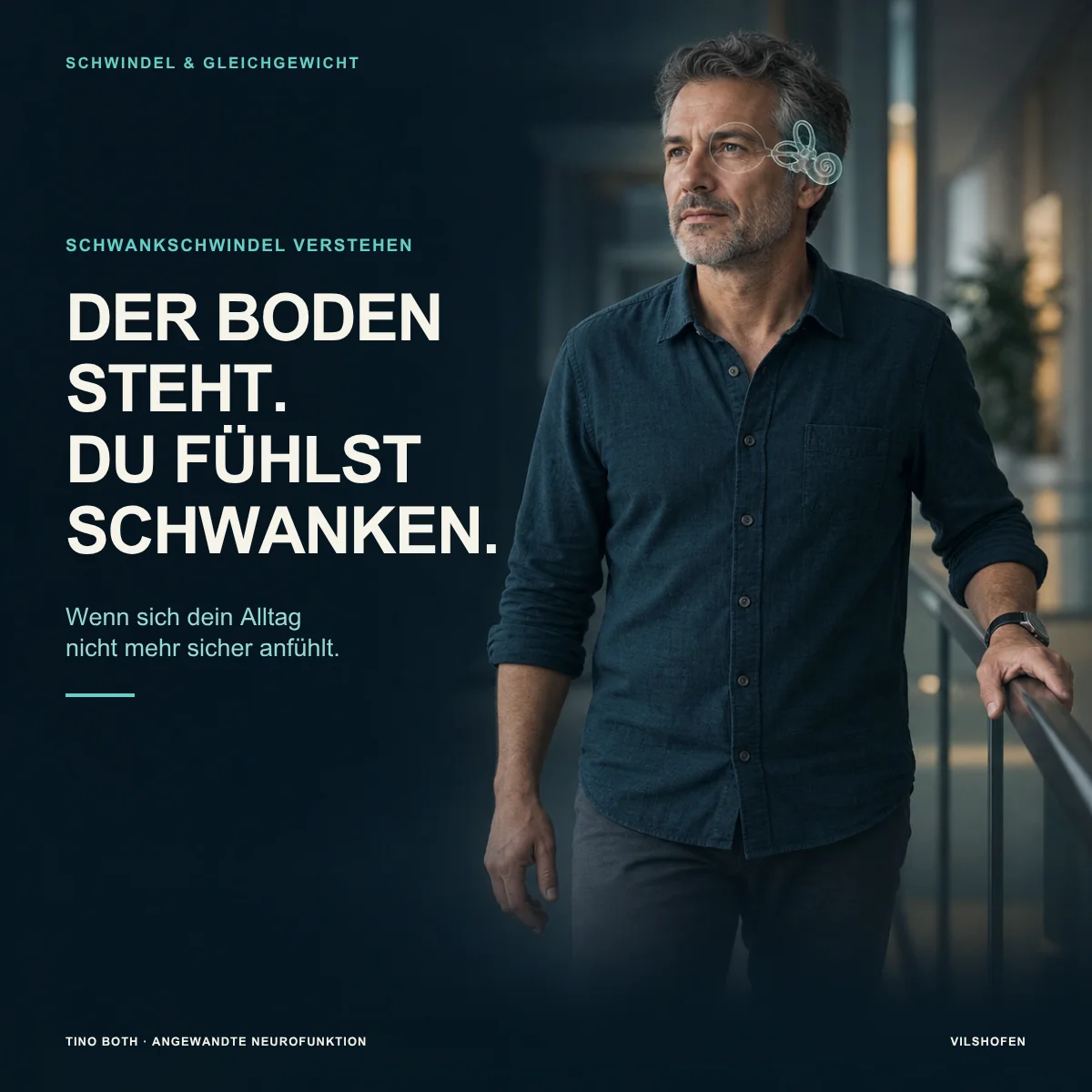
Briefly explained: Swaying dizziness feels like swaying, an unstable floor or standing on a boat. The term describes the feeling, rather than the cause. Alongside balance system conditions or circulatory problems, the interaction between vision, balance and body awareness can play a part.
Have you had medical assessment — yet still lack confidence when walking?During the free initial telephone consultation, we clarify whether my functional support in Vilshofen fits your situation. We discuss your symptoms, previous examinations and a possible next step.
Book a free initial consultation about your swaying dizziness →
You do not need to know beforehand which system might be involved.
Book a free initial consultation about your swaying dizziness →
You do not need to know beforehand which system might be involved.
Sudden new, severe dizziness needs medical assessment first. If symptoms such as speech disturbance, paralysis, double vision or a sudden inability to stand or walk occur as well: 112. Read on here for recurring or longer-standing symptoms.
When the ground moves although nothing is wobbling
You stand in a queue and want to hold onto something. During a walk, you look at the ground more often. In the supermarket, the swaying increases even though you were managing well at home just before. Perhaps nobody can see anything wrong — but you have to concentrate constantly to feel secure.
Such descriptions fit swaying dizziness. Some experience it in brief phases, others for hours or almost all day. Assessment therefore considers more than how it feels: How long has it been present? What worsens it? Are there situations with few symptoms? These differences help find the next useful step.
What can cause swaying dizziness?
A diagnosis cannot be inferred from the swaying sensation alone. Possible explanations include balance system disorders, vestibular migraine, circulatory problems or medication side effects. Longer-lasting functional forms of dizziness are also possible. A general practice is a useful first contact; ENT or neurology may be involved depending on the findings.
Unremarkable examinations do not mean imaginary symptoms.An unremarkable finding answers the question assessed by that examination. It does not automatically explain every difficulty when walking, moving the head or in busy surroundings. Following medical assessment, it can therefore also be interesting to consider how these specific tasks go.
For symptoms on most days for at least three months, a doctor may consider PPPD: Persistent postural-perceptual dizziness. Worsening in an upright position, during movement and with moving or complex visual impressions is typical. Further diagnostic criteria must be met; not all persistent swaying dizziness is PPPD. This form of dizziness is real and can coexist with other conditions.
Why walking, standing and supermarkets can present different difficulties
For orientation, your brain connects several information sources. The eyes show how the surroundings move relative to you. The balance system in the inner ear detects head movement and orientation relative to gravity. Muscles, joints and skin provide information about your body and ground contact. The demands on this interaction change with the task.
When walking: Moving while keeping your bearingsBody and head move with every step. At the same time, you want to recognise signs, avoid people or look to the side. If head movements or gaze shifts specifically worsen the swaying, that is an important observation for further assessment.
When standing: Small adjustments rather than complete stillnessEven in quiet standing, your body constantly compensates for small movements. Prolonged standing also places demands on circulation. If you mainly feel light-headed or your vision goes dark after standing up, this information belongs in medical assessment.
In the supermarket: Many visual impressions during movementShelves, patterns and passing people continually change the image. Such visual situations can worsen swaying dizziness. This supports considering tolerance of moving visual impressions — rather than automatically indicating an eye disease.
More about this everyday topic is available in the article on overwhelm from supermarkets, crowds and patterns.
My functional approach to swaying dizziness
'I feel dizzy' becomes a specific, checkable task.
In my work with Applied Neurofunction, we begin with your daily life and the findings already available. What would you like to do more easily again: Take a short walk, stand at the checkout or look at someone while walking? We select a safe starting task from this that can later be repeated under the same conditions.
I then assess suitable functions specifically — such as eye movements, gaze stability during small head movements, standing or walking. I consider more than whether a task succeeds. I also observe effort, symptoms and recovery. We do not need to trigger the strongest possible dizziness for this.
Eye movement is possible, head movement is possible — but together it becomes difficult?
This combination can be particularly interesting in swaying dizziness. When walking, your eyes and head do not move independently. If a sign is to remain clearly visible while the head moves, the eyes need to counter-move appropriately. I therefore assess how both interact, as well as whether you can turn your head or follow a target with your eyes.
A possible example: Only the coupling makes the differenceFollowing medical assessment, we first choose a safe seated position. Suppose gaze can follow a target upwards with the head still. A small downward head movement is also possible. But as soon as you need to keep looking clearly at a stationary target during this head movement, the task feels awkward.
These are three different observations: Eye movement alone, head movement and combined gaze stabilisation. During the third task, the eyes need to counter-move upwards as the head lowers. Simply saying 'the eyes work' or 'the neck is mobile' would miss this additional demand.
These are three different observations: Eye movement alone, head movement and combined gaze stabilisation. During the third task, the eyes need to counter-move upwards as the head lowers. Simply saying 'the eyes work' or 'the neck is mobile' would miss this additional demand.
If I additionally assess this connection through an indicator muscle, everything again begins with a reliable, pain-free starting response. I compare it after the individual component tasks and after the coupled task. If it remains stable during the components and repeatedly changes only during the combination, this exact coupling becomes the next question within my method.
Even an apparent side issue can change the testIf you hold the visual target yourself, more than your visual system is working: Your arm and shoulder also have to hold it. I can therefore compare the other hand or mount the target independently of you. If the response is unusual only when you hold it yourself, I would continue differently than with the same response to a stationary target.
Only after considering such accompanying conditions do I seek additional input under which the selected task permits a more stable response. I compare with and without the addition, integrate the suitable combination and then assess again without this support.
Only after considering such accompanying conditions do I seek additional input under which the selected task permits a more stable response. I compare with and without the addition, integrate the suitable combination and then assess again without this support.
We then return to the safe starting task — for example, a short stretch of walking with a small gaze shift. Does your sense of security change? Does the image stay clearer? How quickly do you recover? A suitable exercise also needs to prove useful outside the test situation. If benefit is absent or symptoms increase, we change the approach.
Beyond a general instruction to 'train balance more'The next step may involve one direction of gaze, the coupling of eyes and head or an accompanying demand. These differences make functional assessment personal: The demand actually causing difficulty determines your programme, rather than the name 'swaying dizziness'.
Is looking around or a moving environment particularly difficult for you? Describe such an everyday situation during the free initial telephone consultation. We clarify whether my additional support in Vilshofen fits your previous findings and your goal.
What helps with swaying dizziness — and what can you observe yourself?
What usefully helps depends on medical assessment. Targeted vestibular rehabilitation is an option for certain vestibular conditions, for example; other causes require other measures. An arbitrary balance exercise from the internet therefore does not automatically suit your dizziness.
A few specific observations are more helpful for an appointment than constant self-testing. Note the following in a few typical everyday situations:
Situation: When does swaying occur — on standing up, standing, walking or looking around?
Environment: Does being at home or among moving people make a difference?
Course: How long does it last, and how quickly do you recover?
Accompanying circumstances: Are there hearing changes, headaches, palpitations or a timing connection with new medication?
Environment: Does being at home or among moving people make a difference?
Course: How long does it last, and how quickly do you recover?
Accompanying circumstances: Are there hearing changes, headaches, palpitations or a timing connection with new medication?
Do not provoke symptoms for this or assess your standing alone with closed eyes or on an unstable surface. Use support and safe routes when unsteady. Please do not change medication on your own.
The neck and stress: Consider them without prematurely assigning blame
A tense neck can occur alongside swaying dizziness. This does not establish it as the cause. The connection between neck symptoms and dizziness is not clearly established scientifically. Functional work can assess how tolerable head and trunk movements go, while keeping other explanations in view.
Stress, anxiety and increased attention to balance can also interact with symptoms. This does not make them less real. Depending on the findings, psychotherapeutic support and appropriate management of demands can be useful alongside physical training. There need not be an either–or between 'physical' and 'psychological'.
When medical assessment takes priority
New, unexplained or increasing swaying dizziness should be assessed medically. This also applies to falls, new hearing changes or symptoms after a head injury. For sudden severe dizziness with neurological signs or marked inability to stand and walk, the emergency advice at the beginning applies. My service complements necessary medical care; it does not replace it.
Your next step in Vilshofen
If medical assessment has taken place but you remain restricted when walking, standing or in visually busy surroundings, we can explore together whether additional functional support suits your concerns. I am Tino Both and work with Applied Neurofunction in Vilshofen an der Donau — also for people from Passau, Deggendorf and elsewhere in Lower Bavaria.
During an in-person appointment, we record your starting situation, choose suitable assessments and compare the response to targeted inputs. You do not need a ready-made explanation. Existing findings and two or three examples from everyday life are a good beginning.
Does this approach suit your situation?We first clarify this during a free initial telephone consultation. Tell me when swaying occurs, what has already been examined and what you would like to do more easily again in daily life.
Book a free initial telephone consultation →
Would you like to learn more about the service first? Here is my focus on dizziness and balance in Vilshofen.
Book a free initial telephone consultation →
Would you like to learn more about the service first? Here is my focus on dizziness and balance in Vilshofen.
Frequently asked questions about swaying dizziness
Can swaying dizziness occur with an unremarkable MRI?Yes. An MRI answers particular structural questions. Not every form of dizziness is visible in it. Further examinations depend on the course, triggers and accompanying symptoms.
Can the eyes be involved even though I see clearly?Yes. Visual acuity and stabilising gaze during movement are different functions. Processing moving visual impressions can also matter. This alone does not establish a particular cause.
How long does swaying dizziness last?This varies greatly with the cause and course. It can occur in episodes or persist for longer. Symptoms on most days for months warrant targeted medical assessment. This cannot establish a fixed number of appointments until improvement.
Do I need a diagnosis before an initial consultation?You do not need everything clarified for the orientation conversation. We can discuss which assessments have taken place and whether my service fits at all. New or acute symptoms need medical care first.
Is the initial consultation already a functional assessment?No. The free telephone conversation provides orientation and explores whether working together makes sense. Standing, walking, eye movements and the response to targeted inputs are assessed at an in-person appointment.
Sources and further reading
NIDCD: Balance Disorders — an overview of balance, possible causes and individual care.
Staab and colleagues: Diagnostic criteria for PPPD, Bárány Society, 2017 — assessment of persistent postural-perceptual dizziness.
Seemungal and colleagues: The Bárány Society position on 'Cervical Dizziness', 2022 — scientific assessment of the connection between the neck and dizziness.
DEGAM: Dizziness in general practice — a guideline for medical assessment.
Staab and colleagues: Diagnostic criteria for PPPD, Bárány Society, 2017 — assessment of persistent postural-perceptual dizziness.
Seemungal and colleagues: The Bárány Society position on 'Cervical Dizziness', 2022 — scientific assessment of the connection between the neck and dizziness.
DEGAM: Dizziness in general practice — a guideline for medical assessment.