

Spinning & tilting
The surroundings seem to spin, the body feels as if it is tilting or the spatial axis briefly shifts.
Dizziness & balance
Whether in a supermarket, during head movements or on uneven ground, what matters is under which conditions the nervous system loses orientation. Applied Neurofunction breaks the pattern down into specific components, tests targeted inputs and then reassesses the original task.
About these images: The scene images on this page are AI-generated illustrations. They do not show real clients or document actual situations in my practice.
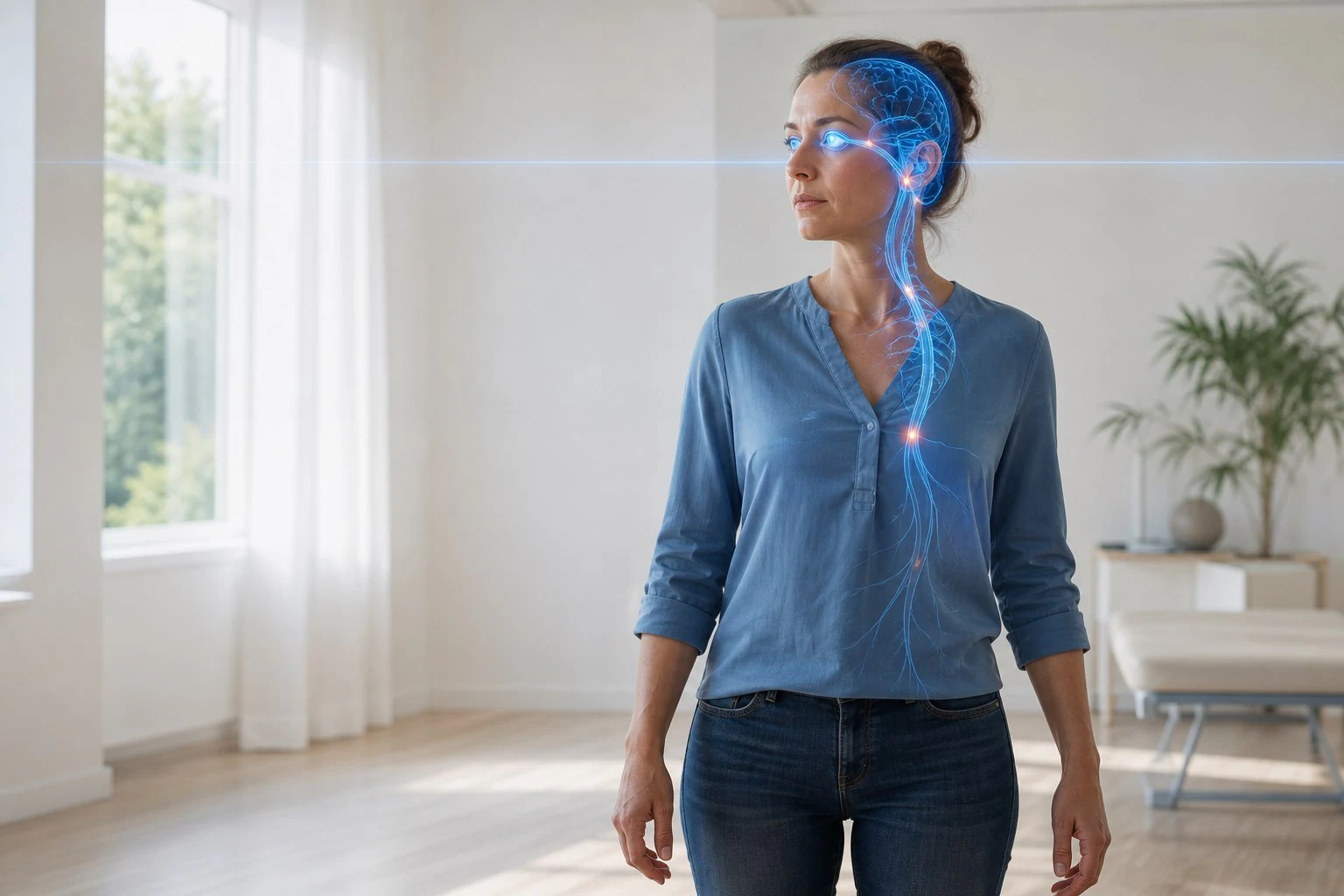
The observable result
The label alone does not determine the assessment pathway. Direction, triggers, duration and associated changes suggest which components should be explored more closely.
The surroundings seem to spin, the body feels as if it is tilting or the spatial axis briefly shifts.
The ground feels soft, your walking path drifts or standing without support requires unusual attention.
Your head feels ‘foggy’, gaze shifts are tiring or moving surroundings disrupt orientation.
Turning your head, looking up, standing up, driving or walking while shifting your gaze triggers the pattern.
Orientation emerges from systems working together
The nervous system combines several sources of information into a stable picture of the head, body and surrounding space. Even an imprecise component or an unhelpful combination can make orientation considerably more demanding.
Fixation, saccades, smooth pursuit and optic flow report what is moving in the visual field and where a target is located.
The balance organs detect rotation, acceleration, tilt and the head's orientation relative to gravity.
The feet, joints, muscles, skin and neck report how the body is positioned, bears weight and moves through space.
Precisely combining this information enables clear vision, a stable body axis and steady walking.
The conditions provide a clue
That is why I begin with the situation in which orientation actually becomes unstable, rather than a generic balance exercise.
Many visual targets, rapid gaze shifts and surrounding movement increase the demands on fixation, optic flow and sensory filtering.
The eyes must keep a target stable despite head movement, while vestibular signals report direction and speed.
Less visual guidance increases the importance of information from the feet, joints, neck and balance organs.
Stabilisation, eye movement control and spatial navigation must work together dynamically under changing demands.
From a broad view to specific functions
Initial screening shows which task causes stability to deteriorate. We then break down that area further through testing and retesting.
Fixation near and far: Does a target remain still and clear? Does head movement change visual acuity or your subjective sense of stability?
Saccades, smooth pursuit and optokinetic responses: Are target accuracy, movement flow, direction and endurance consistently organised?
Rotation, inclination, tilt and linear movement: Which plane changes vision, standing, walking or the feeling of dizziness?
Head repositioning accuracy and joint position: Can the body accurately return to a specified position, even without help from the eyes?
Plantar sensation, pressure distribution and standing conditions: How does stability change with the eyes open or closed and on different surfaces?
Walking, gaze shifts and multiple demands: Does the function hold up when vision, head movement and body stabilisation work at the same time?
Three example assessment pathways
These scenarios show how specific everyday situations can be broken down into components that can be assessed. The individual assessment pathway always follows the person's own pattern.

Scenario 1 · Visual processing
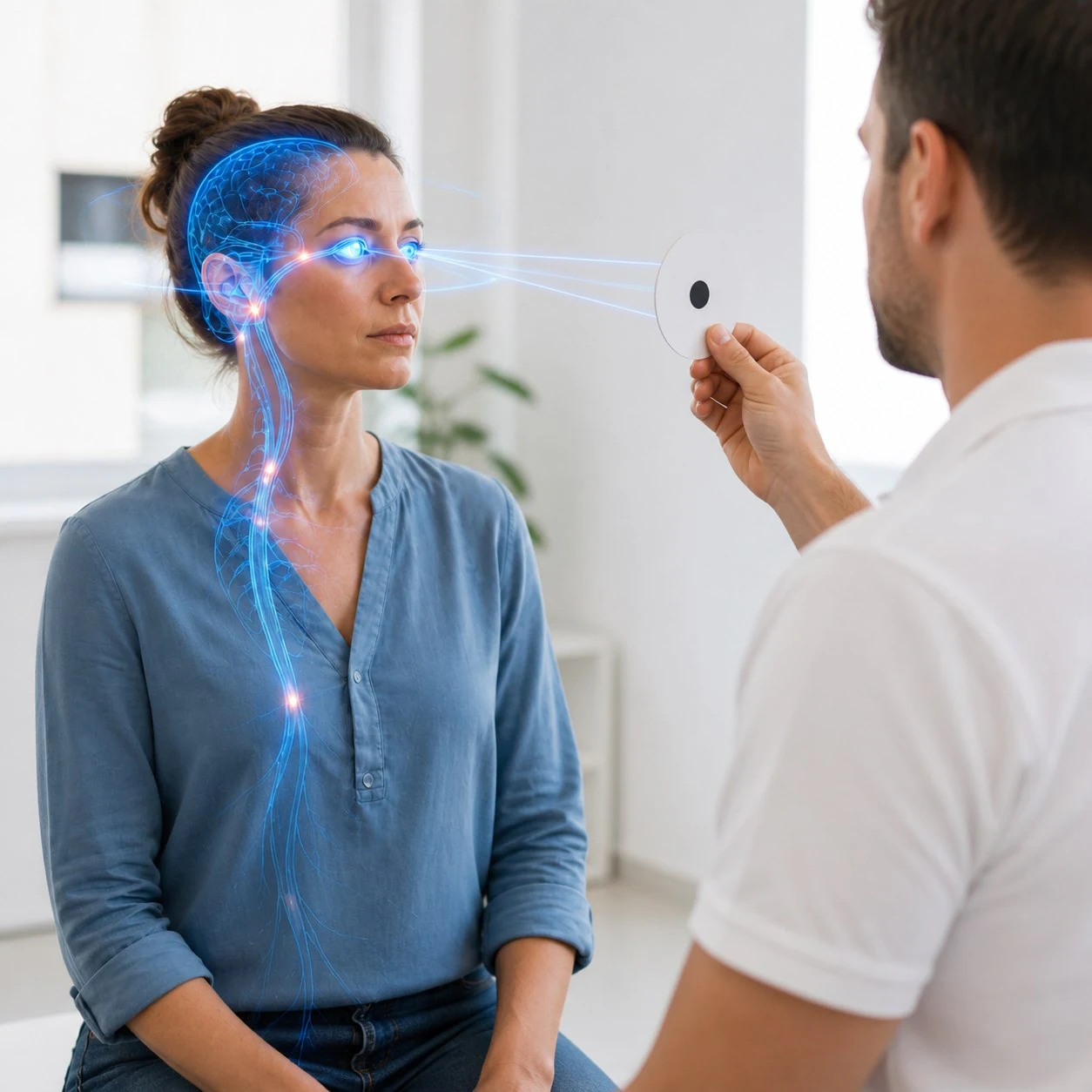
Scenario 2 · Vestibular stabilisation
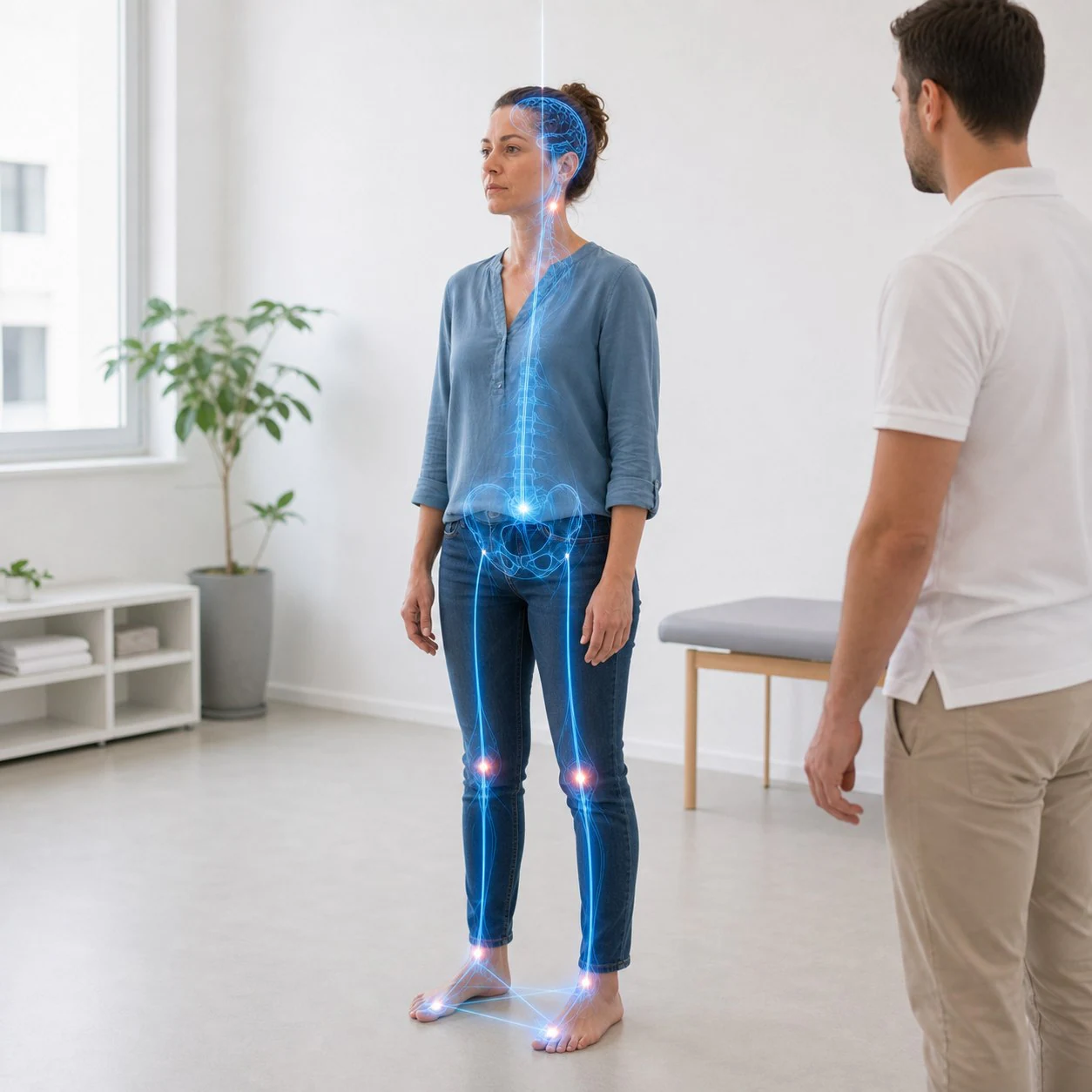
Scenario 3 · Proprioception
Why I look so closely
To find a product on a shelf, I had to scan each row extremely slowly. Every larger gaze shift made my orientation worse.
My symptoms at the time limited me so much that I could no longer work as an engineer. Driving was difficult and shopping extremely demanding. Visual disorientation during rapid gaze shifts was particularly noticeable.
Only when individual eye movements, stabilisation tasks and their connections with the balance and movement systems were assessed precisely did the diffuse overall picture gain a tangible structure.
That experience continues to shape my work: I want to identify which specific function becomes unstable under which conditions — and which input immediately helps organise it better — rather than approach all dizziness in the same way.
Systematic and individual
Review triggers, direction, duration, associated symptoms and previous findings.
Record vision, standing, walking and the personally relevant task in a comparable way.
Break down the area showing a difficulty into individual visual, vestibular or proprioceptive functions.
Apply suitable sensory or motor inputs in a targeted, well-tolerated way.
Assess directly whether vision, stability, walking or the everyday task is more clearly organised.
In a free first conversation, we explore which situations are difficult for you, which examinations have already taken place and whether Applied Neurofunction is a sensible next step for you.
FAQ
Examples include visually triggered disorientation, swaying, unsteadiness while walking and symptoms during head movements, position changes or complex everyday situations. The recurring functional pattern matters more than the label.
The eyes must quickly locate many targets, filter moving inputs and work with head movement, balance and walking at the same time. Fixation, saccades, smooth pursuit, optic flow and their combinations are therefore assessed specifically.
Stable orientation comes from several information sources. The eyes report movement in the surroundings, the vestibular system reports head movement, and proprioception from the neck, joints, skin and feet reports body position. The function showing a difficulty may lie in any of these areas or their interaction.
First, we establish a relevant initial task, such as gaze stability, standing or walking with head movement. We break the pattern showing a difficulty into components, test suitable inputs and then reassess exactly the same initial task.
Yes. Existing findings and diagnoses help us understand the context. Functional assessment complements this information by exploring which specific visual, balance and body functions currently show difficulties in everyday life.
New or very severe dizziness, neurological deficits, altered consciousness, new hearing loss, an unusually severe headache or chest pain require prompt medical assessment.