

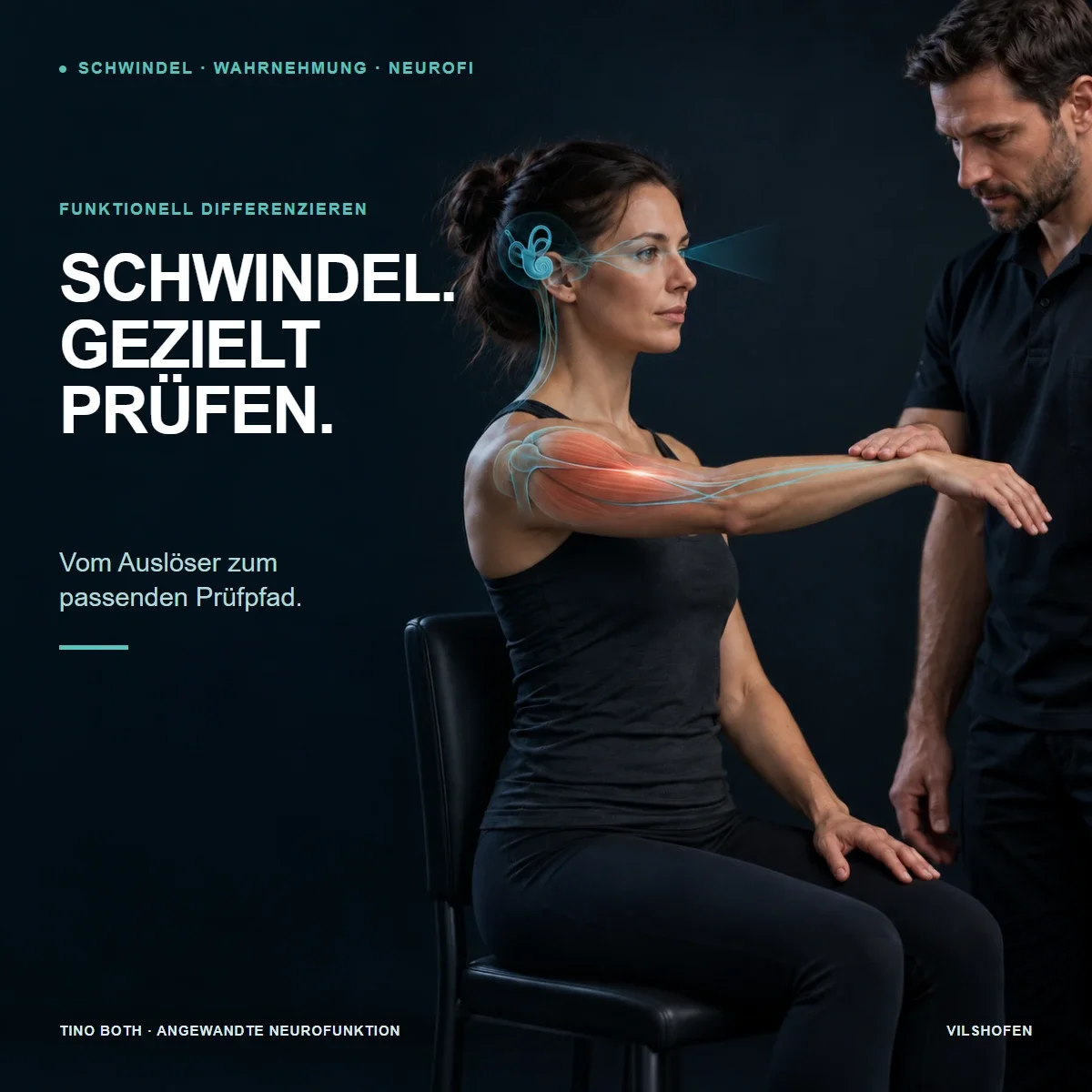
Briefly explained: Assessing dizziness functionally means breaking a specific everyday situation into distinguishable demands: what changes with head movement, a gaze task, body position or their combination? In my work with Angewandte Neurofunktion, a suitable indicator muscle can serve as a comparison in an additional stimulus assessment. Targeted searching for a solution, integration and a further comparison of the original task then follow.
Do you roughly know when you become dizzy, but not which component makes the difference?In the initial telephone consultation, we discuss your typical situation and previous medical assessment. We then clarify whether an additional functional assessment of gaze, balance and movement in Vilshofen fits your concern.
Discuss your dizziness pattern and next steps →
The initial telephone consultation is free.
Discuss your dizziness pattern and next steps →
The initial telephone consultation is free.
Turning the head works. Looking at the shelf makes it unpleasant.
Perhaps you can move your head while sitting without noticing much. Walking along a row of shelves, however, becomes difficult. Or looking steadily at a point feels pleasant while the same point seems to jump during a small head movement. To you, it all feels like dizziness. For targeted assessment, the differences are decisive.
That is why we do not begin with the longest possible list of balance exercises. First, the everyday situation is described precisely enough to allow a manageable comparison. The clearer the question, the fewer unnecessary stimuli are needed.
What the systems involved contribute to orientation
The balance organ in the inner ear detects, among other things, rotation and linear acceleration of the head. The eyes provide information about the surroundings. Muscles, joints and skin report body position and contact with the ground. This information is combined for orientation, posture and gaze control. The NIDCD describes this interaction when explaining balance symptoms.
A head movement changes several kinds of information at once: movement of the balance organ, neck position and often the image on the retina. That is precisely why ‘dizziness when turning the head’ is not yet a clear-cut explanation. Only differences between specifically chosen conditions make the question more precise.
Four comparisons that answer different questions
1. Self-generated or guided movement?A movement you perform yourself also involves movement planning and active muscle control. A professionally selected, gently guided movement sets different conditions. Differences can guide the next assessment route. But they do not permit a simple assignment of ‘active equals brain, passive equals inner ear’.
2. Head movement with or without a fixed visual target?When gaze remains on a stationary target while the head moves, eye–balance coupling is particularly challenged. This task is not the same as a gaze shift with a still head or tracking a moving object.
3. The same task in a different starting position?Supported sitting, unsupported standing and walking create different demands. A simpler starting position can help examine a component question with less overall load. A difficult task is not automatically repeated while standing.
4. Individual parts or their connection?An eye movement and a neck movement can each be unremarkable alone. Perhaps only the simultaneous task becomes unpleasant. Further consideration then focuses on the combination rather than a blanket classification of ‘bad eyes’ or ‘bad neck’.
These comparisons are selected to fit previous findings, safety and tolerability. The aim is not to trigger symptoms as strongly as possible. Closing the eyes, rapid head impulses or provocative neck positions are not self-tests for home.
Additional stimulus assessment begins with a reliable comparison
If targeted contact and stimulus assessment makes sense, I use a suitable indicator muscle. It must first be testable reliably in a pain-free position. If a shoulder hurts, for example, assessment is not simply continued through the painful shoulder. The muscle response should make the question comparable, rather than itself being distorted by pain.
The specific stimulus is then applied: a small, tolerable head movement while looking at a defined point, for example. The same muscle is then tested under the same conditions. If its holding response changes, the criteria of this procedure describe an unusual response or inhibition. This is the starting point for further differentiation, not already the finished explanation.
How the question becomes more precise: stimulus reception, tissue or control?
A gaze–head task showing a finding can now be broken down through different assessment routes. Does movement alone already show a finding? Does the difference only arise with fixation? Does a different, safe head position change the response? Depending on results, I add specific contact assessments to pursue a selected functional relationship.
Depth lies in the precise questionIn a gaze–head task, for example, I distinguish feedback from the neck muscles, gaze control and their coupling with head movements. A different gaze direction with the same head movement asks a different question from the same gaze direction with an altered head position.
For a selected relationship, I combine the reference region with the associated contact points. Within this procedure, the test response provides a working hypothesis for the next comparison. With position-dependent circulatory symptoms, by contrast, an autonomic question would need clarification; it is not inferred from this gaze–head assessment.
For a selected relationship, I combine the reference region with the associated contact points. Within this procedure, the test response provides a working hypothesis for the next comparison. With position-dependent circulatory symptoms, by contrast, an autonomic question would need clarification; it is not inferred from this gaze–head assessment.
The connection between eye control, vestibular information and neck sensory information may likewise be involved. Not every level is worked through in every person. The history and previous comparisons determine which next step makes sense at all. A long list of possible structures cannot replace a targeted question.
A practical example: vertical head movement with a fixed visual target
Suppose someone describes moving the head up and down with fixed gaze as ‘uneven’. Little is initially noticeable from outside. A suitable indicator muscle responds more weakly after this exact task than in the starting situation. Repeating the same head movement for minutes is then not automatically the next step.
In the search for a solution, a cranial relationship might emerge, for example: contact in the region of the sphenoid bone. We now compare the task without and with this contact. If the muscle response only becomes stable again with the additional contact, this difference is assessed again under comparable conditions. Contact here does not mean a skull bone must be displaced.
From the comparative response to integrationStarting stimulus: The agreed gaze–head task changes the holding response.
Searching for a solution: An additional contact or sensory input changes this response in an understandable way.
Integration: The identified combination is connected with the integration stimulus in a suitably selected sequence.
Assessment afterwards: The original task is considered again without an additional solution contact. Does the muscle response remain stable? How does the person experience the head movement?
Searching for a solution: An additional contact or sensory input changes this response in an understandable way.
Integration: The identified combination is connected with the integration stimulus in a suitably selected sequence.
Assessment afterwards: The original task is considered again without an additional solution contact. Does the muscle response remain stable? How does the person experience the head movement?
The solution can be sought and integrated in a simpler position than the one in which the everyday problem appears. If the difficult moment normally occurs while walking, the entire search for a solution therefore does not need to happen while walking. The relevant everyday step is revisited afterwards, as far as safe.
This is a substantial difference from ‘dizziness means train balance’. The first finding identifies a question. Integration addresses the point where a suitable relationship has been found. The final comparison assesses whether this has also produced something useful for the original situation.
What follows a good immediate comparison
An immediately easier feeling of movement is interesting. Further planning also considers whether the change remains in everyday life and how the person tolerates the activity later. A selected exercise should consolidate a helpful step, rather than keep as many systems busy as possible.
With confirmed vestibular hypofunction, professionally guided vestibular rehabilitation is an important treatment route. Where indicated, it remains part of care. An additional neurofunctional question is aligned with it rather than displacing existing treatment with a new explanation.
What you can observe before a conversation
Describe a typical situation as specifically as possible: looking at a sign while walking, turning around in the kitchen or becoming upright after sitting. Does the environment spin, do you sway or become light-headed? How long does it last? Which examinations and treatments have taken place? These details are more helpful than self-performed provocation tests.
When medical assessment is needed first
New, persistent or significantly changed dizziness needs medical assessment. Sudden dizziness with speech disturbance, paralysis, new double vision, unusually severe headache or marked new inability to stand and walk requires immediate help. Sudden hearing loss also requires urgent assessment. Such situations are not subjected to further functional testing.
Frequently asked questions about functional dizziness assessment
Is severe dizziness deliberately triggered in testing?No. Conditions are chosen to allow a tolerable and safe comparison. Strong provocation is not a necessary feature of good assessment.
Why is a muscle tested when I am dizzy?In this additional testing, the indicator muscle serves as an additional comparative response to a defined stimulus. Symptom experience and the actual gaze, standing or movement task are also considered.
Does the solution have to be at the balance organ?Not necessarily. A task showing a finding can combine several types of information. The search for a solution may therefore include a visual, proprioceptive or cranial relationship, for example.
What happens if no clear response is found?An arbitrary sequence of contacts is then not declared a solution. The question is simplified, deferred if needed or connected to more suitable professional assessment or care.
The difference between a symptom and an assessable task
‘I feel dizzy’ describes a real problem. ‘Looking at a fixed target during this head movement changes the response’ turns it into a specific functional question. This is precisely where my work begins: carefully distinguish, look for a suitable connection and reassess against the original concern.
Would you like to address dizziness with more than random exercises?In the initial consultation, we consider your previous findings and a specific everyday situation. This helps clarify whether differentiated functional work in Vilshofen is a suitable addition for you.
Discuss functional dizziness assessment →
The initial telephone consultation is free.
Discuss functional dizziness assessment →
The initial telephone consultation is free.
Related pages and articles
Distinguishing dizziness and everyday lifeDizziness despite unremarkable findings: what next?
Swaying dizziness explained simply – why the floor moves even though nothing is wobbling
Taking a functional look at POTS, CFS and Long COVID-like symptoms
Swaying dizziness explained simply – why the floor moves even though nothing is wobbling
Taking a functional look at POTS, CFS and Long COVID-like symptoms
Including the visual systemUnderstanding oculomotor function: how eye movements guide everyday life
VOR explained simply – why the vestibulo-ocular reflex keeps gaze stable
Visual overload: why the supermarket can trigger dizziness
VOR explained simply – why the vestibulo-ocular reflex keeps gaze stable
Visual overload: why the supermarket can trigger dizziness
Relevant areas of focus in VilshofenDizziness and balance
Visual disturbances and visual processing
My approach: Angewandte Neurofunktion
Visual disturbances and visual processing
My approach: Angewandte Neurofunktion
Sources and further reading
NIDCD: Balance Disorders – fundamentals and medical assessment
Hall et al.: Vestibular rehabilitation for peripheral vestibular hypofunction. Guideline, 2022
Hall et al.: Vestibular rehabilitation for peripheral vestibular hypofunction. Guideline, 2022