

← All articles
Complex symptoms & the autonomic nervous system
POTS, ME/CFS and Long COVID: Differences and functional support
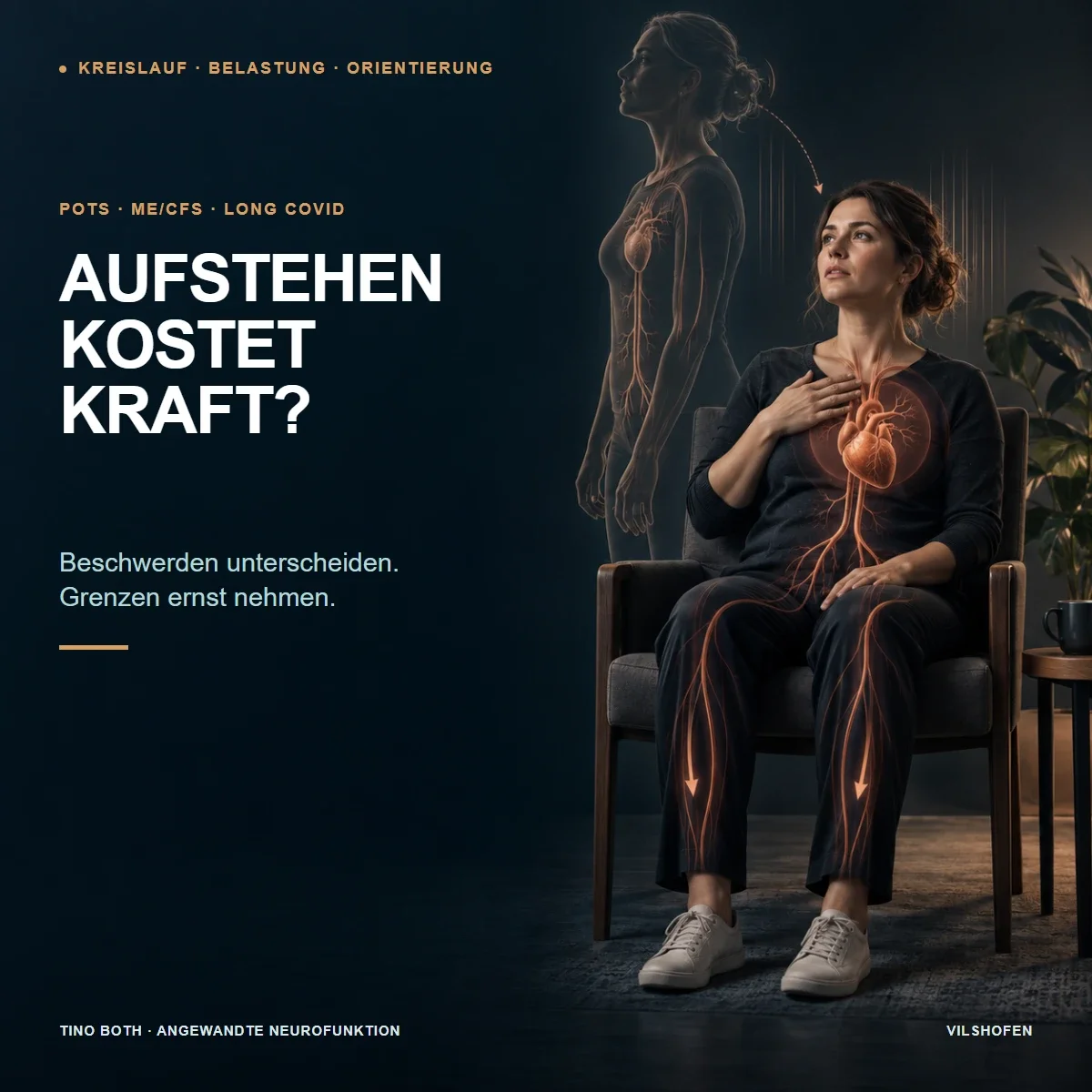
Briefly explained: POTS, ME/CFS and Long COVID can cause similar symptoms and occur together, but are different conditions. POTS mainly concerns the circulatory response on becoming upright. Worsening after exertion, PEM, is central to ME/CFS. Long COVID encompasses different ongoing effects of a SARS-CoV-2 infection. These distinctions also determine which additional support is appropriate.
Are you seeking orientation without starting another demanding programme?During the initial consultation, we look at existing diagnoses, medical support and your current capacity for activity. Only then can we clarify whether a limited functional question is useful — or additional testing has no appropriate place at present.
Discuss your situation and possible support →
The initial telephone consultation is free of charge.
Discuss your situation and possible support →
The initial telephone consultation is free of charge.
A racing heart when standing and a crash the following day are different questions
You stand at the worktop and notice your heart beating faster. Lying down makes it easier. On another day, a conversation initially feels manageable, but later you can do markedly less. Perhaps you encounter several diagnoses in this context. This can be confusing: Is everything connected? Do you need more rest, circulatory treatment, rehabilitation or a different approach?
A clear distinction helps first. A symptom describes your experience. A diagnosis medically classifies particular features. A functional question describes one everyday situation to be considered more closely. These levels can complement each other, but should not blur into one another.
What distinguishes POTS, ME/CFS and Long COVID
POTS: Symptoms in an upright positionIn postural orthostatic tachycardia syndrome, heart rate increases persistently and excessively on becoming upright, alongside typical symptoms. These may include light-headedness, palpitations or weakness. Medical diagnosis includes standardised circulatory measurements and excluding other explanations; one high pulse reading is insufficient.
ME/CFS: An illness with limits on activityMyalgic encephalomyelitis/chronic fatigue syndrome is a serious illness affecting several body systems. PEM is a key feature: Even minor exertion can markedly worsen existing symptoms. This is more than tiredness or an unwillingness to become active.
Long COVID: Different consequences after an infectionLong COVID does not have one uniform symptom pattern. Depending on the person, breathing, circulation, concentration or capacity for activity may be affected, among other things. Some also meet criteria for POTS or ME/CFS, while others do not. The specific presentation determines further care.
Helpful resources for the terms and care include the clinical overview of POTS in CMAJ and the CDC's clinical information on Long COVID. What matters is taking your actual limitations and the course of symptoms seriously, rather than collecting as many labels as possible.
Autonomic regulation explains part of the picture — not automatically everything
When you stand up, circulation must respond to the changed distribution of blood. Heart rate and vascular tone are adjusted. The autonomic nervous system is substantially involved. Position-dependent symptoms therefore differ from a sense of unsteadiness that occurs only with moving images.
ME/CFS and Long COVID cannot, however, be reduced to an 'overactive sympathetic nervous system' or a poorly trained vagus. Nor can an unpleasant eye exercise establish the cause of the entire illness. For practical support, it is more helpful to distinguish medical care, activity management and any additionally relevant individual function.
The first decision: How much demand can an appointment involve at all?
With limited capacity for activity, the exercise itself is only part of the demand. Travel, waiting time, upright sitting, speaking and the environment can also matter. These conditions are discussed before any possible collaboration. An extensive assessment of everything is not a sign of quality here.
With PEM, staying within limits takes priorityA good response in the moment does not justify automatic progression. The NICE guideline for ME/CFS advises against programmes with fixed increases in activity. With pronounced or unstable PEM, additional neurofunctional assessment may be unsuitable. Specialist medical support and a tolerable everyday life then come first.
Medically supported measures for POTS can have different goals from those for ME/CFS with PEM. When both occur together, activity planning must consider the combination. Recommendations about circulatory medicines, salt, amounts of fluid or compression belong in the relevant treatment and are not derived from a muscle test.
Which question an additional functional perspective can answer
If someone is sufficiently stable and medical support has been considered, a clearly limited task can be explored. For example: Why does a brief head movement during reading become uncomfortable, although reading in a comfortable, supported position goes well? The aim is this additional difference relevant to daily life, rather than 'testing away' POTS or ME/CFS.
A quiet gaze task, a small tolerable movement and different support for body position are different conditions. We choose the one that fits the reported difficulty, rather than as many as possible. If the starting situation itself is already intolerable, the assessment ends there.
An example from my work: Assessing an additional gaze–head demand
A possible example with a stable starting situation: A near target is comfortable while sitting with support. A very small gaze–head shift, previously considered tolerable, nevertheless changes how movement feels. An indicator muscle that can be tested without pain is first selected without tiring the person through repeated strength tests. The specific stimulus is compared with the starting response.
Which aspect of the connection is differentiated further?If an unusual muscle response appears during this additional stimulus assessment, I narrow down the gaze–head connection further: Sensory information from the neck, control of eye movements or their interaction. This is the question in this example. Within my method, autonomic activation, innervation or supply relationships are pursued through their own contact assessments. They cannot be inferred from a question about vascular mechanics or a changed head movement.
A selected solution contact is combined with the same task. If the response remains stable with it, the difference is compared again — only as far as is tolerable. The suitable combination can then be integrated. Afterwards, the original task is considered again without the solution contact.
A selected solution contact is combined with the same task. If the response remains stable with it, the difference is compared again — only as far as is tolerable. The suitable combination can then be integrated. Afterwards, the original task is considered again without the solution contact.
This example shows the depth of the question, rather than the size of the demand. Especially with a sensitive starting condition, a useful appointment may consist of very few steps. It does not replace a medical standing test; circulatory provocations or repeatedly standing up are not automatic parts of the additional work.
The chosen everyday situation and its tolerability over time remain the measure. If a head movement becomes immediately more comfortable, that does not mean more standing or a longer walk is possible. An additional approach remains worth considering only if benefit, demand and later response fit together. Robust clinical evidence of efficacy for NeuroFI as a treatment for POTS, ME/CFS or Long COVID is lacking.
What I would like to know for a first conversation
Existing diagnoses, ongoing care and a description of current limits are helpful. Does an upright position worsen symptoms? Are there delayed crashes? How long do they last? Which specific everyday activity matters now? Existing information is enough to begin; you do not need to perform new self-tests or exertion trials beforehand.
A useful goal could be to understand one individual, additional visual or movement demand better. An unsuitable goal would be explaining the whole illness or 'resetting' the limit on activity in one appointment. This distinction helps keep expectations and demands appropriate.
Do not automatically attribute new symptoms to the known diagnosis
Even with known POTS, ME/CFS or Long COVID, new illnesses can occur. New fainting, increasing breathlessness or a clear change in the previous pattern need medical assessment. Acute chest pain, severe breathlessness, impaired consciousness or sudden paralysis and speech disturbances require immediate help.
Frequently asked questions about POTS, ME/CFS and Long COVID
Can I have POTS and ME/CFS at the same time?Yes, the conditions can occur together. The combination matters for care because circulatory symptoms and delayed worsening after exertion create different demands.
Is all exhaustion after COVID automatically ME/CFS?No. Persistent exhaustion has various possible associations. ME/CFS requires checking the diagnostic criteria; PEM is a central feature.
Can an indicator muscle show whether I have POTS?POTS is assessed through the symptom pattern, standardised circulatory measurements and further medical investigation. The indicator muscle has a different role in my additional assessment: Comparing a limited functional question.
Do I need to arrange an assessment appointment just to enquire?No. During the initial telephone consultation, we first clarify your concerns, capacity for activity and existing care. One outcome may be to plan no additional assessment at present.
A suitable addition begins with a clear limit
Individual support comes from choosing the right question, rather than testing as many systems as possible. If an additional functional perspective is an option, it should begin with a specific everyday problem and respect existing care. Your energy expenditure is part of the decision, rather than a side issue.
Would you like to clarify whether my service fits your situation at all?During the free initial telephone consultation, we discuss your specific concerns and the conditions for a possible appointment in Vilshofen. This creates no obligation to begin a training programme or series of tests.
Clarify suitability for additional support →
The initial telephone consultation is free of charge.
Clarify suitability for additional support →
The initial telephone consultation is free of charge.
Related pages and articles
Responses to daily life and activityActivity intolerance — why small stimuli sometimes cause large responses
Understanding the autonomic nervous system — sympathetic, parasympathetic and functional symptoms
Autonomic dysregulation: Understanding symptoms and connections
Understanding the autonomic nervous system — sympathetic, parasympathetic and functional symptoms
Autonomic dysregulation: Understanding symptoms and connections
Orientation and stimulus processingVisual overwhelm: Why the supermarket can trigger dizziness
Swaying dizziness explained simply — why the ground feels as though it moves when nothing is swaying
Neurofunctional Integration for complex symptoms: How I work
Swaying dizziness explained simply — why the ground feels as though it moves when nothing is swaying
Neurofunctional Integration for complex symptoms: How I work
Relevant areas of focus in VilshofenDizziness and balance
Visual disturbances and visual processing
How I work: Angewandte Neurofunktion
Visual disturbances and visual processing
How I work: Angewandte Neurofunktion
Sources and further reading
Raj, Fedorowski and Sheldon: Diagnosis and management of POTS. CMAJ, 2022
NICE NG206: ME/CFS — diagnosis and care
CDC: Long COVID Clinical Guidance, updated March 2026
CDC: Clinical overview of ME/CFS
NICE NG206: ME/CFS — diagnosis and care
CDC: Long COVID Clinical Guidance, updated March 2026
CDC: Clinical overview of ME/CFS