

← All articles
Complex symptoms & the autonomic nervous system
Understanding the autonomic nervous system: Appropriate regulation rather than constant relaxation
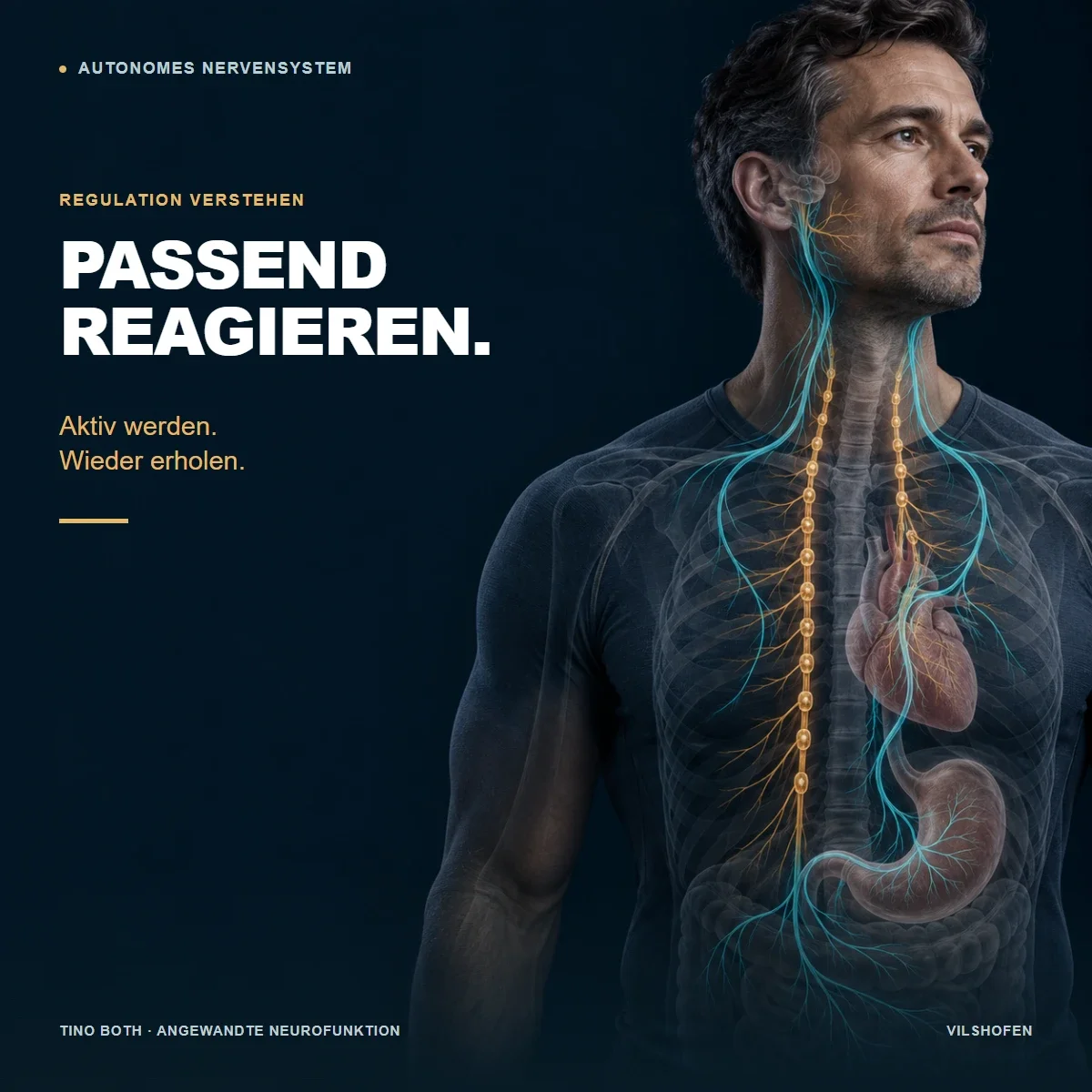
Briefly explained: The autonomic, also called vegetative, nervous system adjusts internal body functions such as heart activity, digestion and sweating. The sympathetic and parasympathetic systems do not act like a simple on–off switch. What matters is whether the response fits the situation — activation during action as well as recovery afterwards.
Are you exhausted, but your body struggles to settle?During the free initial telephone consultation, we discuss the situations in which your symptoms occur and what has already been assessed. This helps judge whether an individual functional perspective in Vilshofen might be useful for you.
Discuss your regulation and symptoms →
Discuss your regulation and symptoms →
Why 'just relax' is often an insufficient answer
You lie down because you are tired. Yet your heart beats noticeably, your abdomen feels unsettled or you cannot find a comfortable breathing rhythm. On another day, an activity goes surprisingly well. Such fluctuations raise the question of how the body organises demands and recovery.
The autonomic nervous system is part of this answer, but not an umbrella term for every unexplained symptom. Lack of sleep, medication, illnesses, training, nutrition and emotional strain can also matter. The perspective becomes helpful only when a broad explanation becomes a specific question.
What belongs to the autonomic nervous system?
While you can move an arm deliberately, you do not have to consciously organise digestive movements, pupil size or sweating. Autonomic nerve pathways are involved in such processes. They interact with central regulatory networks and information from inside the body.
Sympathetic: Necessary for activitySympathetic activity supports adaptation of the heart and circulation to demands, among other things. It is useful during sport and on standing up, rather than inherently harmful. 'Switching off the sympathetic system' would therefore not be a useful everyday goal.
Parasympathetic: More than a relaxation switchParasympathetic pathways influence heart activity, digestion, glands and pupils, among other things. The vagus is an important part of this, but not the whole parasympathetic system. 'As much parasympathetic activity as possible' is also not a universal solution for every discomfort.
Enteric nervous system: Its own networks in the digestive tractNetworks of nerves in the intestinal wall help organise digestive processes and cooperate with other autonomic systems. The abdomen is therefore not simply remotely controlled by one single nerve.
Breathing, alertness and sleep relate to autonomic regulation but are not controlled exclusively by it. The breathing muscles have different motor control from the smooth muscle of the intestinal wall, for example. Such distinctions matter when deriving a suitable question from an observation.
The vagus also sends information back
The vagus connects the brainstem with areas in the neck, chest and abdomen. It contains fibres influencing organs and many fibres carrying information from the body to the brain. Perception and response are therefore two different sides of the same connection.
For my work, this produces a more precise question than 'Is your vagus too weak?': Does the issue concern the received stimulus, its processing or the appropriate physical response? The person's state also matters: A stimulus may be tolerated differently on a well-rested day than after a stressful week.
Which symptoms may fit the question?
Unusual autonomic regulation can affect circulatory adaptation, digestion, sweat production and temperature tolerance, among other things. Symptoms such as palpitations, dizziness or stomach problems are not specific, however. Different illnesses or medicines may also lie behind them.
Medically established autonomic nerve damage differs from a general feeling of being unable to regulate well. The NIDDK information on autonomic neuropathy describes consequences and examinations for autonomic nerve damage associated with diabetes, for example. Such a condition should therefore not be inferred from a symptom list alone.
Four everyday situations, four different questionsDizziness on standing up: How are pulse and blood pressure adjusted? This may be a medical question about circulation.
Feeling unwell in the supermarket: What part do visual movement, sounds, standing and duration play?
Abdominal symptoms after eating: Which meal, which timing and which accompanying symptoms matter?
Tired but active inside: What do the actual opportunity for sleep, daily demands, caffeine and recovery look like?
Similar sensations do not automatically lead to the same assessment route.
Feeling unwell in the supermarket: What part do visual movement, sounds, standing and duration play?
Abdominal symptoms after eating: Which meal, which timing and which accompanying symptoms matter?
Tired but active inside: What do the actual opportunity for sleep, daily demands, caffeine and recovery look like?
Similar sensations do not automatically lead to the same assessment route.
What I mean by appropriate regulation
A good day consists of more than rest. You want to move, concentrate, eat, talk with people and recover afterwards. I am therefore less interested in a label such as 'constantly in sympathetic mode' than in switching between specific demands.
We begin with your history and a suitable starting observation. What is readily possible, when does it become difficult and how long does recovery take? Depending on the concern, we can consider a body position, a small movement demand, a visual task or a clearly limited mental context. The demand is adapted to your current tolerance.
A possible example: Compare deep breathing and humming separately
Someone describes finding it harder to turn their neck when tense. 'Take a deep breath' has not helped so far. After necessary assessment, we choose a comfortable head rotation as the starting task and document how movement feels and the effort involved.
We do not now change breathing depth, body position, direction of gaze and duration simultaneously. First, we observe the response to a comfortably small breath. In a separate comparison, brief, quiet humming during an unforced exhalation may be added. Breath-holding and breathlessness are unnecessary. The same head rotation is then considered again.
If only humming is associated with a more favourable response, this is practically different information from 'breathing helps'. Likewise, feeling comfortable while humming is not yet equivalent to a change in head movement. I check both. An individually dosed option develops from the observation; it does not automatically mean a particular nerve was previously damaged.
Why I seek shared relationships when several findings are unusual
Applied Neurofunction allows me to divide questions further. Contact assessments with an indicator muscle that can be tested without pain may also be added. The muscle serves as a comparison measure while a clearly defined question is introduced through a stimulus or contact combination.
A possible assessment route with several organ-related contactsSuppose different relationships — such as those to the stomach and intestine — produce unusual responses in functional contact assessment. I do not automatically work through them separately in sequence. Within my method, I first compare whether a shared autonomic level emerges, such as a relationship to the vagus or a particular neural relay site.
The further question is then more specific: Which selected functional relationship changes the indicator response, and under which additional input does it remain stable? The stimulus alone and the stimulus plus a possible solution are repeatedly compared. After integration, all originally unusual combinations are assessed again — followed by the function or tolerance of activity important to you.
This creates a structured search process. Whether it helps practically is determined by benefit for your concern and the subsequent course, rather than by contact alone.
The further question is then more specific: Which selected functional relationship changes the indicator response, and under which additional input does it remain stable? The stimulus alone and the stimulus plus a possible solution are repeatedly compared. After integration, all originally unusual combinations are assessed again — followed by the function or tolerance of activity important to you.
This creates a structured search process. Whether it helps practically is determined by benefit for your concern and the subsequent course, rather than by contact alone.
Autonomic control, perception of organs and local mechanical sensitivity are different questions. They are not equated with one single contact. A changing test response is also not a measurement of blood flow. This distinction helps me keep the question precise rather than grouping every symptom under one term.
Consider sleep, digestion, breathing and pain together — without equating everything
If you have too little opportunity to sleep at night, more actual room for sleep is needed first. A brief change during an appointment does not replace this. With digestive symptoms, meals, medication, tolerances and medical findings matter. Breathing symptoms require clarification of whether an illness is involved. Pain, in turn, depends on several biological, psychological and social influences.
The shared element is the person in whom these experiences come together. The individual questions nevertheless remain different. Sometimes a simple daily rhythm is the most important approach. Sometimes a closer look at a sensory demand is worthwhile. Sometimes attention, distressing experiences or the expectation of a situation belong in the picture. I reduce your history neither to muscle training nor to a vagus tip.
What you can usefully observe in daily life
A small record of patterns instead of constant self-measurementFor a few typical situations, note: What was the task? In which body position? For how long? What did you notice? How quickly did you recover?
Add sleep, meals, caffeine, heat or an especially demanding day if relevant. A watch or app can supply extra data but cannot explain how you feel by itself. Do not change medication on your own.
If breathing exercises, cold or other personal experiments trigger symptoms, do not increase them because the internet calls them 'calming'. A smaller demand or another strategy may be more useful.
Add sleep, meals, caffeine, heat or an especially demanding day if relevant. A watch or app can supply extra data but cannot explain how you feel by itself. Do not change medication on your own.
If breathing exercises, cold or other personal experiments trigger symptoms, do not increase them because the internet calls them 'calming'. A smaller demand or another strategy may be more useful.
The timing of the response also matters. If you feel well immediately afterwards but markedly worse later, the dose needs reassessment. Pronounced delayed deterioration after minor exertion requires medical assessment. The answer is then not automatically more training.
When you need medical support
Repeated fainting, marked circulatory problems, new heart rhythm symptoms, unexplained weight loss or increasing digestive symptoms need medical assessment. Acute chest pain, severe breathlessness, impaired consciousness or new neurological deficits require immediate emergency help.
Frequently asked questions about the autonomic nervous system
Is the vegetative nervous system the same as the autonomic nervous system?Yes, the terms refer to the same part of the nervous system. 'Vegetative' is particularly common in German-speaking countries.
Is an active sympathetic system bad?No. Activation is necessary for many everyday demands. What matters is whether its extent, duration and subsequent recovery fit the situation.
Should I train my vagus every day?Not solely on the basis of a symptom list. A measure should fit your concern and be tolerable. Questions about sleep, demands and medical assessment may be more important than an additional exercise.
Can one nervous system explain all my symptoms?Several symptoms may be connected but need not share the same origin. I look for checkable relationships and keep independent influencing factors in view.
What happens at the first contact?You describe which situations are difficult and what assessment has already taken place. We discuss whether Applied Neurofunction suits your concerns and what a useful next step might look like.
Regulation becomes more tangible when the question becomes more specificIf you would like to make better sense of your recurring responses, we can first discuss them by telephone. My work takes place in Vilshofen and is also available to people from Passau, Deggendorf and the surrounding area.
Arrange a free initial consultation →
Arrange a free initial consultation →
Related pages and articles
Explore autonomic regulation furtherAutonomic nervous system / autonomic dysregulation
Activating the vagus nerve — why breathing exercises, cold and humming are not always the solution
Activating the vagus nerve — why breathing exercises, cold and humming are not always the solution
Symptoms and suitable supportDizziness & balance
Visual disturbances and visual processing
Pain & functional symptoms
How I work: Angewandte Neurofunktion
The inner ear and dizziness — when the cause is not only in the ear
Understanding functional symptoms — when symptoms are real but not clearly explained
Visual disturbances and visual processing
Pain & functional symptoms
How I work: Angewandte Neurofunktion
The inner ear and dizziness — when the cause is not only in the ear
Understanding functional symptoms — when symptoms are real but not clearly explained
Sources and further reading
MSD Manual: Overview of the autonomic nervous system.
NIDDK: Autonomic Neuropathy — medical assessment of autonomic nerve damage.
NIDDK: Autonomic Neuropathy — medical assessment of autonomic nerve damage.