

← All articles
Nervous system & health
Activating the vagus nerve: why breathing exercises and humming do not always help
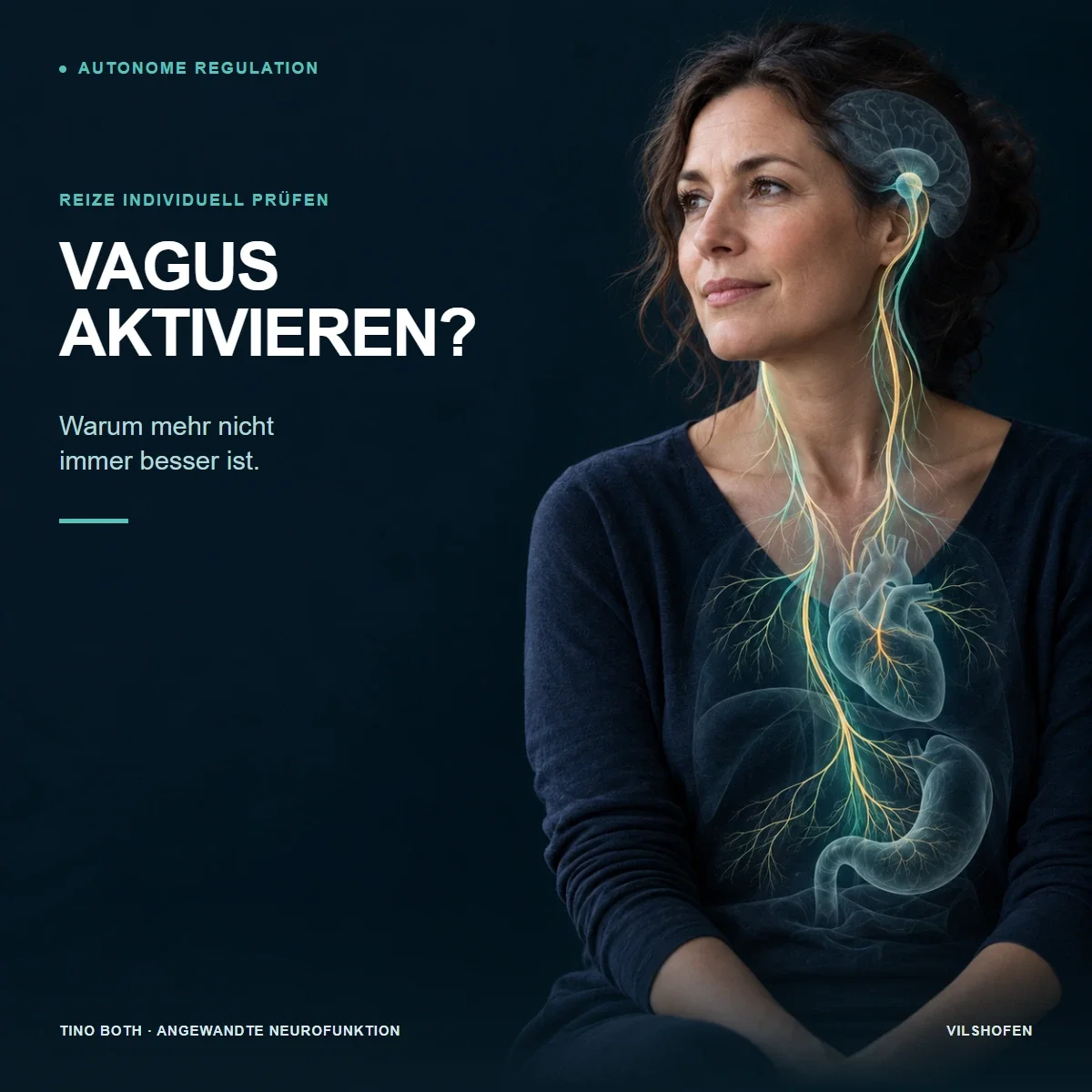
Briefly explained: ‘Activating’ the vagus nerve is not a general remedy for restlessness, exhaustion or digestive symptoms. Breathing exercises can influence bodily regulation. Whether a particular stimulus suits you is shown by your response and the specific concern, rather than by the name of the exercise.
You try relaxation tips – and still do not make progress?In the free initial consultation, you describe what you find difficult in everyday life and how you have responded to exercises so far. We establish whether an individual functional look at breathing, perception and regulation in Vilshofen would be a useful addition.
Make sense of your responses together →
Make sense of your responses together →
Breathe calmly, hum, take a cold shower – and then?
You have already tried several recommendations. A breathing exercise makes you calmer, but your actual problem remains. Humming changes little. Cold feels more like additional stress. It is then natural to wonder whether your vagus nerve is not working properly or you are doing the exercises incorrectly.
That conclusion would be premature. A stimulus never acts on an isolated nerve, but on a person in a particular situation: with their current load, breathing, expectations and possibly existing illnesses. The same stimulus can therefore feel different at different times.
The vagus nerve is a connection – not a relaxation button
The vagus nerve connects the brainstem with various structures in the neck, chest and abdomen. It carries information from the body and is involved in autonomic control; an anatomical overview of the vagus nerve describes these sensory and motor components. Its tasks therefore extend well beyond the feeling ‘I am becoming calmer’.
Regulation also does not mean reducing activity as a general rule. A demand requires appropriate activation; recovery should then be possible again. If you are already exhausted, ‘calming down even more’ is not automatically a useful goal. First, we need to establish which situation should actually become easier to manage.
One measured value does not represent all regulationA systematic review of slow breathing shows changes in vagally influenced heart rate variability. This means variation in the intervals between heartbeats. It supports the use of targeted breathing, but does not mean that every symptom is due to an insufficiently active vagus nerve.
Why a pleasant stimulus may still not solve your problem
Imagine breathing more calmly for a few minutes and feeling pleasantly relaxed. As soon as you work at a screen, the same effort as before begins. The break may then have been helpful, while the demands on vision, posture or working rhythm remain unchanged.
In my work with Angewandte Neurofunktion, I therefore want to be more precise: what should change? More comfortable breathing in a particular position? Less effort during a head movement? Better tolerance of a visual task? A clear starting point makes the difference between ‘That felt good somehow’ and a usable next decision.
First example: the breathing exercise makes you more restlessWe initially observe your normal breathing, without deliberately deepening it, in a comfortable position. We then compare a small, well-tolerated breathing stimulus with this starting situation. You do not need to breathe as deeply as possible or force a particular duration. If it becomes less comfortable, we reduce the demand or choose another approach. We also reassess the task specified beforehand – such as a relaxed head turn. The goal is a suitable stimulus, rather than persisting with a prescribed instruction.
When several relationships lead to the same level
Alongside these direct functional comparisons, my method uses targeted contact-based assessments through an indicator muscle. This is a previously selected muscle that can be tested without pain, whose holding response I compare under different conditions. It need not be in the area causing symptoms.
I distinguish between two questions: does the test respond to a particular relationship between a body region and the vagus? Or do several assessed areas show a similar response at the same assigned level? This distinction changes where I look for a suitable integration stimulus.
Second example: stomach and intestinal relationships lead to the same assessment pathwaySuppose that, in separate contact-based assessments relating to the stomach and intestines, the holding response changes in each case together with the same vagus assignment. I do not then automatically work through each area individually. I first examine the shared relationship more closely: within my testing system, is it more about surrounding structures, assigned supply relationships, or activation and processing? This produces a specific direction for exploration, rather than simply ‘stimulating the vagus’ in a general way.
These assignments are part of my functional working model. For me, the observed differences in response are the starting point for further assessment; on their own, they do not demonstrate a disease of an organ or the vagus nerve. This is precisely why the question of whether your previously specified concern also changes remains central.
How I assess an approach that has been identified
From the contact-based question back to your function1. Reliable starting test: I select a suitable indicator muscle and assess its holding response without painful loading.
2. A specific question: a targeted stimulus or combination of contacts establishes the relationship. If the holding response becomes weaker, I look for a suitable addition.
3. The counter-comparison: I compare the triggering condition alone with the same condition plus a possible integration stimulus. An understandable change is of interest: weaker alone, more stable again with the addition.
4. Integration: the suitable stimulus is applied specifically. I then assess whether the original condition also receives a stable response without the additional help.
5. Transfer to everyday life: we repeat the starting task and observe whether the change remains helpful later. A short-term test response and a longer-term improvement are two different results.
2. A specific question: a targeted stimulus or combination of contacts establishes the relationship. If the holding response becomes weaker, I look for a suitable addition.
3. The counter-comparison: I compare the triggering condition alone with the same condition plus a possible integration stimulus. An understandable change is of interest: weaker alone, more stable again with the addition.
4. Integration: the suitable stimulus is applied specifically. I then assess whether the original condition also receives a stable response without the additional help.
5. Transfer to everyday life: we repeat the starting task and observe whether the change remains helpful later. A short-term test response and a longer-term improvement are two different results.
This also explains why a short exercise tip does not represent the entire method. The actual work lies in selecting the question, making the counter-comparison and relating the change identified back to your function. If this transfer does not occur, the exploration is not complete.
What you can observe yourself
You do not need a collection of self-tests for an appointment. Two or three specific observations are more helpful: when does it become difficult? How do you feel immediately after an exercise and later in the day? Does only the general feeling of calm change, or also the activity that causes you problems? Note it too if you notice no difference at all.
With breathing exercises, do not force yourself to breathe particularly deeply, slowly or for a long time. Uncomfortable breathlessness, dizziness or intense restlessness are not the goal. Intense cold stimuli, prolonged breath-holding and pressure on the neck are unsuitable self-experiments for testing a supposed weakness of the vagus nerve.
When a medical assessment matters first
New or persistent symptoms such as fainting, an unusual racing heartbeat, swallowing problems or marked digestive disturbances require medical assessment. For acute chest pain, severe breathlessness or new neurological deficits, call 112. Existing illnesses and medicines belong in the joint planning; do not change them because of an exercise tip.
Frequently asked questions about activating the vagus nerve
Is humming generally useful?It can feel pleasant and change breathing. This does not predict whether it supports your concern. I would assess a small, tolerable trial through a specific task, rather than a promised ‘vagus effect’.
Does dizziness during a breathing exercise mean a weak vagus nerve?No. Among other things, breathing inappropriately deeply or quickly can contribute to dizziness. Stop an uncomfortable exercise. Repeated or unclear symptoms should be assessed, rather than read as confirmation of a particular nerve weakness.
Can the vagus nerve simply be reset?A ‘reset’ does not meaningfully describe complex regulation. In practice, the aim is to find a tolerable approach and assess whether it helps a particular function.
How is a personal appointment different from an exercise list?We begin with your question, select a suitable starting test and compare targeted stimuli. Selection depends on your response. This produces an individual next step, rather than the longest possible list of exercises.
Which change would really make your everyday life easier?That is exactly where we can begin. In the free initial consultation, describe your concern, assessments already completed and your experiences so far. We can then consider whether my work with Angewandte Neurofunktion is suitable.
Discuss a suitable next step →
Discuss a suitable next step →
Related pages and articles
Understanding autonomic regulation more closelySympathetic and parasympathetic systems: what regulation means
When the sympathetic system seems continuously active
Autonomic symptoms: when relaxation alone is not enough
When the sympathetic system seems continuously active
Autonomic symptoms: when relaxation alone is not enough
Getting to know individual workComplex symptoms and shared functional relationships
Free initial telephone consultation
Free initial telephone consultation