

← All articles
Complex symptoms & the autonomic nervous system
Neurofunctional Integration for complex symptoms — why I assess beyond the local area
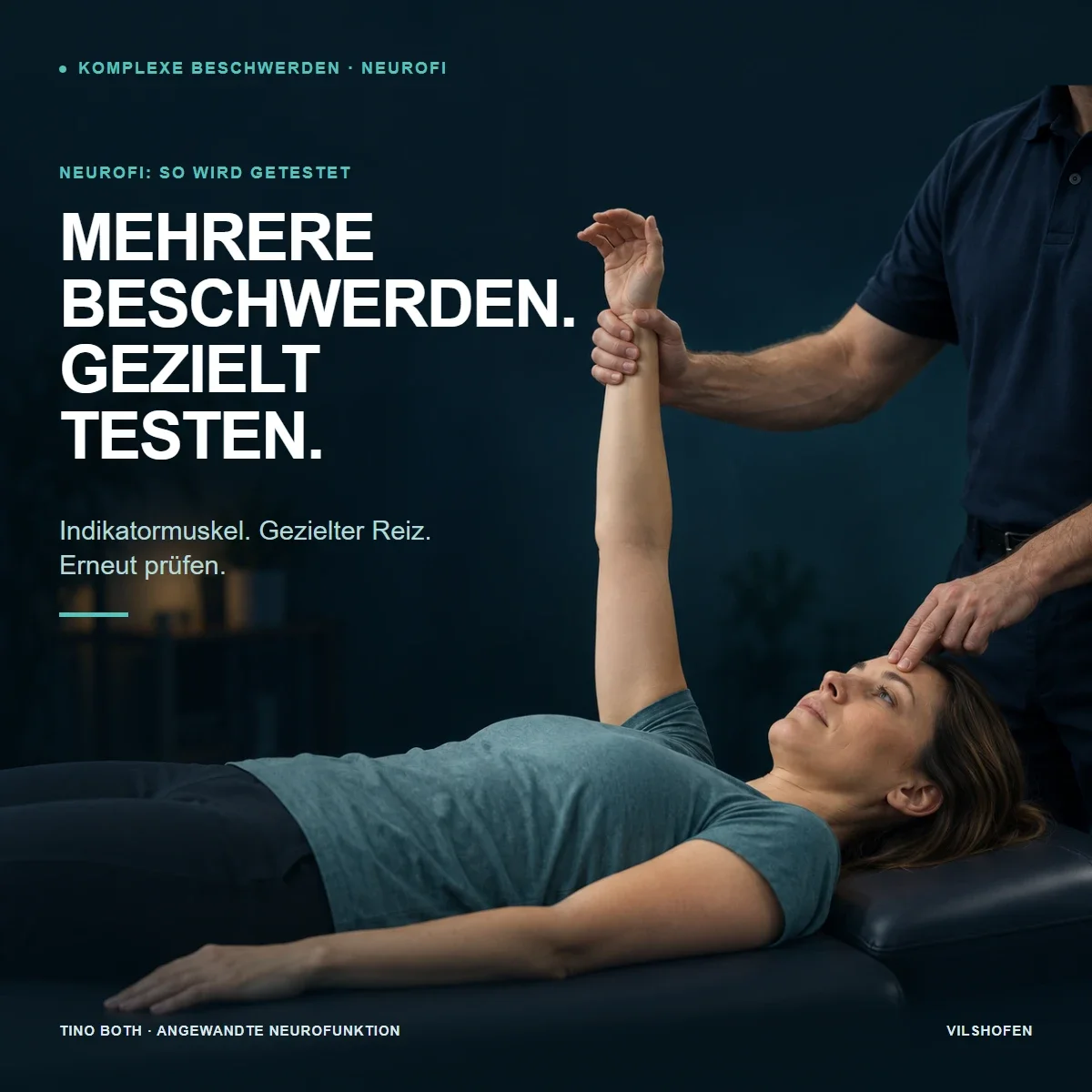
Briefly explained: Applied Neurofunction provides the framework for my work. One component method used within it is Neurofunctional Integration, or NeuroFI: An experience-based procedure through which I compare responses to targeted stimuli using an indicator muscle. With complex symptoms, I am interested in the painful area and its interaction with perception and movement. The goal is an individually suitable next step checked in practice.
Do you have individual findings — but no clear next step yet?Describe what restricts you most in everyday life and which examinations have already taken place. We discuss whether my approach in Vilshofen suits your question.
Discuss your situation during an initial consultation →
The initial telephone consultation is free of charge.
Discuss your situation during an initial consultation →
The initial telephone consultation is free of charge.
When every body region has been considered separately
Your neck pulls, your gaze feels unsteady when looking around and standing for longer becomes demanding. Perhaps the individual symptoms have already been examined. Yet the question remains for you: What can I actually do now to make daily life work better again?
I do not begin by assuming everything must have one hidden cause. First, we choose a situation that really affects you. For example, looking over your shoulder while walking or reaching into a higher shelf. Such a task makes the concern tangible and offers a starting point we can return to after assessment.
Why I do not stay exclusively at the site of symptoms
Movement arises from the interaction of several pieces of information. You sense your arm's position, see the target and align your body with it. Walking adds orientation and balance. The cooperation of the eyes, balance organs and body information is described, for example, by NIDCD in its account of balance regulation.
This produces a useful question: Does the difficult movement change when we deliberately alter one of these demands? The local area remains important. A shoulder is not ignored simply because vision might also be involved. We examine movement more closely, rather than prematurely fixing its explanation on one muscle or one sensory system.
Input → processing → outputInput: Information from the body and surroundings.
Processing: The nervous system connects this information with the particular task.
Output: The specific response, such as a movement or changed muscle response.
This framework helps with asking questions. Which connection is practically relevant in an individual case is then assessed specifically.
Processing: The nervous system connects this information with the particular task.
Output: The specific response, such as a movement or changed muscle response.
This framework helps with asking questions. Which connection is practically relevant in an individual case is then assessed specifically.
What an indicator muscle has to do with your shoulder or neck
In this additional assessment, the indicator muscle serves as a repeatedly checkable response to a question. It first needs to be suitable: Testing should be possible without pain and reliable under comparable conditions. A painful shoulder test is therefore not a useful starting point merely because your concern involves the shoulder.
We distinguish the muscle test from your actual everyday task. Within the method, the muscle response helps me select and differentiate. Whether the approach found is useful for you is then considered again through the movement or function that brought you here.
How Neurofunctional Integration proceeds
1. Choose a reliable indicator muscleFirst, I check which muscle can be assessed suitably under the starting conditions. Test position and procedure should remain readily comparable. You do not need to tolerate pain or demonstrate as much strength as possible.
2. Assess a specific connectionA targeted stimulus or defined contacts direct the question towards a particular functional relationship. If vascular mechanics around the shoulder are to be considered, for example, the shoulder reference region and the intended contact points are combined within this assessment system.
3. Compare the indicator responseThe indicator muscle is then assessed again. If its response is unusually weak under the applied stimulus, this response is examined more closely. Direction, position and normal movement-dependent responses are part of the interpretation.
4. Look for suitable solution inputI look for an addition under which the unusual muscle response becomes stable again. The comparison is: The stimulus alone — the stimulus together with the additional input. This alternation is assessed repeatedly, rather than prematurely accepting one single difference.
5. Integrate and check the same stimulus againThe combination previously found suitable in testing is used for integration. Afterwards, I assess the original stimulus again without the additional solution input. What matters now is whether the muscle response also remains stable under this condition.
6. Return to the original functionFinally, your starting task returns: Such as raising the arm, turning the head or a safely selected stretch of walking. We compare changes in execution, mobility or sensation and how tolerable the approach was.
A possible example: Raising the arm takes great effort
You raise the arm to a well-tolerated point. We note when movement becomes demanding and how it feels. The indicator muscle is selected independently. I can then differentiate the question by tissue relationship, sensory information or motor control.
Depending on the starting situation, it may also be interesting whether a particular gaze task or head position changes the comparison. Everything is not combined at once. We want to understand which stimulus was assessed and which addition belongs with the changed response.
After integration, raising the arm follows again under the same conditions. Easier movement would be a useful starting point for further work. If the everyday task remains unchanged, a changed muscle response alone is not yet enough as a practical result. The starting approach is then reassessed.
Complex does not mean as many tests as possible
Many symptoms can tempt us to assess more and more areas. But the process should become understandable for you. I therefore keep the original question in view and prioritise responses that can be repeated under suitable conditions. Not every unusual contact has to become the next focus of work.
An unclear response also has consequences: We simplify the comparison, check the starting conditions or choose another question. Fatigue, pain or a changing test procedure should not be turned into a complicated explanation after the fact.
What matters after the appointment
An immediate difference is a beginning. In everyday life, what matters is whether it appears again with similar tasks and how capacity for activity develops. If exercises are a useful next step, I choose a few tolerable tasks with a clear purpose. Integration and training can belong together, but are different steps.
For the initial consultation, you can describe a typical difficult situation and have existing relevant findings available. You do not need to understand all the connections already or prepare your own tests. What already works well and what support you currently receive also matter.
When something else takes priority first
New or rapidly increasing symptoms need appropriate medical assessment. Sudden signs of paralysis, speech disturbance, severe new headache or acute vision loss make immediate care the priority, via 112 in an emergency. With longer-standing, assessed symptoms, we adapt the approach to your tolerance and existing recommendations.
Frequently asked questions about Neurofunctional Integration
Is the shoulder always tested when it hurts?No. The indicator muscle must be testable reliably and without pain. Shoulder movement can still remain the important starting task compared before and afterwards.
Does a weak muscle test simply mean insufficient strength?This approach concerns a change in a previously comparable muscle response under a particular stimulus. Training strength and this kind of test response are different questions.
Do I have to do exercises constantly during integration?Not necessarily. The process depends on the specific question. Targeted contact or a small functional task can form part of the approach. Any subsequent exercise programme is selected separately.
Can I notice a difference in the first appointment?It is possible, but not predictable. We compare a specific function and discuss what the difference means for the next step. The subsequent course is part of the evaluation too.
Would you like to turn many separate issues into one specific question?During the free initial telephone consultation, we clarify the possible starting point together. Appointments take place in Vilshofen — also readily accessible from Passau and Deggendorf.
Discuss the approach and your concerns personally →
The initial telephone consultation is free of charge.
Discuss the approach and your concerns personally →
The initial telephone consultation is free of charge.
Related pages and articles
Differentiating functional symptomsSympathetic nervous system constantly active? Understanding tension and regulation
Autonomic dysregulation: Understanding symptoms and connections
Dizziness, nausea and visual disturbances: Understanding connections
Autonomic dysregulation: Understanding symptoms and connections
Dizziness, nausea and visual disturbances: Understanding connections
Vision and movement working togetherAssessing eye movements functionally — why an indicator muscle shows more than observation alone
VOR explained simply — why the vestibulo-ocular reflex keeps your gaze stable
Neuroathletic training in strength sports: Using strength and movement with control
VOR explained simply — why the vestibulo-ocular reflex keeps your gaze stable
Neuroathletic training in strength sports: Using strength and movement with control
Relevant areas of focus in VilshofenComplex symptoms and autonomic regulation
Pain and functional symptoms
How I work: Angewandte Neurofunktion
Pain and functional symptoms
How I work: Angewandte Neurofunktion
Sources and further reading