

← All articles
Neuroathletic training & performance
Neuroathletic training in strength sports: Applying strength and movement with control
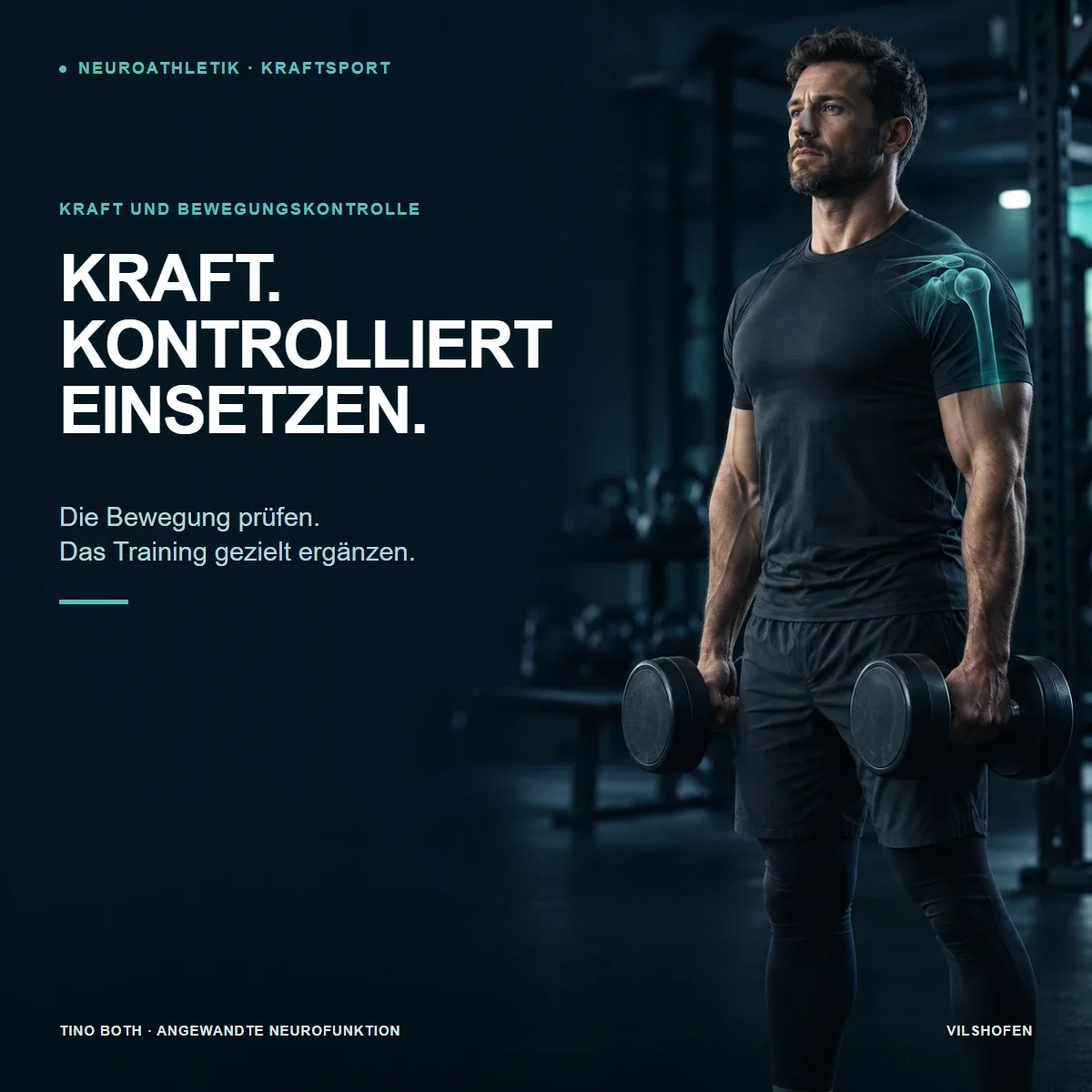
Briefly explained: Neuroathletic training in strength sports considers how perception, coordination and movement execution interact in a specific exercise. It can be a targeted addition to strength training. We assess whether an input is helpful in the same movement — rather than solely through an isolated test or a short-lived feeling of strength.
Do you train regularly, but a movement does not feel reliable?Whether squatting, lifting or pressing: Describe where control, stability or force transfer becomes difficult. We discuss whether an individual assessment in Vilshofen can usefully complement your existing training.
Discuss your strength training question →
The initial telephone consultation is free of charge.
Discuss your strength training question →
The initial telephone consultation is free of charge.
The strength is there — it just does not come together in this movement
One exercise goes smoothly; in another, you are constantly searching for a stable position. The barbell feels uneven. Or you can perform a movement well without added weight but lose confidence even under a moderate load. The general instruction “more tension” then often helps only to a limited extent.
We need to be more precise: Is strength actually lacking? Is the chosen load too high? Is a position not yet well controlled? Or does a particular gaze or body reference change the execution? These questions are not mutually exclusive. A useful comparison shows where you can focus your training.
Muscle strength and how it is used belong together
Strength training challenges the muscles and the control of their activity. A systematic review of cortical activity during strength exercises describes studies of this neural involvement. However, it does not establish a particular additional exercise that makes more strength available to everyone.
In practice, training planning, repetitions that provide sufficient load, learning technique and recovery remain essential. Neuroathletic training does not replace these foundations. It becomes interesting where a clearly selected demand needs closer examination: Holding a position, orientation in space or coordinating a phase of movement, for example.
Not every limit is a “brake in the nervous system”A heavy weight can simply be heavy. Fatigue, training level and unfamiliar technique influence performance. It is not useful to explain every unsuccessful repetition as a hidden protective response. First, we need a clear starting situation.
What does stability mean in your exercise?
“Becoming more stable” can mean different things. In a squat, you may want to reach a controlled depth. In a press, it may mean a reliable bar path. When carrying a load, you want to maintain a position without constantly compensating. We formulate the goal so that a change can actually be recognised.
A useful starting question is specificInstead of “My left side does not work”: “At this load, the barbell drifts to the right in the final third.”
Instead of “My trunk is unstable”: “From the fourth repetition, I lose the agreed starting position.”
Instead of “I need more body tension”: “I hold my breath and become stiff, even though the load is light.”
Instead of “My trunk is unstable”: “From the fourth repetition, I lose the agreed starting position.”
Instead of “I need more body tension”: “I hold my breath and become stiff, even though the load is light.”
A precise description prevents you from collecting more exercises at random. It also helps connect this work with discussions with your coach. Sometimes a technical adjustment or a different load level is already the most useful next step.
An example: A squat feels uncertain
For comparison, we choose a light, well-tolerated variation. Stance width, shoes, surface, weight and movement speed remain as similar as possible. You perform a few repetitions. We record where the movement becomes unsteady, what depth you can control and how demanding the task feels.
Change one condition — then assess the same movementBaseline movement: A few controlled repetitions at a clearly agreed load.
Targeted question: Is foot contact difficult to perceive, for example, or does orientation change when you shift your gaze?
Small input: Depending on the observation, we may choose a brief body awareness task or a clear visual reference point.
Re-test: The original squat then follows with the same instructions. We compare quality, controlled movement range and subjective effort.
Assessment: A difference is assessed repeatedly and later in regular training. The weight is not immediately increased substantially solely because of one good attempt.
Targeted question: Is foot contact difficult to perceive, for example, or does orientation change when you shift your gaze?
Small input: Depending on the observation, we may choose a brief body awareness task or a clear visual reference point.
Re-test: The original squat then follows with the same instructions. We compare quality, controlled movement range and subjective effort.
Assessment: A difference is assessed repeatedly and later in regular training. The weight is not immediately increased substantially solely because of one good attempt.
This is not about closing your eyes during heavy exercises or creating conditions that are as unstable as possible. The task should remain safe and assessable. If a change makes the movement worse, that informs the selection — it is not an instruction to push through.
Why perception is a practical question in strength training
You use information about your position, contact with the ground and the movement of the load. At the same time, understanding the task and practised sequences also contribute. A gaze point can provide orientation without becoming a general rule for every lift. Clearer foot contact can make a movement easier to understand without the foot previously having been “switched off”.
I therefore do not automatically look for the most spectacular input. Sometimes less change is more helpful: A clearer task, a more suitable speed or a better starting position. Further differentiation is worthwhile only if a specific question remains.
When the movement comparison leaves another question open
In my work, Applied Neurofunction includes both neuroathletic training and complementary integration methods. A training stimulus and a targeted contact assessment have different roles. If a particular movement relationship remains unclear, I can explore it through an additional stimulus assessment. A reliable, pain-free indicator muscle is first selected for this. The troublesome shoulder or loaded knee does not itself have to be used for the muscle test.
A targeted stimulus or defined contacts then narrow down the question. If the muscle response changes noticeably, I look for an additional input under which the response becomes stable again. Stimulus alone and stimulus with the addition are repeatedly compared. After integration, I assess the original stimulus again and then return to the agreed movement.
For you, this needs to make a practical difference: Can the movement be performed with greater control? Does the change persist in a comparable repetition? And how does it fit into your training? The muscle test is therefore part of the approach, rather than the sporting training goal.
What follows a good re-test
A short-term change provides a starting point. Further sessions show whether it holds up. We observe whether you can perform the exercise more reliably and how load and recovery develop. An input that becomes increasingly elaborate but makes no difference in training deserves reassessment.
You therefore receive as few tasks as possible, with clear reasons for each. They should be manageable alongside your regular training. If you already follow a plan, it makes sense to coordinate changes with it, rather than beginning every session with new tests.
Pain and new deficits are a different questionNew, significant loss of strength, numbness or symptoms following an injury should be medically assessed. In acute pain, a supposedly activating stimulus is not used to bypass the load issue. We choose a tolerable task for comparison.
Frequently asked questions about neuroathletic training in strength sports
Does neuroathletic training replace my normal strength training?No. It can be a targeted addition. Strength development still requires an appropriate load, regular training and recovery.
Can an eye exercise immediately produce more strength?A short-term change in a movement is possible, but cannot be predicted. It does not yet demonstrate a lasting increase in strength. Repeated assessment in the relevant exercise is what matters.
Should I train with heavy weights on an unstable surface?That is not a general aim of this approach. For a meaningful comparison, the conditions remain safe and as consistent as possible. The choice of surface must fit the specific training task.
Do I need extensive training experience for an appointment?No. A specific movement or question is particularly helpful. The task is adapted to your training level; a maximum strength test is not required.
Would you like to know which addition really helps your training?We discuss your goal and the movement you want to understand more closely. In Vilshofen, the next step is a clear comparison and a realistic transfer into your strength training.
Arrange a free initial consultation about training →
The initial telephone consultation is free of charge.
Arrange a free initial consultation about training →
The initial telephone consultation is free of charge.
Relevant further pages and articles
Looking more closely at movement and trainingNeuroathletic exercises: Why general exercises often are not enough
Neuroathletic training and balance in sport — why balance is more than standing on one leg
Neuroathletic training after injuries — a functional perspective on return to play
Neuroathletic training and balance in sport — why balance is more than standing on one leg
Neuroathletic training after injuries — a functional perspective on return to play
Perception and transfer to sportVisual training in sport — why good vision is more than visual acuity
Neuroathletic training for tennis, handball and ball sports — processing the ball, space and reactions more effectively
Neuroathletic training for elite athletes in Bavaria — when the final few per cent are missing
Neuroathletic training for tennis, handball and ball sports — processing the ball, space and reactions more effectively
Neuroathletic training for elite athletes in Bavaria — when the final few per cent are missing
Relevant areas of focus in VilshofenNeuroathletic training and performance optimisation
My approach: Angewandte Neurofunktion
My approach: Angewandte Neurofunktion
Sources and further reading