

← All articles
Neuroathletic training & performance
Visual training in sport: See more, respond more precisely
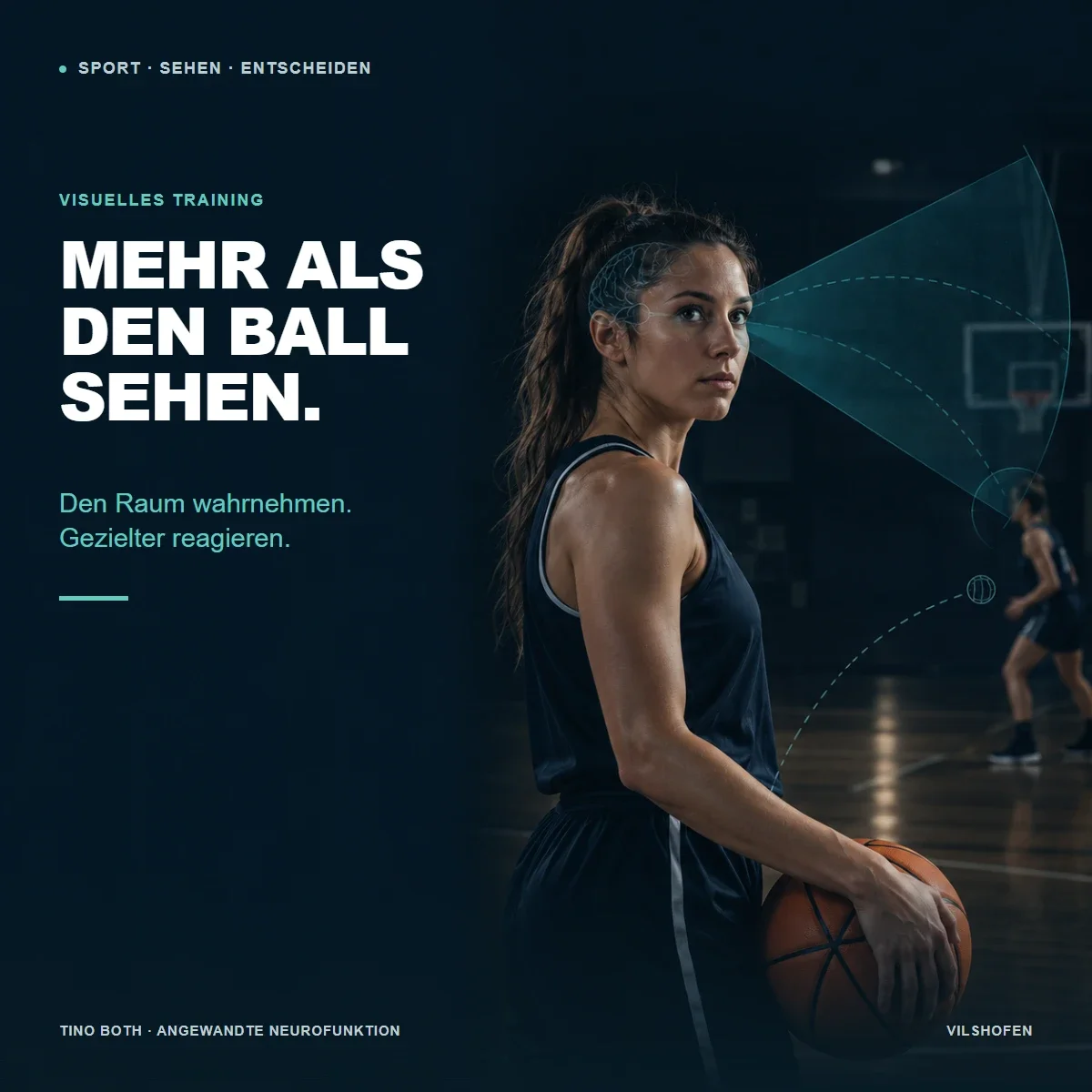
Briefly explained: Visual training in sport addresses more than clear vision: Gaze shifts, gaze stability, peripheral perception and recognising relevant cues in time. What matters is which demand causes difficulty and whether improvement also reaches your sporting task.
Good in the eye test — yet late or without an overview at speed?Describe a typical sporting situation during the free initial consultation. We discuss whether a functional view of vision, orientation and response could usefully complement your existing training.
Discuss your sporting question →
Discuss your sporting question →
You see the ball. But do you also see the next option?
The pass arrives, you receive the ball — and only then notice the unmarked teammate. Technique works in training. As soon as speed and pressure from opponents are added, everything becomes hectic. Perhaps your legs are fast enough. The question is which information you have available in time to use them appropriately.
This is not proof of an eye problem. Experience, tactics, attention, fatigue and technical skills also matter. But it is a good reason to consider vision under the conditions in which the difficulty actually occurs.
Why visual acuity is a foundation — rather than the whole task
A visual acuity test assesses an important ability: Recognising detail. In sport, your own position, head movement, distance and target speed also change. You need to select information and process it during movement. Good glasses or contact lenses can provide the optical foundation; the particular sporting task nevertheless remains demanding.
Seeing a stationary ball clearly does not yet show, for example, how well you notice a teammate to the side, regain orientation after turning or recognise the start of an opponent's movement. Conversely, a good result in a coordination task does not replace necessary vision correction.
Which visual abilities interact in sport
Fixation and saccades: Looking directly and looking around in timeFixation means keeping a reference point in view. Saccades are rapid gaze shifts between targets. In play, the aim is to take in the right information at the right moment, rather than make as many gaze shifts as possible — for example, checking space before receiving the ball.
Pursuit movements: Following a moving targetThe eyes can follow slow, predictable movements. Very fast balls also require gaze shifts and prediction. A ball's flight is therefore not simply tracked continuously through one single eye movement.
Near, far and spatial judgementBoth eyes need to work together at different distances; focusing and spatial cues complement each other. A target directly in front of you creates different demands from a teammate on the opposite side of the pitch. New double vision or marked near-vision discomfort needs professional assessment.
Gaze stability: Seeing while the head movesDuring head movement, vestibulo-ocular responses help stabilise the image on the retina, among other mechanisms. Whether a target is clearly visible when standing quietly or becomes uncomfortable only during head movement therefore represents different assessment conditions.
Peripheral vision: Noticing the space beyond the focusOutside the central point of gaze, we cannot recognise equally fine detail. Nevertheless, movement, position and the appearance of a stimulus can provide important cues. A broad attentional focus and targeted scanning complement each other; nobody needs to see the whole pitch sharply at once.
A possible assessment example: Recognising, deciding or moving?
Imagine a basketball player who often notices passes on the left late. I would do more than repeat catching technique. First, we separate three demands that occur almost simultaneously in play.
Three comparisons for the same apparently 'slow response'Recognising alone: With a stationary central visual target, a clearly visible stimulus appears to the side. The player reports when she notices it. Side, distance and presentation remain comparable.
Recognising and identifying: She now names a simple feature, such as colour. If identifying alone takes longer, this differs from noticing late.
Recognising and acting: Only afterwards is a clear action added, such as a step or passing to a partner. This reveals whether difficulty arises particularly in the transition to movement.
Recognising and identifying: She now names a simple feature, such as colour. If identifying alone takes longer, this differs from noticing late.
Recognising and acting: Only afterwards is a clear action added, such as a step or passing to a partner. This reveals whether difficulty arises particularly in the transition to movement.
If a recurring difference between sides appears under identical conditions, we refine the task: Above or below, a still or moving stimulus, sitting or standing? A new actual visual field deficit needs ophthalmological assessment. In training, we compare performance in an agreed task, rather than the size of a medically measured visual field.
Why even physical input can be interesting in a visual comparison
Vision and movement are not organised independently. Functional assessment can therefore also compare whether targeted physical input changes the visual task. One possible variation is a short, light tactile stimulus on one hand, separate from a small coordinated hand movement. The same lateral recognition task is then repeated.
The interesting question is not 'Does hand training automatically improve the eyes?' It is: Does an observable change remain in this person under otherwise identical conditions? If not, we do not pursue the stimulus simply because the connection sounds theoretically interesting. If so, the sporting task follows again. This second step prevents a good exercise result from being confused with a better overview during play.
From the simplified test back to play
For the basketball player, the next comparison would be a repeatable passing task with the same distances and understandable rules. Movement, an additional decision and finally pressure from opponents are added only afterwards. Errors, correct decisions and reaction time can be considered together. Being faster but making more incorrect passes would not represent clear progress.
Mere repetition can also improve results. A study of peripheral perception in sport explicitly considered such practice and repetition effects. Several initial rounds, comparable conditions and later checks are therefore useful. One better round does not decide everything.
How the question changes with the sport
Football and team ball sportsScanning before receiving the ball, gaze shifts between ball and space and recognising open passing lanes are central. Training should not fix attention permanently on one point when the game task needs changing information.
Combat sportsDistance, movement onset and feints need to be distinguished. A shoulder movement may signal something but need not do so. Controlled partner tasks close to the sport are therefore more informative than assuming a fast finger tap on a light explains the entire ability to respond in combat.
Tennis, badminton and other racket sportsBall flight, opponent movement and anticipatory positioning interact. Gaze behaviour is considered during a serve, return or specific game situation. Isolated tracking of a slowly moving target is a different demand.
Running, cycling and strength sportsFor running, the surface, bends and orientation during steps matter. Cycling adds speed and safety-relevant gaze shifts. In strength training, a visual reference can help positioning. New visual exercises are not tried in road traffic or under a heavy barbell.
How I select a suitable exercise
I begin with a question and a demand you tolerate well. Target size, distance, direction, speed and duration can be varied separately. An easy version can take place sitting with both eyes; a later version connects perception with standing, movement or a decision. Not every possible progression is needed for every goal.
If a task worsens or becomes uncomfortable, that is not an instruction to simply persevere longer. First, we check whether dosage, task understanding, vision correction or extra demands offer an explanation. If necessary, I can differentiate functional relationships further within my method. An indicator muscle is one possible additional comparison measure, rather than a compulsory part of every sporting session.
What you can usefully observe yourself
Four questions for your next training dayWhen does the error occur? At rest already, or only after a turn, in a sprint or under pressure?
Which information is missing? Ball, teammate, free space or the start of a movement?
Does fatigue change anything? Is the task easier at the beginning than at the end?
What happens after simplification? Does less speed, a clear rule or a greater distance help?
Such observations give an appointment more direction than an arbitrary list of eye exercises.
Which information is missing? Ball, teammate, free space or the start of a movement?
Does fatigue change anything? Is the task easier at the beginning than at the end?
What happens after simplification? Does less speed, a clear rule or a greater distance help?
Such observations give an appointment more direction than an arbitrary list of eye exercises.
What research means for training practice
Visual training includes very different procedures. Anticipation tasks close to the sport differ from general screen games or one single eye-movement stimulus. A meta-analysis of training with temporarily occluded sport videos specifically examines recognising sporting actions earlier. This does not create a universal guarantee of success for every visual training programme. Transfer to the specific sporting task remains the decisive criterion for your practice.
When training is not the next step
Sudden vision loss, new double vision, visual field loss or visual disturbances with neurological deficits need immediate medical assessment. Symptoms after a blow to the head also need evaluation; they are not 'trained away' with extra eye exercises. Persistent visual discomfort warrants ophthalmological or orthoptic examination.
Frequently asked questions
Can peripheral vision be trained?Noticing and using lateral information can be practised in a task-specific way. Whether this creates a sporting advantage is checked in the relevant game situation. Medical visual field deficits are a different question.
Which eye exercise is best for athletes?There is no single exercise for everyone. Tracking a ball, scanning in advance, head movement and a decision under pressure make different demands.
Does this also help in amateur and recreational sport?Questions about vision, orientation and suitable movement apply regardless of performance level. Duration and complexity are adapted to your sport and goal.
Does a better reaction test automatically mean better playing performance?No. Accuracy, decisions and the sporting task therefore belong in the comparison. Practice can make a test easier without the game having changed yet.
Which visual demand limits you in your sport?In my work with Applied Neurofunction in Vilshofen, we connect a specific sporting situation with targeted functional comparisons. During the initial consultation, we clarify whether this fits your concern.
Free initial consultation about sporting training →
Free initial consultation about sporting training →
Related pages and articles
Explore vision and orientation furtherGaze stability in sport — why stable eye movements influence performance
Neuroathletic training and balance in sport — why balance is more than standing on one leg
A functional view of visual disturbances and visual processing
A functional view of dizziness & balance
Neuroathletic training and balance in sport — why balance is more than standing on one leg
A functional view of visual disturbances and visual processing
A functional view of dizziness & balance
Your sport and suitable trainingNeuroathletic training & performance optimisation
Neuroathletic exercises: Why general exercises are often insufficient
Neuroathletic training in football — seeing faster, responding faster, deciding better
Reaction training in sport — why fast responses are more than fast muscles
Neuroathletic training in combat sports — perceiving faster, responding better, moving more stably
Neuroathletic training for sports clubs — modern performance assessment in team training
Neuroathletic training for strength sports — when tension, stability and strength cannot be accessed reliably
Neuroathletic training for runners and endurance athletes — moving more efficiently, staying more stable
Neuroathletic exercises: Why general exercises are often insufficient
Neuroathletic training in football — seeing faster, responding faster, deciding better
Reaction training in sport — why fast responses are more than fast muscles
Neuroathletic training in combat sports — perceiving faster, responding better, moving more stably
Neuroathletic training for sports clubs — modern performance assessment in team training
Neuroathletic training for strength sports — when tension, stability and strength cannot be accessed reliably
Neuroathletic training for runners and endurance athletes — moving more efficiently, staying more stable
Sources and further reading
Peripheral Vision Tests in Sports: Training Effects and Reliability of Peripheral Perception Test.
Accelerating Visual Anticipation in Sport Through Temporal Occlusion Training: A Meta-Analysis.
Accelerating Visual Anticipation in Sport Through Temporal Occlusion Training: A Meta-Analysis.