

← All articles
Neuroathletic training & performance
Gaze stability in sport: when the ball slips out of view during movement
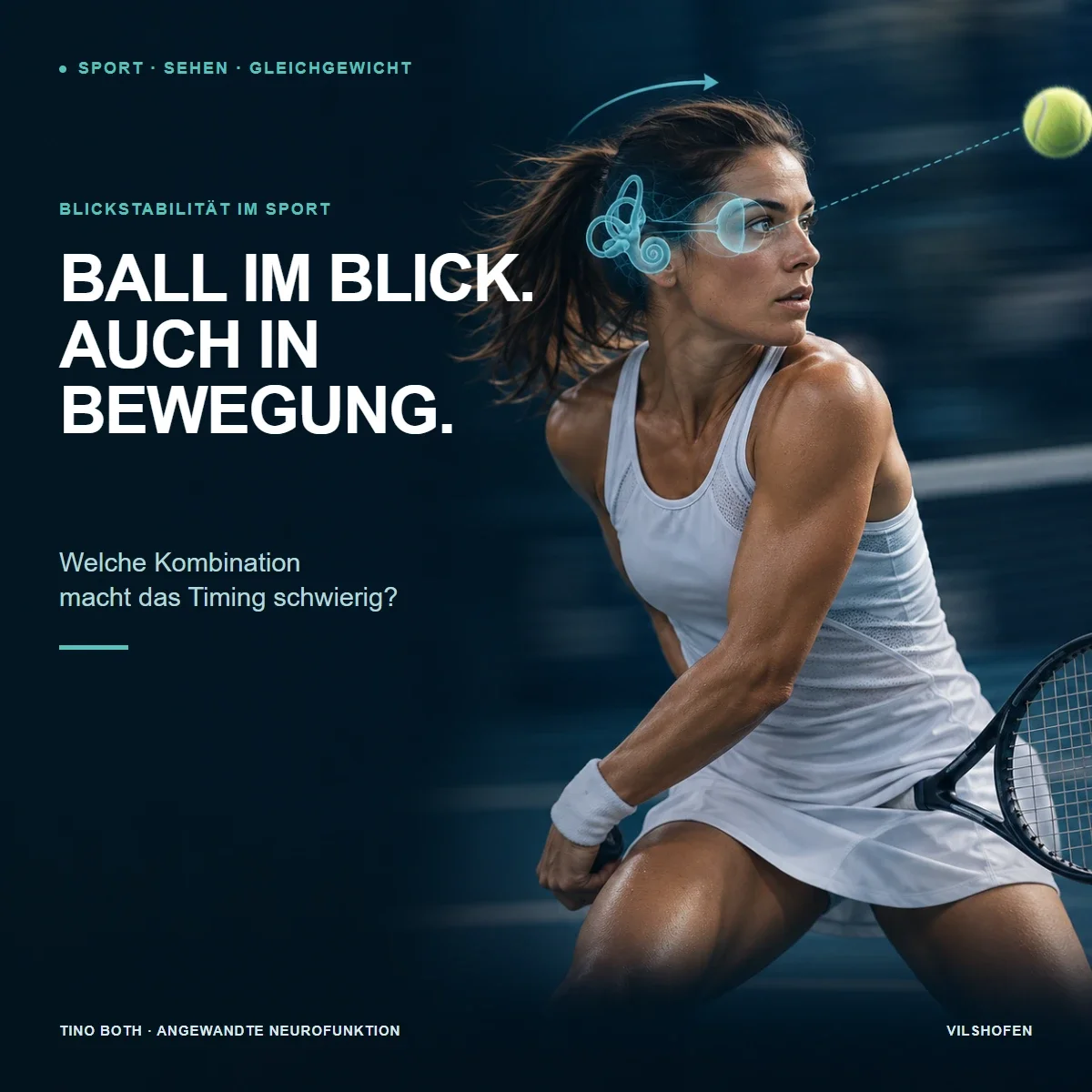
Briefly explained: Gaze stability in sport means taking in relevant information reliably while you are moving. Eye movements, head movement and balance need to suit the particular game situation. A stationary point with a moving head presents a different task from a ball in flight.
It works in calm practice – but you lose your timing during movement?Describe your sport and the situation in which it becomes difficult. In the free initial consultation, we establish whether a targeted assessment of gaze, orientation and sporting movement could usefully complement your training.
Discuss your sporting gaze and movement task →
The initial telephone consultation is free.
Discuss your sporting gaze and movement task →
The initial telephone consultation is free.
You reach the ball. But contact feels too late.
Your return succeeds from a stationary position. After a sideways step, contact is less clean. Everything is controlled with calm passes, but after a turn you briefly lose awareness of the situation. Such differences are quickly labelled technique or reaction problems. They may indeed be related to these areas – but it is worth considering the visual demand too.
The key question is not: ‘Are your eyes good or bad?’ It is: with which combination of target movement, your own movement and decision-making does the task become harder? This question is specific enough to assess practically and open enough to avoid prematurely attributing everything to the eyes.
Three game situations – three different demands
A fixed target, with your head movingYou run and orient yourself using a marker. The vestibulo-ocular reflex, or VOR, supports eye movements in the opposite direction so that the image remains stable despite head movement. The link between the balance organ and gaze control is the main focus here.
A moving target, with your head relatively stillYou take in the flight path of a ball. Slow pursuit movements and quick gaze shifts have different tasks. With very fast balls, the eyes cannot simply ‘stick’ to the ball continuously; prediction and sporting experience also play a part.
The ball, head and body move at the same timeYou run sideways, turn your head and prepare the shot. Target tracking, stabilisation and movement preparation now need to work together. Depending on what moves relative to you, a reflex needs to be supported or its effect adjusted. More VOR activation is therefore not automatically better.
This very change explains why a single exercise on the wall does not represent the whole sporting task. An athlete may keep a letter clear during head movement yet still miss important game information during a change of direction. Equally, not every imprecise ball contact indicates a problem with gaze stabilisation.
What we record in a functional comparison
The starting point is a repeatable task from your sport that is not maximally difficult. For example, several controlled passes to the same side, once while stationary and once after a specified step. Contact point, errors, orientation, subjective image clarity and the feeling of movement are of interest. Ball speed, distance and sequence should remain comparable.
Better exercise performance needs to transfer to sportBecoming faster in a visual test does not automatically improve your return. Research on visual training shows different results and limits to transfer depending on the type of training. The original sporting task and later training sessions therefore belong in the assessment – alongside the immediate test improvement.
An example: after a look over the shoulder, the next step falters
One possible starting point: a player can move sideways and receive the ball reliably. If a look over her left shoulder is added immediately beforehand, the next step feels held back. We initially compare the components: head movement without the ball, a gaze shift without a large head turn, and then the agreed combination. This turns ‘too slow’ into a precise question.
For an additional stimulus assessment, I choose an indicator muscle that can be tested without pain and with a stable response. It may be in the arm, even though the problem appears when starting to move. After the specific gaze-head task, its holding response is assessed. If reproducible inhibition appears, the relevant relationship is explored: for example, processing head movement, sensory information from the neck or the link to eye control.
The solution need not lie in the eyeA specifically selected assessment pathway in this additional contact-based test can also include cranial tissue relationships, such as contact around the sphenoid bone. The sphenoid forms part of the skull and eye socket. The contact is a targeted test condition, rather than a claim that the bone is ‘displaced’.
The comparison now follows: the gaze-head task alone, then the same task together with the selected contact. If the indicator muscle response stabilises only under the second condition, this combination is reassessed and, where appropriate, integrated. The original task then needs to be considered again without the additional contact.
The comparison now follows: the gaze-head task alone, then the same task together with the selected contact. If the indicator muscle response stabilises only under the second condition, this combination is reassessed and, where appropriate, integrated. The original task then needs to be considered again without the additional contact.
The sequence may matter: a brief preparatory contact, the precisely specified eye-head task and the integration stimulus. The aim is not to touch as many places as possible at once. It is to work on the relationship found in a way that can be understood. Only then do we compare the look over the shoulder again with the next step and receiving the ball.
If the arm test becomes more stable but the sporting task remains unchanged, the sporting goal has not yet been reached. If a helpful difference appears, it can lead to a small, suitable training task. Integration and repeated practice in sport serve different roles here.
How this becomes manageable training
Only one demand is changed to begin with. Options include a different target distance, a smaller head turn, a calmer background or a slower pass. The next component is added only when the task succeeds clearly and is well tolerated. This makes it possible to see whether the athlete benefits from the addition or simply becomes better at handling an artificial drill.
In tennis, the comparison may involve a controlled return; in handball, receiving after a turn; in football, the scanning glance before receiving the ball. The shared principle is the same decision-making approach, rather than the same eye exercise: describe the demand, consider component functions, choose a suitable change and reassess the sporting task.
What you can usefully observe yourself
During normal training, notice whether errors occur particularly after head movements, when switching sides or under particular lighting. Distinguish image blur from a tactical decision error and from a lack of technical confidence. A short description or existing training footage may be more helpful in the consultation than a long list of exercises you have tried.
Do not try to induce dizziness deliberately or perform fast sporting movements with your eyes closed. If a stimulus worsens orientation, that is not evidence of performance. The task needs to be selected so that a safe comparison remains possible.
Eye care and symptoms after head injuries
Recurring blurred vision, double vision or dizziness require appropriate professional assessment. After a head impact or suspected concussion, medical assessment and return-to-sport guidance apply; an unremarkable functional test does not provide clearance. Suitable vision correction and, where needed, eye protection are also part of the sporting foundation.
Frequently asked questions about gaze stability in sport
Can I train gaze stability?Depending on your starting point, targeted visual and vestibular tasks can be useful. Appropriate selection, tolerance and transfer to your sporting task are what matter.
Is tracking a ball the same as VOR training?No. The VOR concerns gaze stabilisation during head movement. Tracking a moving target presents different demands. Several forms of gaze control need to work together in a game.
Why is an arm muscle tested when assessing vision?In this additional assessment, a suitable indicator muscle provides a comparison response to a defined task. Whether the relevant sporting movement changes is also assessed.
Does neuroathletic training replace technique training?No. The functional approach complements your training by asking which perception or movement combination is currently difficult. Technique, tactics and physical prerequisites remain essential.
Your game remains the benchmark
An eye exercise does not need to look spectacular. It needs to suit the difficult situation. The particular value of a differentiated assessment lies in finding out whether the problem is already visible in a component function or only in their combination. This is precisely what produces an individual approach rather than an arbitrary extra programme.
Would you like to know which combination makes your timing difficult?In Vilshofen, we consider your gaze and movement task with a sport-specific goal. In the initial consultation, you describe what succeeds in calm practice and under which conditions it becomes difficult.
Discuss neuroathletic training for your sporting task →
The initial telephone consultation is free.
Discuss neuroathletic training for your sporting task →
The initial telephone consultation is free.
Related pages and articles
Explore your sport furtherNeuroathletic training in ball sports: see, decide and respond appropriately
Neuroathletic training exercises: how to find out what suits you
Balance in sport: why single-leg standing alone is not enough
Neuroathletic training exercises: how to find out what suits you
Balance in sport: why single-leg standing alone is not enough
Explore gaze control furtherVOR explained simply – why the vestibulo-ocular reflex keeps gaze stable
VOR-C and fixation suppression: when gaze moves with the head
Functionally assessing eye movements – why an indicator muscle shows more than observation alone
VOR-C and fixation suppression: when gaze moves with the head
Functionally assessing eye movements – why an indicator muscle shows more than observation alone
Relevant areas of focus in VilshofenNeuroathletic training and performance optimisation
Visual disturbances and visual processing
My approach: Angewandte Neurofunktion
Visual disturbances and visual processing
My approach: Angewandte Neurofunktion
Sources and further reading
Training vision in athletes to improve sports performance – systematic review
IOC consensus: Sports-related ophthalmology issues in elite sports
NIDCD: the balance system and gaze stabilisation
IOC consensus: Sports-related ophthalmology issues in elite sports
NIDCD: the balance system and gaze stabilisation