Visual difficulties & visual processing

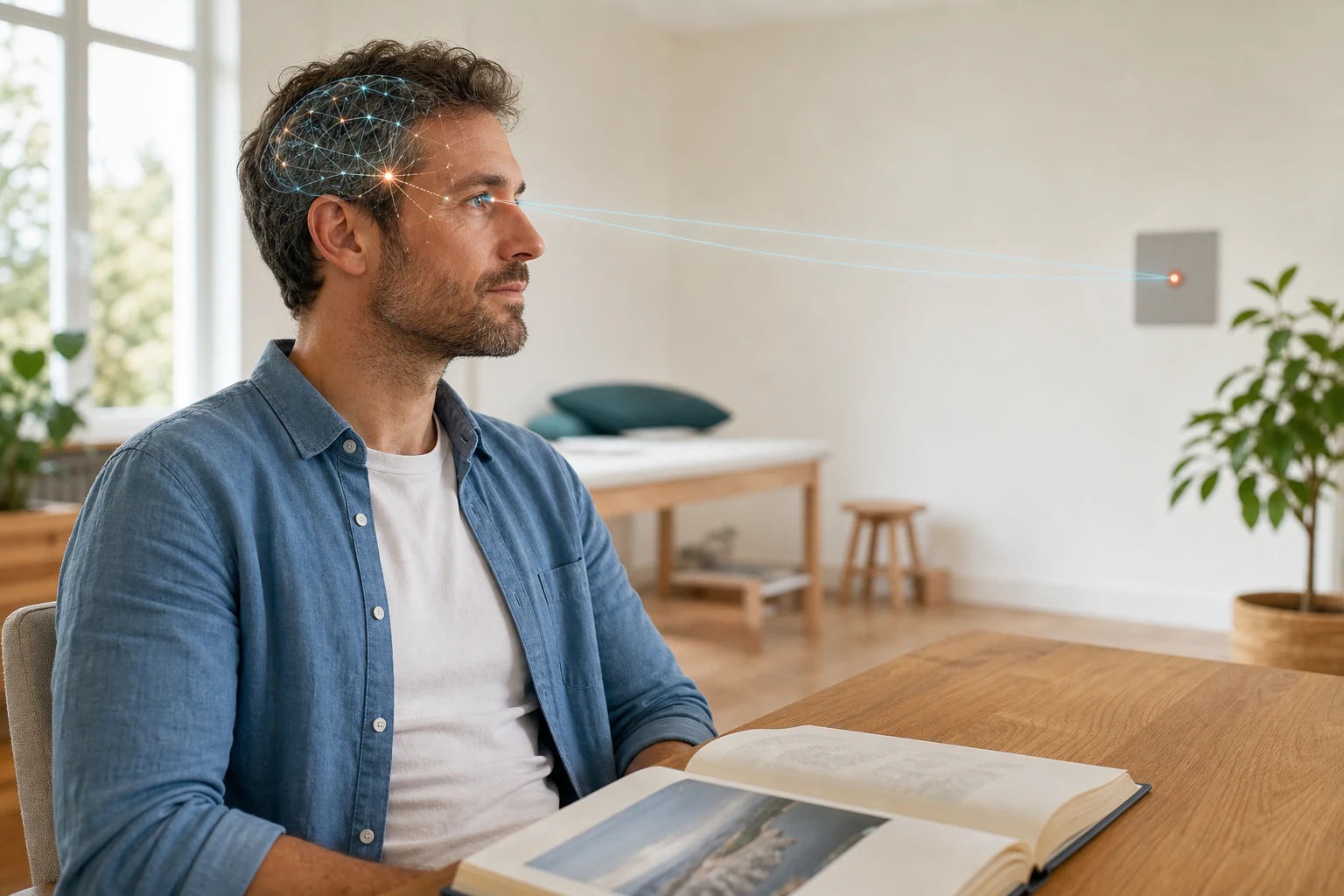
Illustration of a functional assessment of visual processing between near and distant targets

When seeing takes effort.

Is reading, screen work or looking into the distance difficult? A gaze shift shows which functions I assess and how I work on them.

AI illustrations · no real client scenes.

One example · five steps

From the screen to the distance

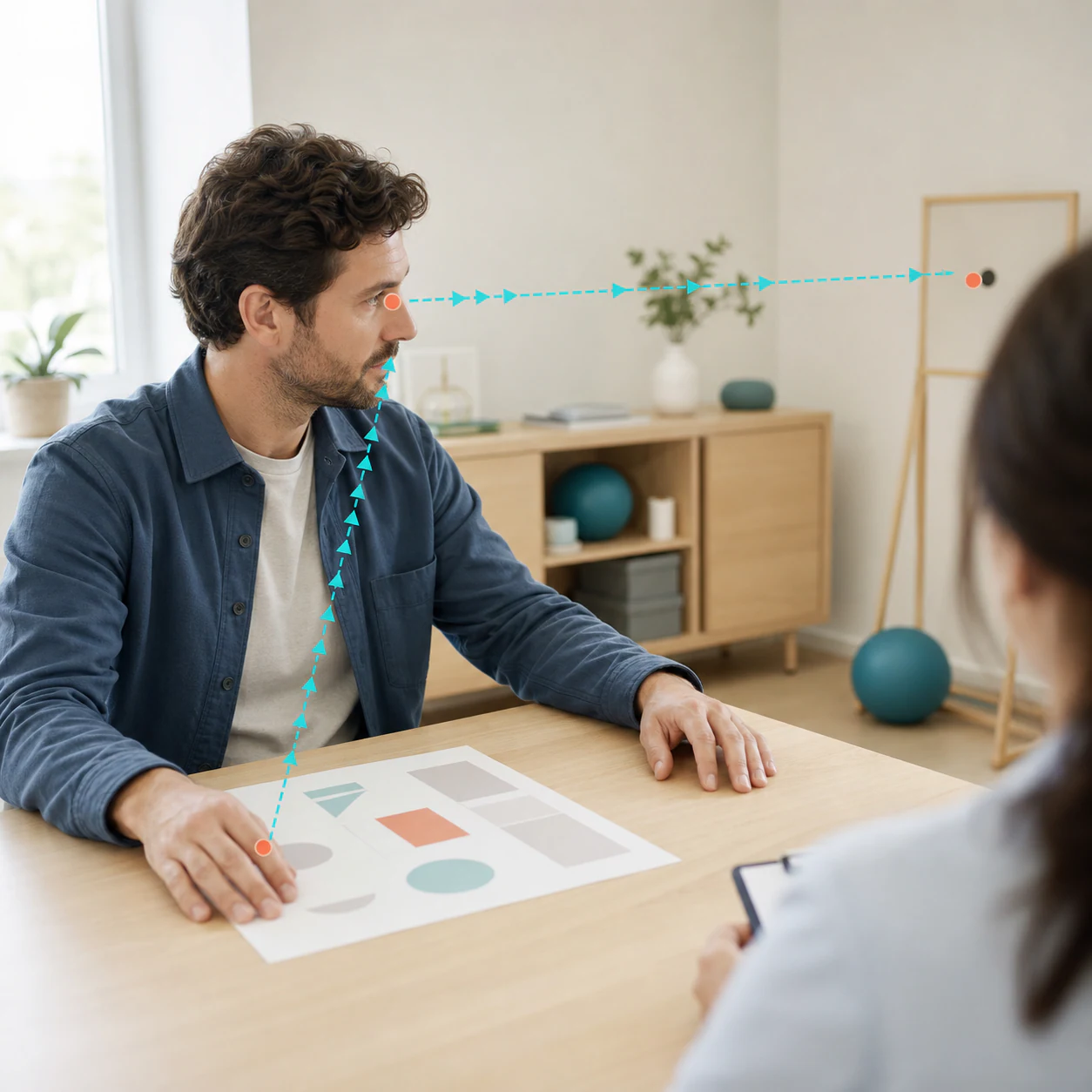
Illustration: shifting gaze from a nearby screen to a distant targetInitial task
Compare near and far under defined conditions.

Step 01

Looking into the distance feels difficult.

We shift from the screen to a distant target. Does the image become clear, does it remain stable, and how much effort does the shift take?

Step 02

What does this gaze shift require?

I consider the individual functions and the conditions in which they work together:

  1. Focus
  2. Align both eyes
  3. Direct the gaze
  4. Head and balance
  5. Autonomic regulation

Combinations matter too: what changes with head position or an additional balance demand?

Step 03

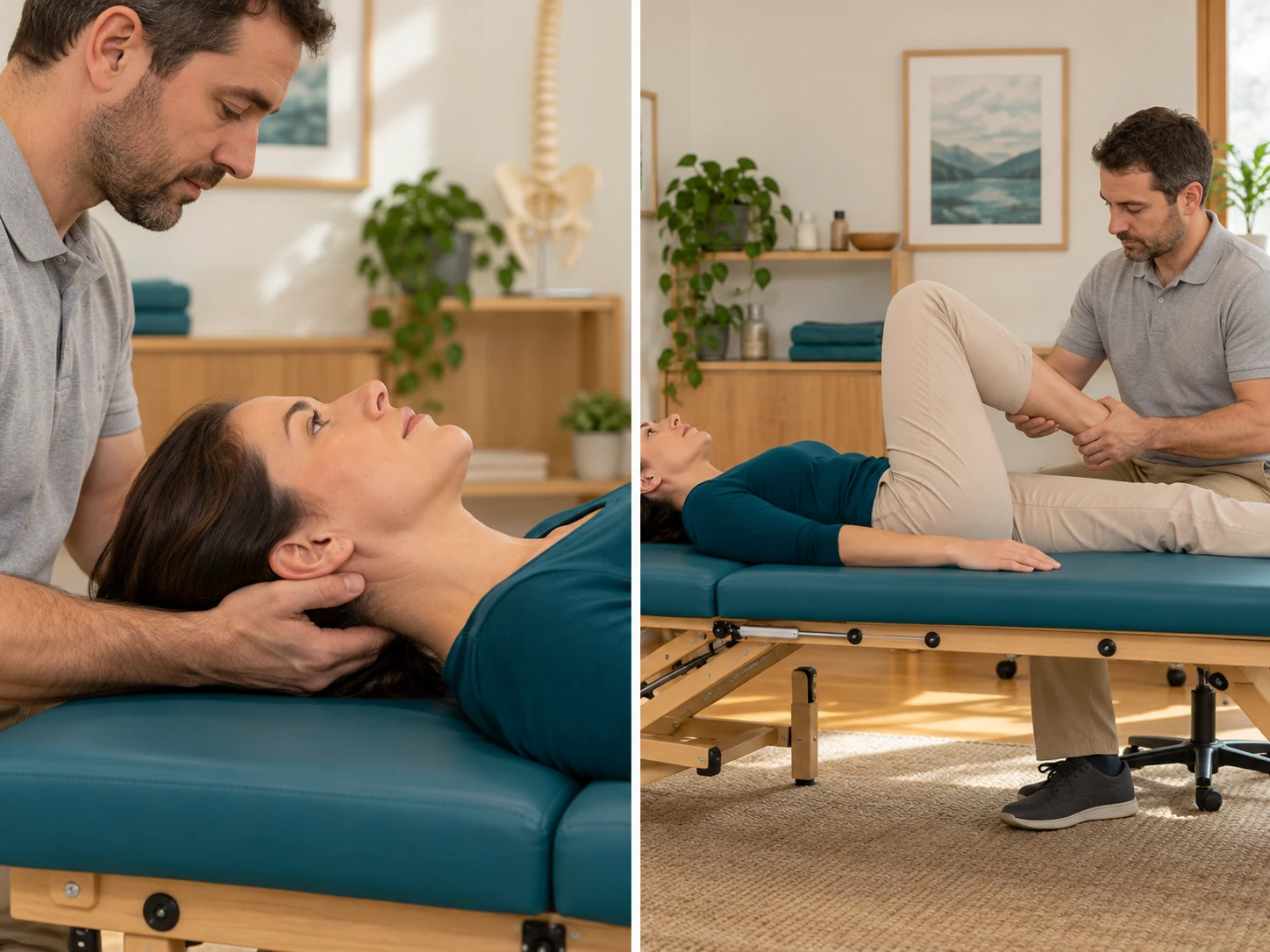
Explore sensory input from the neck.

One possible example on the examination couch: I position the head in extension and compare the response in a muscle test, such as a hamstring test.

An example selected to match the findings.

04 / 05

Return to the screen and the distant target

I connect a helpful response with the particular function or combination that was difficult. We then return to shifting between near and far.

05 / 05

Compare the same visual task again

The same targets, distances, lighting and corrective lenses: we compare clarity, stability and effort.

Step 04

Which visual task feels difficult?

In a free first conversation by telephone, we discuss your visual difficulties and existing findings. Together, we consider whether my functional approach fits your concern.

In-person appointments: Allinger Straße 18, 94474 Vilshofen an der Donau.

Arrange a free first conversation

Explore further

Would you like to understand the approach in more detail?

The example shows one possible approach. Explore the functions, other situations and common questions below.

Read moreHow I approach this concern

Does reading or screen work feel tiring? We begin with a specific task during which you notice the difficulty. I assess which functions show unusual responses and test suitable inputs and techniques. I pair a helpful approach with the previously difficult task. We then compare the same task again — for example, shifting your gaze or keeping your place on a line.

  • Fixation & clarity
  • Saccades & smooth pursuit
  • Near & far
  • Binocular vision
  • Peripheral vision & visual flow

Explore my method →

Explore furtherThe functions in this example

Visual perception and eye movement

Accommodation, vergence, fixation and saccades are considered in relation to the specific visual task. Visual perception, eye movement control and the mechanical conditions of eye movement are possible assessment areas.

Neck, balance and regulation

I also assess neck movement, balance and autonomic regulation. I compare responses to individual demands and to their combination.

The example on the examination couch

In this assessment I change the head position towards extension and compare a selected muscle test, for example a hamstring test. This provides a functional observation. The original visual task is then assessed again; the muscle test alone does not establish the cause of a visual symptom.

Explore furtherSimilar visual difficulties can involve different functions

The everyday situation gives us a starting point

Similar visual difficulties can involve different functions

That is why the approach is not simply to “train the eye”. We break down the observable pattern until it gives us a specific question that can be tested.

You lose your place while reading

Relevant areas include the stability of fixation after a saccade and the accuracy of horizontal eye movements, smooth tracking along a line, how both eyes work together and when accuracy or endurance starts to decline.

Switching between near and far is slow

Here we assess clarity at both distances and the time needed to focus, accommodation, vergence and changes between a near and distant target separately.

An image becomes double or unstable

Distance, direction of gaze and head position are recorded precisely. We then compare one eye with both eyes, convergence, divergence, fusion and possible suppression of an image.

Patterns, people and movement feel overwhelming

Central fixation, peripheral awareness, visual search, optic flow and their relationship with balance and head movement help show which information from the environment becomes too much.

The first minute is fine — then quality drops

Speed, endurance and accuracy are considered separately. This shows whether finding a target takes too long, landing on it becomes increasingly inaccurate or it can only be held steadily for a short time.

Explore furtherVisual processing influences orientation, posture and movement

Seeing does not stop at the eye

Visual processing influences orientation, posture and movement

The visual system constantly works with balance, information from the neck, body awareness and motor planning. This is why a visual difficulty can be felt in a different part of the body.

Gaze stability & balance

If the image does not stay stable during head movement, or moving environments become too dominant, this may show up as swaying, disorientation or unsteady walking.

Explore dizziness & balance →

Eyes, neck & posture

Eye and head movements are organised together. Imprecise eye control may contribute to additional head movement, tension or an unusual sitting or working position.

Explore Applied Neurofunction →

Reaction & sporting performance

In sport, relevant targets need to be noticed early, saccades completed accurately and peripheral information quickly translated into an appropriate movement.

Explore neuroathletic training & performance →
Expert detailVisual functions in detail

Seeing is a chain of decisions

A sharp image is only one of several visual abilities

For reading, screen work, orientation and movement to feel easy, the nervous system needs to receive visual information, stabilise it, shift between targets, combine it and translate it into an appropriate action.

Hold a target

Fixation

Keep a visual target steady and clear without increasing tension.

Switch targets

Saccades

Move the eyes quickly and accurately from one point to the next and settle there steadily.

Follow movement

Smooth pursuit

Follow a moving target smoothly, without jerky corrections or accompanying head movement.

Adjust focus

Accommodation

Switch quickly between near and far and bring the new distance into clear focus.

Bring both eyes together

Vergence & fusion

Align both eyes at the same distance and combine their input into a stable image.

Take in the surroundings

Peripheral vision

Notice movement, space and relevant cues outside the central visual target in time.

Movement in the environment

Visual flow

Process moving patterns and your own movement through space without losing orientation.

Translate vision into action

Eyes–head–body

Coordinate eye control with posture, balance, walking, reaction and movement.

The key distinction: A conventional eye test answers important questions about visual acuity and eye health. Applied Neurofunction adds another question: which visual function becomes unstable, slow or easily fatigued in your particular everyday situation?
Explore furtherTurning a visual difficulty into a clear assessment process

Test, integrate, repeat under the same conditions

Turning a visual difficulty into a clear assessment process

We first establish which visual task causes difficulty. I then assess relevant individual functions and work directly on unusual responses. I pair a helpful approach with the previously difficult task, then compare the result.

Define the everyday situation

Reading, screens, near–far changes, supermarkets, sport or movement: the particular moment determines which function is relevant.

Record the starting point

Distance, target size, lighting, visual correction, direction of gaze, head position, speed and duration are set so they can be repeated identically later.

Isolate a function

Fixation, saccades, smooth pursuit, accommodation, vergence, fusion, peripheral vision or visual flow are assessed separately and through useful comparisons.

Find an input for each difficulty

For each function that stands out, we separately test which targeted input directly improves it. For eye movements, suitable starting points are often found in the brainstem networks that control them.

Integrate the findings

I deliberately pair an approach that proved helpful during testing with the input or task that previously produced an unusual response. This is the integration step. We then assess the same visual task again.

Re-test the original function identically

The original visual task is repeated under the same conditions: accuracy, clarity, time, errors, endurance and perceived effort are compared.

The session does not automatically end with an exercise programme. Often the functions that stand out are addressed and integrated directly. Suitable exercises are only selected and introduced into everyday life if additional visual training is needed.

Expert detailThe visual functions I assess

From clarity to visual search

Which functions can be assessed when vision is difficult?

Distance, target size, lighting, visual correction, head position, direction, speed and duration remain comparable. This is essential for identifying which variable actually changes the function.

Clarity & fixation

Near and far, both eyes and each eye individually: does the target stay clear and steady, or does it begin to drift?

Saccades

Accuracy, latency, corrections and fixation after landing are compared horizontally, vertically and diagonally.

Smooth pursuit

Can a target be followed smoothly? Jerking, corrective saccades, accompanying head movement and directional differences become visible.

Near–far & vergence

Changes in clarity, the near point of convergence, recovery and the combined image from both eyes are assessed under standardised conditions.

Peripheral vision & search

Sides, quadrants, range, reaction time and search strategy are compared while central fixation remains stable.

Movement & integration

Visual flow, head movement, the eyes–head sequence and standing, walking or the actual everyday task connect the individual test with overall performance.

Explore moreThree everyday examples

Three example assessment pathways

From a visual difficulty to a precise functional question

These scenarios show how very similar difficulties can be broken down through completely different visual functions. The individual route depends on the person's starting pattern.

Functionally assessing near–far changes and precise saccades

Scenario 1 · Reading and near–far changes

Reading starts clearly — after a few minutes you lose your place

Typical everyday pattern
Short texts are manageable, but as time passes words blur, line changes become inaccurate and the head feels tired. Switching from the screen to the distance takes noticeably long.
Neurofunctional screening
The same text is read at a fixed distance, with the same lighting and visual correction. Errors, speed, comfort and the point at which quality declines provide the starting measurements.
Detailed assessment
Fixation duration and stability after landing, horizontal saccades between word targets, smooth pursuit along a line, near–far changes in clarity and the coordination of both eyes are compared individually.
Solution, integration & re-test
The functions that stand out are examined one after another through testing and re-testing. For fixation, saccades, smooth pursuit and near–far control, we look for an input that directly improves that particular function. As eye movements are largely controlled by brainstem networks, suitable starting points are often found in this area. The identified inputs are integrated; the same line of text, distance and reading duration are then assessed again, including target accuracy, error count and time until fatigue.
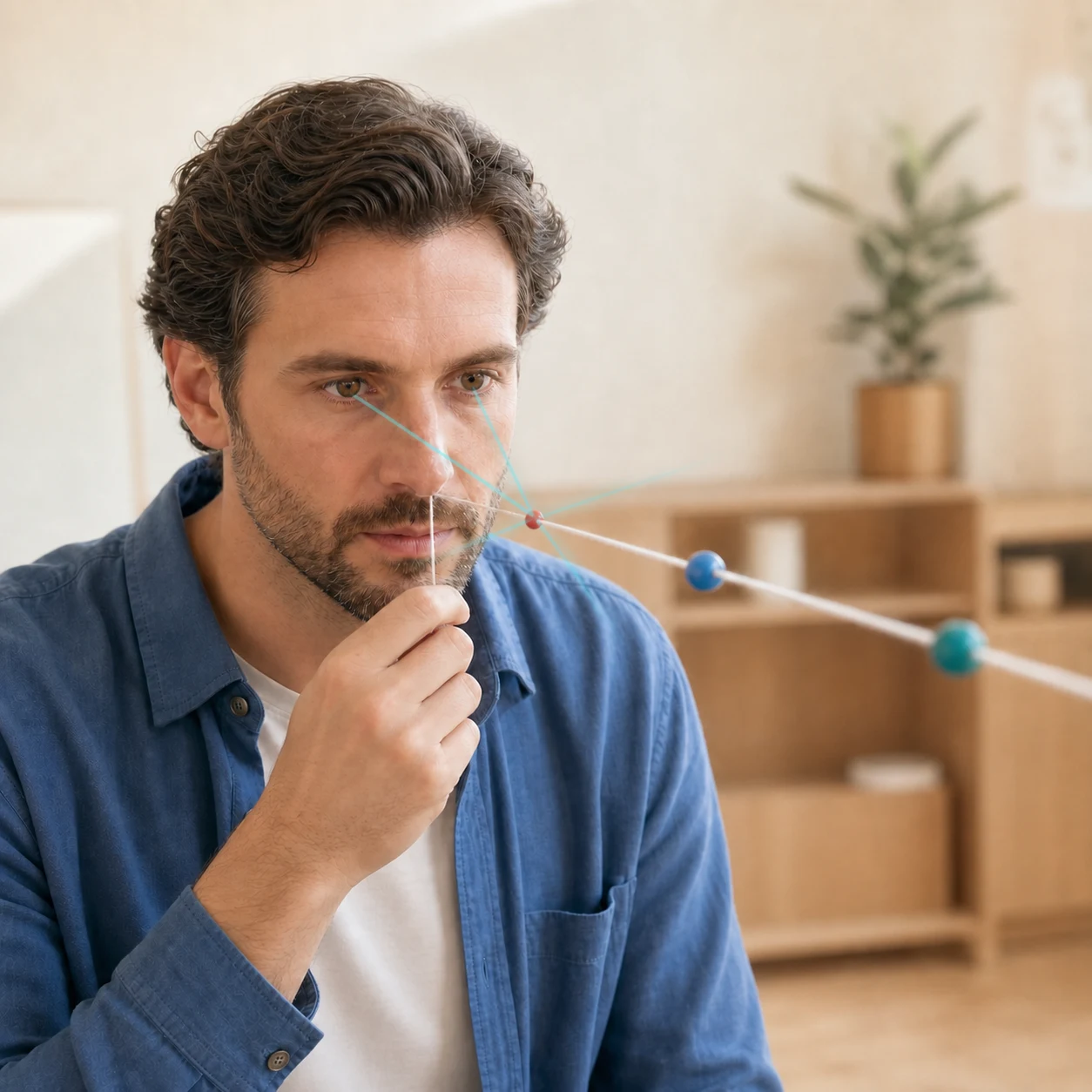
Brock string held by the client at the nose and extending straight ahead into depth

Scenario 2 · Both eyes working together

An image only becomes unstable or double at a particular distance

Typical everyday pattern
Vision works at close range, but at a middle or greater distance the image begins to drift — or the reverse. Fatigue, direction of gaze or head position changes the pattern.
Neurofunctional screening
Distance, direction and onset are recorded precisely. Comparing both eyes with each eye separately shows whether the strain only arises from combining the two images.
Detailed assessment
The near point of convergence, including break and recovery, vergence at different distances, possible suppression and head and neck position are considered separately. With the Brock string, the client holds one end at the nose and the string extends straight forwards into depth. While a bead is fixated, we assess whether both images form a clear “X”, crossing exactly at the bead being viewed.
Solution, integration & re-test
Findings in convergence, divergence, fusion or suppression are examined individually. For each function that stands out, we look for a suitable input through testing and re-testing and integrate it. The Brock string is then assessed again under the same conditions, along with the distance and direction of gaze that originally caused difficulty.
Assessing peripheral vision and visual processing in a moving environment

Scenario 3 · Peripheral vision and visual flow

People, patterns and movement quickly feel overwhelming

Typical everyday pattern
Supermarkets, scrolling on a screen or busy environments lead to pressure in the head, reduced concentration, unsteadiness or a need to narrow the visual field considerably.
Neurofunctional screening
Central fixation is first compared in a quiet setting, then with peripheral targets, visual search or a small moving background.
Detailed assessment
Left, right, upper and lower peripheral vision, reaction time, search strategy, optokinetic directions, visual field size and the relationship with head movement, standing and walking are assessed separately.
Solution, integration & re-test
Quadrants, optokinetic directions, central fixation, visual search and their relationship with head movement, standing and walking are examined as individual functional difficulties. For each finding, we look for an input that directly improves the relevant function on re-testing. Successful inputs are integrated; the same search task or visual environment is then repeated with identical speed and background.
Explore furtherWhen does seeing become tiring for you?

When does seeing become tiring for you?

In a free first conversation, we discuss the everyday situation in which your difficulties arise and whether a functional assessment of visual processing would suit your concern.

FAQ

Common questions about visual difficulties and visual processing

Can visual difficulties persist despite a normal eye examination?

Yes. Visual acuity and eye health may be normal while individual functions such as fixation, saccades, smooth pursuit, near–far changes, binocular coordination or processing moving environments still show difficulties.

How does this differ from an ophthalmological or orthoptic examination?

Ophthalmological and orthoptic examinations assess important medical, optical and binocular findings. Applied Neurofunction adds a view of actual functional performance: how accurately, quickly and sustainably does a visual function work, and how does it affect reading, posture, balance or movement?

What does visual processing mean?

Visual processing describes how the nervous system selects, stabilises and spatially organises visual information and connects it with action. It includes holding targets, shifting gaze, following movement, adjusting between near and far, combining the images from both eyes, peripheral vision and visual flow.

Why can reading and screen work become so tiring?

During reading, the eyes need to hold fixation, move accurately to the next word and settle there steadily again. Near focus, both eyes, following lines and endurance work together at the same time. Even one function that is imprecise or fatigues quickly can make the whole reading process more demanding.

Why are both eyes assessed together and individually?

The comparison shows whether a task is already difficult with one eye or only becomes difficult when the two images are combined. This helps distinguish monocular clarity, eye control, vergence, fusion and possible suppression more precisely.

Can eye movements influence the neck, balance or movement?

Yes. Eyes, head, balance and body awareness are organised together in everyday life. Visual tasks may therefore change accompanying head movement, tension, standing, walking or spatial confidence. Where relevant, they are assessed in exactly this combination.

When should a visual difficulty be assessed medically first?

Sudden loss of vision, new persistent double vision, loss of part of the visual field, a painful red eye, an eye injury, flashes of light with a new “curtain” or accompanying neurological symptoms require prompt medical assessment.

Explore moreExplore individual visual functions
Your data. Your decision.

What would you like to allow?

This website works without optional services. With your permission, Matomo on our own webspace helps us understand website use, and Google Ads helps us measure advertising. Spotify plays music directly on the page.

Regardless of your choice, we count page views on the server as anonymous daily totals, without a visitor identifier. More about basic statistics.

Matomo processes a random visitor identifier and usage data on our webspace. Google Ads and Spotify may also transfer data to the USA. Optional services may store information on your device. You can change your choice at any time using ‘Privacy settings’ in the footer.

Necessary functionsAlways active