

← All articles
Vision & visual processing
Gaze stability: why seeing during movement can become difficult
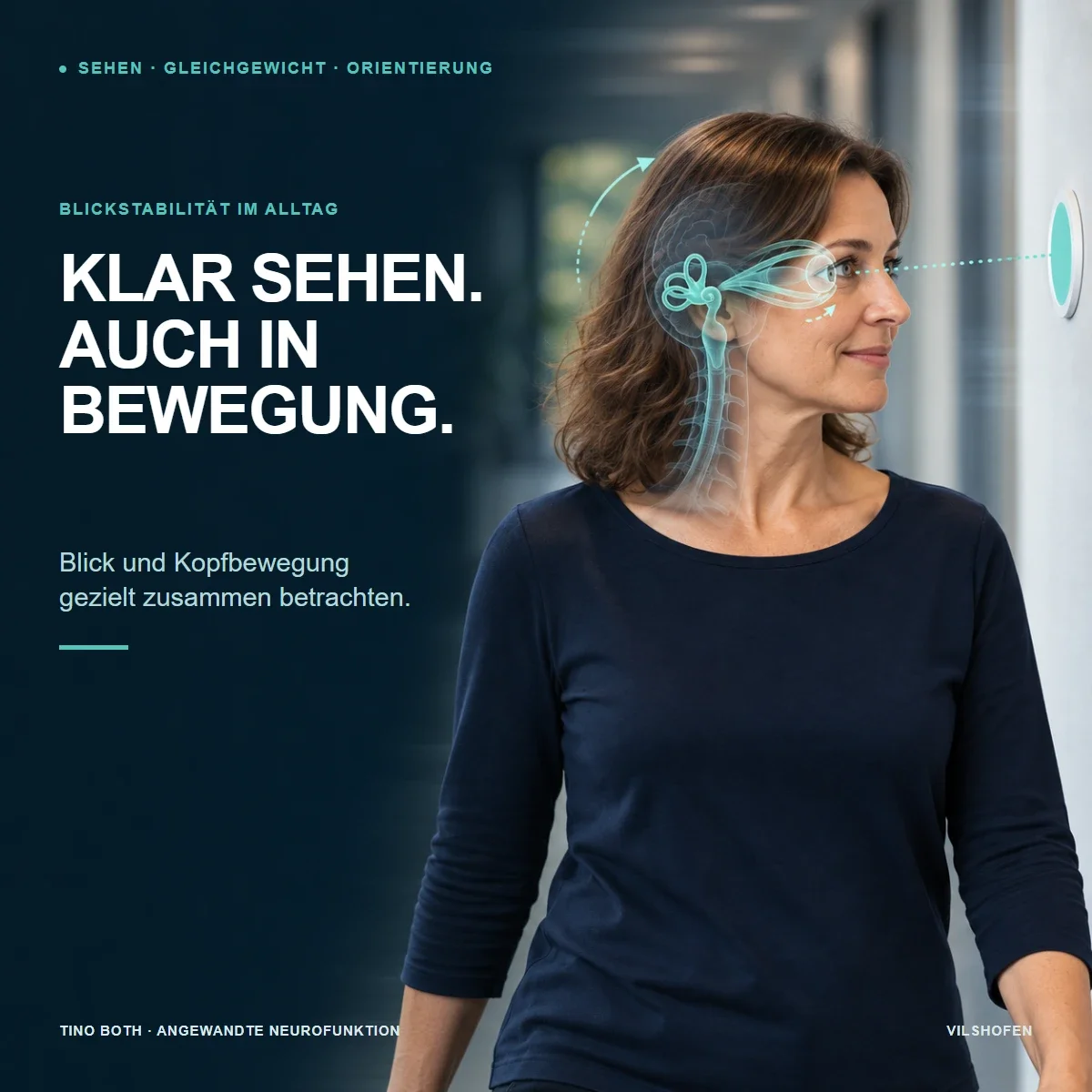
Briefly explained: Gaze stability means keeping a target sufficiently clear in view despite your own movement. Eye movements, information from the balance organ and head movement need to work together for this. Good visual acuity while sitting therefore does not tell us everything about how safely you orient yourself while walking.
Sharp while sitting – but the image becomes unsettled while walking?Once your vision correction has been checked and symptoms have been assessed, we can look more closely at which combination of gaze and movement remains difficult. In the initial consultation, you describe a typical everyday situation. Together, we clarify whether a functional perspective in Vilshofen fits your concern.
Arrange an initial consultation about gaze stability →
The initial telephone consultation is free.
Arrange an initial consultation about gaze stability →
The initial telephone consultation is free.
You can read the sign – until you move
You read the line easily while sitting on a chair. As you walk down the corridor, signs seem less clear. You slow down, hold your head still or briefly stop to recognise something. Perhaps the image is not noticeably blurred, but looking and walking at the same time takes unusually intense concentration.
A more precise question than ‘how well can I see?’ is useful here: Under which conditions does seeing work – and when does it become difficult? The answer may differ depending on whether you move your own head, a target moves past you or many people are moving around you.
Why gaze needs to compensate for head movement
Imagine looking at a house number and turning your head slightly to the side. If the eyes simply moved with the head, the image of the number would travel across the retina. Eye movements in the opposite direction help keep the target represented. One mechanism involved is the vestibulo-ocular reflex, or VOR: information about head movement from the inner ear supports the appropriate eye movement.
You do not need to calculate this compensation consciously in everyday life. It is continuously coordinated with other visual and movement demands. The US specialist institute NIDCD describes the interaction of the inner ear, vision and information from the body as the basis of balance and orientation.
Gaze stability is not the same as glasses prescription strengthSuitable glasses provide important optical conditions. How you stabilise your gaze during movement may also be relevant. Conversely, new blurring should first be checked optically and, where appropriate, by an ophthalmologist. Not every blurred image is a balance system problem.
Four situations that should be kept separate
1. Head and target remain stillIs even reading a stationary word demanding? Vision correction, cooperation between the eyes, near vision and holding gaze are the initial priorities. A rapid head movement exercise would not be an obvious first step for this.
2. The head moves while the target stays stillDoes a sign briefly become unclear when walking or turning your head? Gaze stabilisation during your own movement is an appropriate question here. A professional examination may, for example, compare visual acuity with and without standardised head movement. This is called dynamic visual acuity.
3. A target moves while the head stays relatively stillYou track a ball or a passing bicycle with your eyes. This involves different demands, including smooth pursuit and gaze shifts. It is not simply the same test as reading a stationary symbol with a moving head.
4. Many things move at the same timeOn a station platform or in a shopping centre, movement from different directions is added. The difficulty may lie more in selecting relevant information and making sense of your own movement. A single target in a quiet room only partly represents this demand.
How ‘somehow unsteady’ becomes an assessable task
In my work with Applied Neurofunction, we begin with your specific goal. Would you like to look towards someone during a walk, read labels in the supermarket or recognise a teammate in sport? From this, we choose a manageable starting task. We assess not only visible eye movements, but also your feedback: does the target remain clear? Do you feel uncomfortable? How quickly does that settle again?
We then change just one demand wherever possible. This makes the response meaningfully comparable. Making everything harder at once – faster head movement, a smaller target and a busy background – would tend to obscure the decisive question.
One possible example: looking to the side makes walking unsteadyStarting point: In a safe setting, we compare holding gaze while sitting with a small, well-tolerated head movement. If appropriate, a short walking task with safety support follows.
Targeted stimulus: Based on the observations, we choose one low-dose visual or movement task. Target size, distance and speed are adapted to your response.
Re-test: We then repeat exactly the original task. Clarity, stability and effort matter, not just whether an exercise was technically ‘completed’. As things progress, what counts is whether the gain carries over to your usual route.
Targeted stimulus: Based on the observations, we choose one low-dose visual or movement task. Target size, distance and speed are adapted to your response.
Re-test: We then repeat exactly the original task. Clarity, stability and effort matter, not just whether an exercise was technically ‘completed’. As things progress, what counts is whether the gain carries over to your usual route.
For an additional assessment of a selected gaze–head connection, I can use a separate assessment system: an indicator muscle that can be tested reliably without pain serves as a comparison. A muscle test follows a specific sensory question. If an unusual inhibition appears within the working model, a suitable solution is sought, repeatedly compared with the stimulus and integrated. Afterwards, both the original test response and the relevant visual or walking task are assessed again.
The aim is not the most extensive eye programme possible. It is a reasoned selection for the exact demand that causes you difficulty. Several small steps may be needed; a one-off change and reliable improvement in everyday life are observed separately.
What you can observe yourself
Note one or two typical situations without deliberately provoking symptoms: does it happen while sitting or only when walking? When looking sideways or moving the head? Only near you or also at a distance? Is a quiet corridor different from a busy street? These details are usually more helpful than the longest possible self-test.
Also note which glasses you wear and whether the difficulty is new. If you become unsteady while walking, stop to read a sign. With these symptoms, you should not combine exercises involving rapid head movements, closed eyes or unstable surfaces on your own initiative.
When professional assessment matters
New or increasing visual problems should be assessed by an ophthalmologist or doctor. An image that visibly jumps during walking can, among other things, warrant assessment of balance function. Sudden loss of vision, new double vision with acute dizziness, speech disturbances or paralysis are an emergency: 112.
There is good evidence for targeted vestibular rehabilitation in confirmed peripheral vestibular hypofunction. The guideline by Hall and colleagues concerns this defined patient group. Which exercises make sense depends on the findings and tolerability.
Frequently asked questions about gaze stability
Can visual acuity be good while movement still causes problems?Yes. Good visual acuity in still conditions answers a different question from seeing during head movement. Both aspects can be considered together.
Is gaze stability simply another word for VOR?No. The VOR is an important mechanism of gaze stabilisation during head movement. An everyday task additionally involves target selection, other eye movements and its particular context.
Will new glasses help?If the optical correction is unsuitable, correcting it can matter. If difficulty persists specifically during movement, that demand should also be assessed.
Should I train head movements as often as possible?Not as a blanket rule. The task, starting situation and dose need to fit first. More repetitions cannot replace suitable findings and an understandable re-test.
What matters is the situation in which you want to look safely again
‘Seeing steadily’ becomes tangible when it becomes a specific action: shifting your gaze on a walk or recognising a house number without having to stop. With this goal, we can assess which demand already works well and where a targeted addition might be useful.
Which movement makes seeing difficult for you?In the initial consultation, describe your typical situation and what has already been checked. This allows us to assess whether personal functional support in Vilshofen is a sensible next step.
Discuss your visual and movement task →
The initial telephone consultation is free.
Discuss your visual and movement task →
The initial telephone consultation is free.
Related pages and articles
Understanding the visual systemUnderstanding oculomotor function: how eye movements guide everyday life
Gaze fixation: why looking steadily can become demanding
Vergence and accommodation explained simply – how the eyes adjust for near and far
Gaze fixation: why looking steadily can become demanding
Vergence and accommodation explained simply – how the eyes adjust for near and far
Seeing during movement and targeted assessmentVOR explained simply – why the vestibulo-ocular reflex keeps gaze stable
Visual overload: why the supermarket can trigger dizziness
Functionally assessing eye movements – why an indicator muscle shows more than observation alone
Visual overload: why the supermarket can trigger dizziness
Functionally assessing eye movements – why an indicator muscle shows more than observation alone
Relevant areas of focus in VilshofenVisual disturbances and visual processing
Dizziness and balance
My approach: Angewandte Neurofunktion
Dizziness and balance
My approach: Angewandte Neurofunktion
Sources and further reading
NIDCD: Balance Disorders – fundamentals of balance and orientation
Hall et al. (2022): Vestibular Rehabilitation for Peripheral Vestibular Hypofunction – clinical guideline
Hall et al. (2022): Vestibular Rehabilitation for Peripheral Vestibular Hypofunction – clinical guideline