

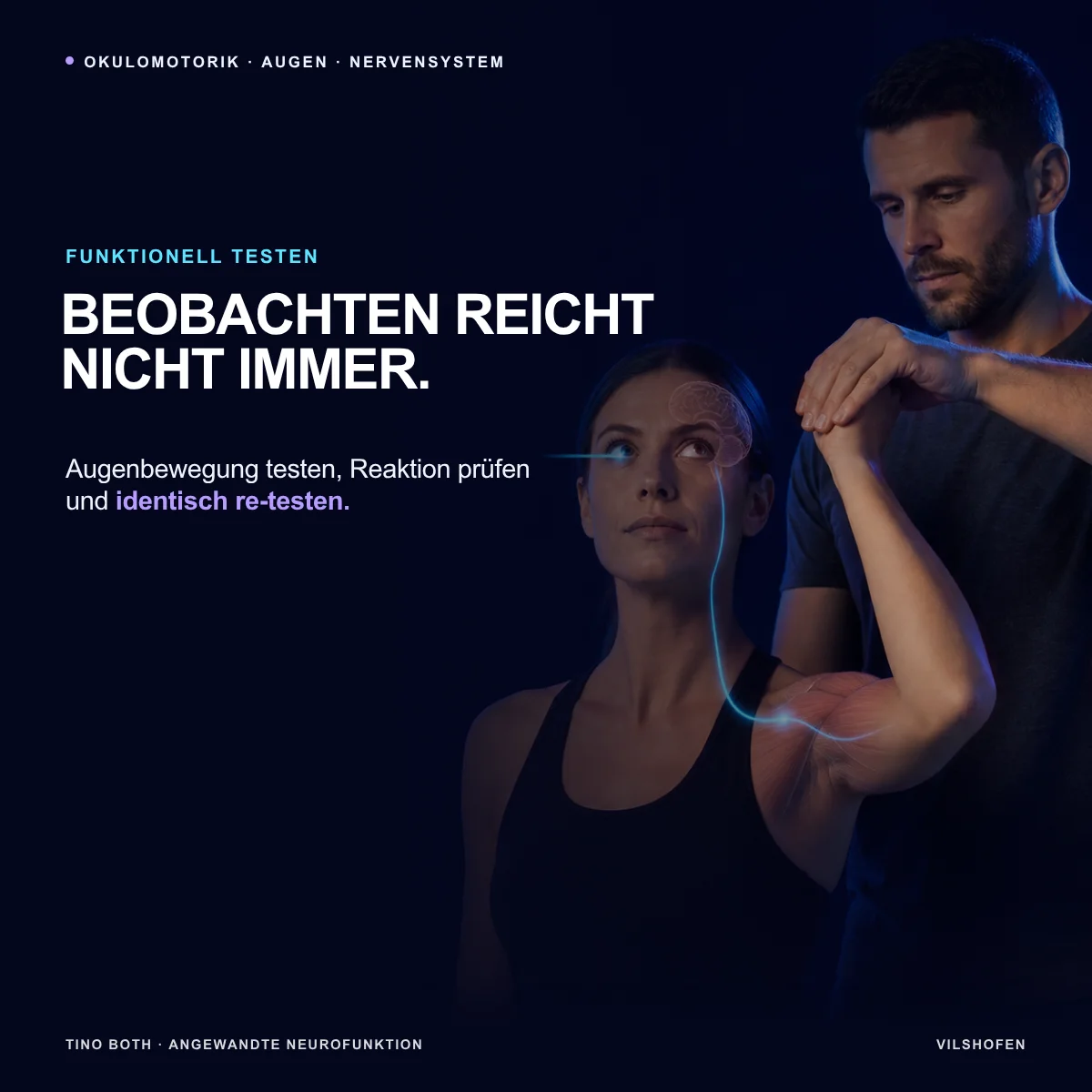
Briefly explained: For me, assessing eye movements functionally means considering more than their visible performance. What a particular gaze task changes for you also matters. In Angewandte Neurofunktion, I therefore connect observation with a specific everyday marker and, depending on the question, a deliberately selected indicator muscle.
Do your eyes see sharply, yet reading or orientation remain demanding?In the free initial telephone consultation, you can describe when things become difficult and what has already been checked. We clarify whether functional consideration of the tasks involved can sensibly follow with me in Vilshofen.
Book your free initial conversation
Book your free initial conversation
Two eye movements can look similar – yet be differently demanding
You follow a finger with your eyes. From outside, the movement looks unremarkable. Yet you need intense concentration, unknowingly hold your breath or notice neck tension afterwards. Another person shows small corrective movements but experiences the same task as easy.
Both deserve attention. Visible movement, your experience and the response in another task are different information. None should replace the others prematurely. An ophthalmological or orthoptic examination assesses important prerequisites for vision; my additional question is: under which conditions does the particular task become easier or harder for you?
Distinguish first: hold a position, track a target or move the head?
Gaze positionFor example, you hold your eyes directed slightly upwards while the head stays still. Holding a position is the question, rather than the quality of prolonged smooth pursuit.
Eye movementYou shift gaze between two targets or track a moving target. Saccades and smooth pursuit are different tasks. A finding in one does not automatically mean the other is equally difficult.
Gaze during head movementThe target now stays still while the head moves. Other demands are added. Equating this task with eye movement alone may overlook the decisive difference.
This separation has practical consequences: if holding a gaze position is already demanding, I begin differently from when only rapid switches cause problems. And if difficulty only develops with head movement, I do not simply assess more and more gaze shifts.
What an indicator muscle can contribute to this question
An indicator muscle is a muscle selected for the particular assessment whose response I test under comparable conditions. It needs to be readily accessible, testable without pain and suitable for the question. This is not a contest of strength.
A gaze task or targeted contact is combined with muscle testing. If the response changes, a further question emerges within my assessment system. I then assess whether a suitable change influences this response understandably. This is a methodological search route, rather than a direct measurement of one brain region.
The surprising point: ‘strong’ is not always automatically rightIn a movement pattern, switching between activation and inhibition can be part of the expected response. The rule ‘weak before, strong afterwards’ is therefore insufficient for every question. It must first be clear which muscle is tested for which pattern and which response is expected.
One possible assessment example: looking upwards changes the leg response
Distinguish position, pattern and everyday transfer rather than test more of the same.
Imagine looking towards a higher shelf feels unpleasant. We first record that exact starting situation: head position, gaze direction and your sensation. I may then select a leg muscle if I want to consider the relationship between gaze position and a postural pattern within my method.
1. Compare two directions specificallyThe head stays in the same position. Muscle response is assessed with the eyes directed upwards and downwards. I distinguish a switch expected for this pattern comparison from an unusual response. A leg muscle performs a different task here from a generally selected indicator muscle.
2. Pursue a specific connection furtherIf an unusual pattern appears, I can compare assigned functional contacts. One example is a contact assigned within the test model to the basal ganglia: networks involved in selecting and coordinating movements, among other things. What becomes interesting is whether the same contact appropriately changes the response in both gaze directions. This turns a single unusual response into a specifically assessable combination.
3. Integrate the appropriate response and assess againIf the combination fits understandably, integration follows. In the described pattern, this can include guided switching of gaze directions. I then reassess the original positions without the additional support contact: does the expected switch also appear now?
4. Return to the actual questionFinally, looking towards the shelf matters again. Does it feel easier? Does the head remain freer? Is the change repeatable and still present later? A changed muscle response alone would be too little for this everyday question.
For me, this is precisely the value of differentiation: the result determines what appears sensible next. Practising a task, changing its dose or more specifically integrating a connection showing a finding are not the same steps.
Why I do not immediately train every finding
Sometimes a gaze task is simply too fast, too large or too long. A smaller, more comfortable task can then be the appropriate starting point. Sometimes a different target distance already changes the demand. And sometimes a clearly limited question remains that I pursue using the assessment system described.
Neurocentric training and functional integration can complement each other. Training practises a task at a suitable dose. In integration, I seek an appropriate combination for a previously unusual test response. Which approach I choose depends on your starting conditions and the specific question.
What you can observe before an appointment
An ordinary situation is helpful, rather than a self-assembled test battery. Does reading only become demanding after several minutes? Is switching between screen and room difficult? Does a gaze shift cause symptoms, or only simultaneous head movement? Glasses, target distance and breaks belong as contextual conditions.
Do not provoke symptoms for this. A brief note about something already noticeable in everyday life is usually more helpful than numerous demanding self-tests.
When should medical assessment come first?
New double vision, sudden deterioration in vision or marked eye pain need prompt medical evaluation. Sudden visual disturbances with paralysis, speech disturbance or severe new walking unsteadiness are an emergency: 112. With longer-standing visual problems, ophthalmological and, where appropriate, orthoptic findings are an important foundation.
Frequently asked questions
Is a normal vision test enough?A vision test mainly answers questions about visual acuity. Depending on symptoms, further ophthalmological or orthoptic assessments make sense. The functional perspective adds how specific visual tasks work in everyday life.
Why is an arm or leg tested when the question concerns the eyes?In my method, the selected muscle serves as a comparative response to a targeted question. A leg muscle can deliberately be chosen for a postural pattern. Which muscle is suitable depends on the assessment goal.
Will I receive eye exercises afterwards?Possibly, but not automatically. A task is only adopted if it fits your question and is tolerable. Sometimes adjusting vision care, reducing demand or other steps matter more initially.
Related pages and articles
Understanding individual visual tasksOculomotor function: eye movements at a glance
Gaze fixation: holding a target steadily
Saccades: switching between targets
Smooth pursuit: tracking moving targets
Gaze stabilisation during head movement
Gaze fixation: holding a target steadily
Saccades: switching between targets
Smooth pursuit: tracking moving targets
Gaze stabilisation during head movement
Your specific situation rather than a general eye programmeOn the focus page Visual disturbances and visual processing you can learn more about my work. If you bring a specific visual task, we can begin there together.
Book your free initial conversation
Book your free initial conversation
Sources and further reading