

← All articles
Vision & visual processing
Understanding oculomotor function: how eye movements guide everyday life
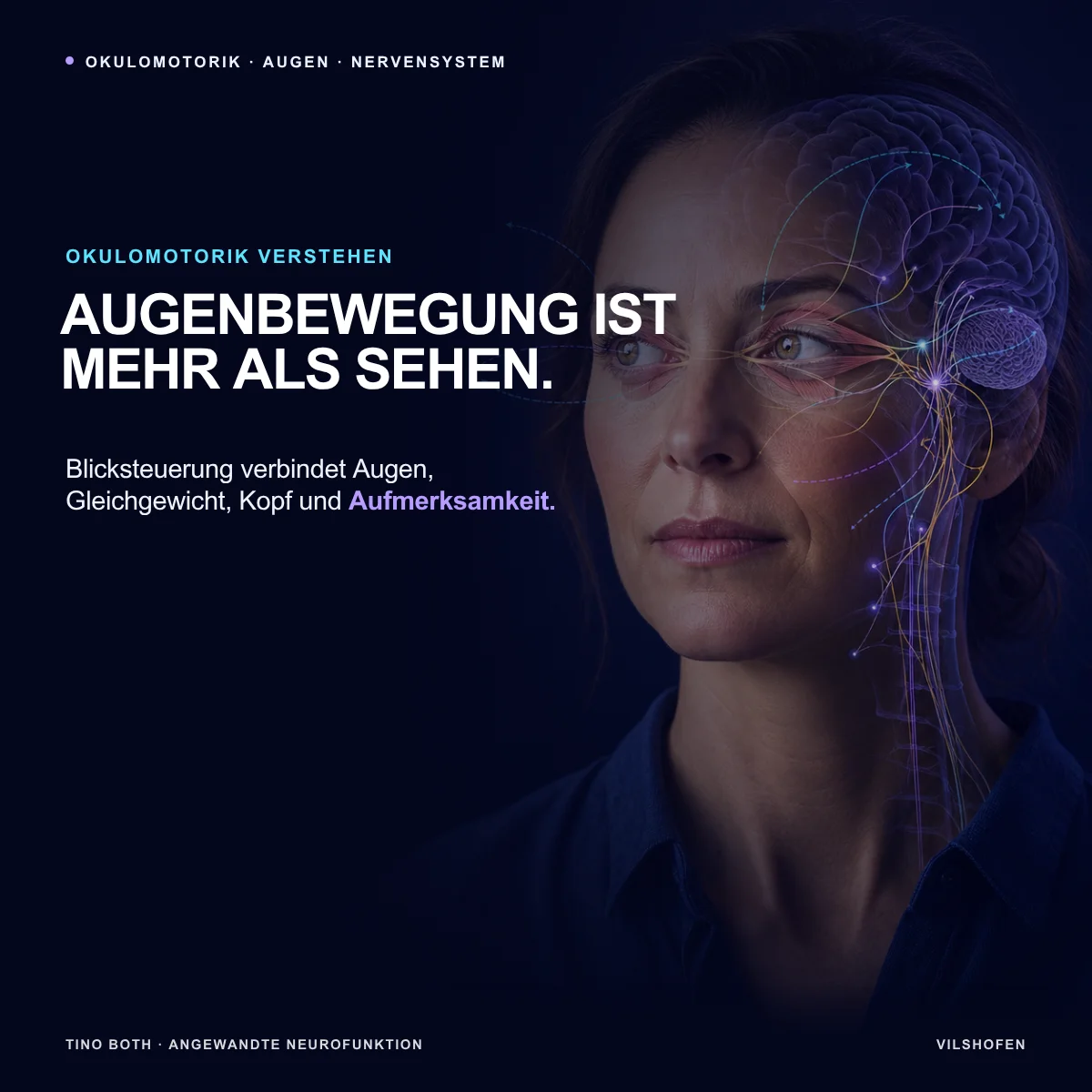
Briefly explained: Oculomotor function means control of eye movements. It enables you to look at a target, shift gaze, track movement and maintain the most stable image possible during head movement. Sharp vision and well-coordinated gaze control are different demands, closely connected in everyday life.
Have your eyes been examined, yet seeing remains demanding?Tell me whether reading, looking around, near–far switching or moving surroundings are difficult. In the initial consultation, we clarify which functional perspective on your situation might make sense.
Discuss your visual situation →
The initial telephone consultation is free.
Discuss your visual situation →
The initial telephone consultation is free.
Recognising sharply is not the entire visual task
You can read the letters on the eye chart. Yet you quickly lose the thread at a screen or need a moment when switching from your phone into the room. Walking may become more demanding even though everything seems clear while sitting. These differences help make the question about vision more precise.
A visual acuity test answers an important question: which details do you recognise under the particular conditions? Everyday life adds further tasks. You need to select the relevant target, align both eyes appropriately and coordinate gaze with head and body. A comprehensive ophthalmological or orthoptic examination can also consider many of these functions; it is certainly not limited to visual acuity.
Which eye movements are there?
The following overview provides orientation, rather than a list you need to test entirely yourself. Initially, the two or three functions fitting your difficult everyday situation are usually enough.
Fixation: stay with a targetYou look at a symbol, face or point. The eyes are not completely still. Small movements and corrections enable a useful, detailed visual impression.
Saccades: jump to the next targetGaze switches rapidly between two places, for example from the end of a sentence to the beginning of the next line. During reading, these gaze shifts alternate with brief fixations. The eyes do not simply glide evenly over the entire text.
Smooth pursuit: follow a moving targetYou track a slowly passing object, for example. Whether this works smoothly also depends on speed, predictability and distance. Jerky corrections during a difficult task therefore need to be considered in context.
Vergence: align both eyes for the same distanceAt near distances, the visual axes align more towards each other. Looking into the distance changes this alignment again. Closely connected with this is accommodation: focusing through the eye’s lens. Focusing and aligning the eyes are two cooperating functions.
VOR: stabilise the image during head movementWhen looking around or walking, the eyes move in coordination with the balance system. The vestibulo-ocular reflex, or VOR, is an important part of this stabilisation. A clear image with the head still does not yet tell us how this moving task works.
Optokinetic responses: respond to large-scale movementWhen much of the visual field moves, demands differ from looking at one still point. A quiet room may therefore be well tolerated while passing shelves or crowds become demanding.
Who controls the eyes?
Six external eye muscles per eye move the eyeball. Commands reach them through three cranial nerves. Movement selection and coordination arise in brain networks: areas of the cerebral cortex support target selection and attention, brainstem networks execution, and the cerebellum fine coordination. Information from the balance system is added for stabilisation during head movement.
This does not become a conscious calculation in everyday life. You do not first think about an eye muscle before responding to a sound. The interaction runs largely automatically. This is precisely why the specific task is so helpful: it shows when an ordinarily incidental ability becomes noticeable work.
One symptom can fit several visual tasks‘My eyes become tired’ does not yet say whether near vision, gaze shifts, dry eyes, lighting or head movement is decisive. The situation turns a general symptom into an assessable question.
From everyday life to suitable functional assessment
I begin with the moment things become difficult. Do you need to restart repeatedly while reading? Do things only become unsettled when standing up and walking? Is switching from a screen to someone in the room the problem? We then choose a manageable starting point rather than randomly examining every eye movement.
Target size, distance, glasses, light and body position belong in this. We then compare a few demands separately: a still target first, then perhaps a gaze shift. Head movement is only added if the question and your capacity make it sensible. Alongside visible movement, seeing clearly and easily and the task’s effort matter.
One possible example: from monitor to conversationYou recognise everything on the monitor. Looking at the person across the room, the image takes longer to feel comfortable. We first consider near and distant targets separately, then switching. This makes it more tangible whether distance, the gaze shift or additional head movement mainly makes the difference. A selected input is then assessed and the same starting task repeated.
Additionally assessing a selected eye function
In my work with Angewandte Neurofunktion, I can additionally compare a selected visual question through an indicator muscle testable without pain. This is first selected and checked. The defined stimulus is then added, such as a particular gaze task. The method’s question is whether an unphysiological inhibition occurs.
If such a response appears, searching for a solution follows. I compare the original stimulus alone with the same situation plus an additional solution stimulus. If the alternation between unusual and stable muscle response can be repeated, the suitable combination is integrated. I then test the original stimulus again without the additional solution and return to the everyday visual task.
This approach differs from a collection of eye exercises. A subsequent training stimulus is separately selected and dosed. You should be able to understand which task we want to change, how we recognise the response and what you may continue practising yourself.
How this becomes a manageable next step
A good appointment does not necessarily end with many exercises. Sometimes the most important decision is to first have vision correction or binocular vision checked more closely. In other situations, a well-tolerated training approach emerges, such as a short gaze shift between two clearly recognisable targets.
We then agree specific conditions and a suitable comparison. How does the original activity feel afterwards? Does the response stay helpful on later repetition? Does the dose need changing? This turns an observation into an understandable course rather than trying a new stimulus programme every day.
What you can observe yourself
Distinguish as clearly as possible: blurred, double, swaying or simply demanding. Note whether one or both gaze directions stand out, near or far is affected and head movement is added. Describe what actually happens without inferring an affected brain region yourself. Brief notes from situations that already occur are enough.
With new visual problems, do not start with practice
Sudden double vision, marked vision loss or new restricted eye movements require urgent medical evaluation. With additional speech disturbances, paralysis, severe new walking unsteadiness or unusually intense headache, call 112. Persistent near-vision symptoms can also make orthoptic assessment of cooperation between the eyes useful.
Frequently asked questions about oculomotor function
Is oculomotor function the same as visual acuity?No. Visual acuity describes recognising fine details. Oculomotor function concerns movement and alignment of the eyes. Both areas interact in seeing.
Which examination makes sense for unusual eye movements?Depending on the symptoms, the first contact is an ophthalmology practice, often with orthoptics. Sudden new symptoms or accompanying neurological signs require urgent assessment.
Can normal glasses solve every gaze problem?Suitable vision correction matters. But it does not answer every question about eye coordination, head movement or visual capacity. Conversely, unsuitable glasses should not be compensated for through training.
Do I need to train every eye movement?No. Selection follows the specific task and your response. A small, understandable approach is often more sensible than many exercises begun together.
Not all eye movements need the same response
Distinguishing visual tasks allows more targeted follow-up questions. In my work in Vilshofen, the focus is therefore your everyday life rather than ‘eye training for everyone’: what should become easier again, and which function deserves a closer look for this?
Would you like to find out where a sensible starting point lies?Describe your most difficult visual situation and which examinations have already taken place. Together, we clarify whether my functional approach fits it.
Free initial consultation about visual processing →
The initial telephone consultation is free.
Free initial consultation about visual processing →
The initial telephone consultation is free.
Related pages and articles
The individual eye functionsFunctionally assessing eye movements – why an indicator muscle shows more than observation alone
Gaze fixation: why stable vision matters for everyday life, reading and orientation
Saccades: why gaze shifts matter for reading and orientation
Smooth pursuit: how the eyes track moving targets
Vergence and accommodation explained simply – how the eyes adjust for near and far
Gaze fixation: why stable vision matters for everyday life, reading and orientation
Saccades: why gaze shifts matter for reading and orientation
Smooth pursuit: how the eyes track moving targets
Vergence and accommodation explained simply – how the eyes adjust for near and far
Head movement and moving surroundingsVOR explained simply – why the vestibulo-ocular reflex keeps gaze stable
OKN and OKR: how the eyes respond to moving environments
Visual vertical explained simply – how the nervous system recognises ‘upright’
VOR-C and fixation suppression: when gaze moves with the head
OKN and OKR: how the eyes respond to moving environments
Visual vertical explained simply – how the nervous system recognises ‘upright’
VOR-C and fixation suppression: when gaze moves with the head
Relevant areas of focus in VilshofenVisual disturbances and visual processing
Dizziness and balance
My approach: Angewandte Neurofunktion
Dizziness and balance
My approach: Angewandte Neurofunktion
Sources and further reading
Purves et al.: Types of Eye Movements and Their Functions – functional distinctions between eye movements.
National Eye Institute: Convergence Insufficiency – symptoms and professional assessment of binocular near vision.
National Eye Institute: Convergence Insufficiency – symptoms and professional assessment of binocular near vision.