

← All articles
Vision & visual processing
Fixation suppression and VOR-C explained simply – when gaze slows the reflex
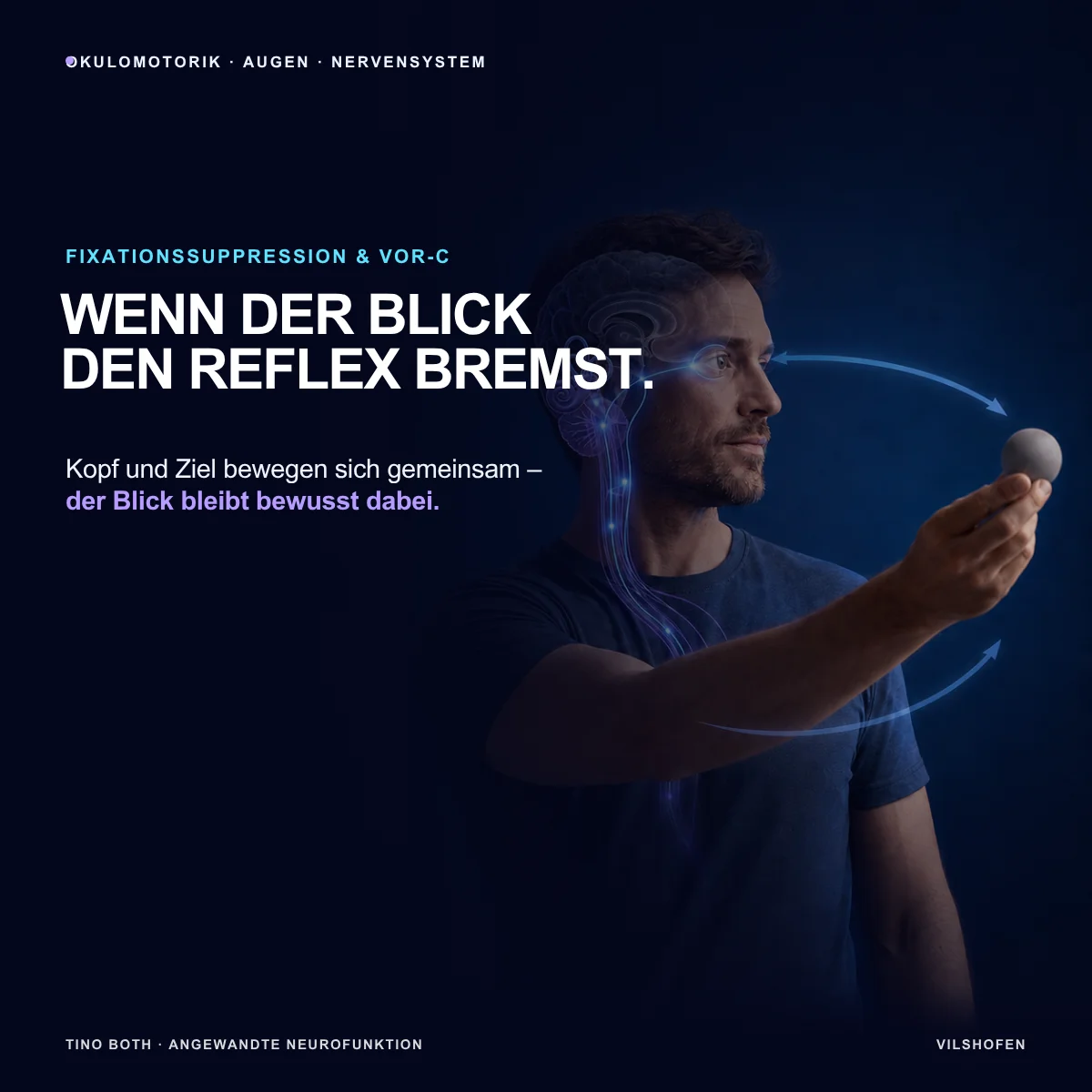
Briefly explained: VOR-C means VOR cancellation: when head and gaze target move suitably together, the usual counter-movement of the eyes needs to be reduced. Fixation suppression describes suppressing certain eye movements through fixation. The terms overlap, but are not synonymous in every examination.
Can you hold a target in view, but moving it together with your head is difficult?If head movements or tracking a target remain unpleasant despite assessment, we can distinguish the different visual tasks specifically. In the initial consultation, we clarify whether my functional work in Vilshofen is suitable for this.
Consider gaze and head movement together →
The initial telephone consultation is free.
Consider gaze and head movement together →
The initial telephone consultation is free.
Why good gaze stability also needs adaptation
Imagine two situations. You look at a clock on the wall and turn your head slightly. The clock stays in the same place, so the eyes need to move in the opposite direction relative to the head. Now you hold a card in front of you and turn your head, card and upper body together. Here, the same counter-movement would take gaze away from the card.
The vestibulo-ocular reflex, or VOR, supports the first task. For the second, its effect is suitably reduced. Good gaze control therefore does not mean always making a reflex stronger. It needs to fit the relationship between head and target. The review by Nerdal et al. (2024): Vestibulo-Ocular Reflex Suppression explains this interaction.
Three tasks, three different target relationshipsVOR x1: The head moves while the target stays stationary in space. The eyes keep it in view through a counter-movement.
VOR x2: Head and target move in opposite directions. This significantly changes the eye movement required.
VOR-C: Head and target move together so that their relative position stays as constant as possible. The otherwise helpful counter-movement is reduced.
These are different tasks, not three interchangeable names for ‘turn your head and look’.
VOR x2: Head and target move in opposite directions. This significantly changes the eye movement required.
VOR-C: Head and target move together so that their relative position stays as constant as possible. The otherwise helpful counter-movement is reduced.
These are different tasks, not three interchangeable names for ‘turn your head and look’.
Fixation suppression and VOR-C: related, but not always the same test
Fixation means holding a target in view. Vestibular diagnostics examines, among other things, whether fixation reduces existing vestibular nystagmus. Nystagmus is a sequence of involuntary eye movements. VOR-C, by contrast, deliberately creates the situation in which head and target move together.
Both questions concern adapting eye movements to a visual target. However, the specific experimental conditions matter. Someone referring to a ‘fixation suppression test’ should therefore explain which stimulus is applied and which eye movement is observed. The term alone does not reveal what was assessed.
It is not about consciously forcing the reflex awayYou do not need to learn to work against your eyes through willpower. Gaze control normally adapts to the task. A suitable assessment makes this coordination observable rather than forcing it through the greatest possible effort.
Why the surroundings can make the difference
One target against a quiet wall is easier to take in than the same target against a full shelf. When head and target move together, the visual surroundings in the background change too. Depending on the task, attention, object tracking and body movement are added.
‘VOR-C makes me feel unwell’ therefore does not yet mean reflex suppression alone explains the difficulty. Distance, target clarity, range of movement, speed and background can change the task. For a helpful approach, these conditions are not all grouped together.
How I narrow down the demand step by step
One possible example: the target stays still, the background interferesAfter the necessary assessment, we choose a safe sitting position and an easily recognisable target. We first consider the gaze task during a small, tolerable shared movement. Head and target move in coordination, rather than independently.
If the task works well against a calm background, exactly one environmental condition may be changed. If difficulty only arises then, it gives further assessment a direction. A selected input is then assessed against the same starting task. Target clarity, movement quality, effort and recovery are recorded, among other things.
If the task works well against a calm background, exactly one environmental condition may be changed. If difficulty only arises then, it gives further assessment a direction. A selected input is then assessed against the same starting task. Target clarity, movement quality, effort and recovery are recorded, among other things.
In everyday life, this should lead to more than a better test score. If your concern is tracking an object while turning, for example, that task is added again later. Functional assessment helps select the approach: do you initially need a simpler visual task, a different dose or an additional sensory relationship?
Distinguishing shared head–target movement more preciselyFor an additional stimulus assessment, I use an indicator muscle that can be tested reliably without pain. It does not have to belong to the symptomatic region. Shared movement of head and target remains separate from looking at a stationary target with a moving head. This difference determines the question. The specific question – here, shared head–target movement in a defined direction – is then assessed through a defined stimulus or suitable contacts.
If this shows an unphysiological inhibition according to the criteria of this testing method, I look for an additional input that changes the response. We repeatedly compare stimulus alone and stimulus plus solution input. The method’s integration step only follows when this comparison is understandable. I then reassess the original stimulus without the additional solution input, followed by the same head–target movement and your previously selected everyday marker.
This keeps the internal test response connected to the result you can feel. Repeatability, tolerability and development in everyday life also matter for further support.
If this shows an unphysiological inhibition according to the criteria of this testing method, I look for an additional input that changes the response. We repeatedly compare stimulus alone and stimulus plus solution input. The method’s integration step only follows when this comparison is understandable. I then reassess the original stimulus without the additional solution input, followed by the same head–target movement and your previously selected everyday marker.
This keeps the internal test response connected to the result you can feel. Repeatability, tolerability and development in everyday life also matter for further support.
From assessment to a suitable amount of exercise
Body position, target size, movement direction and background can be adjusted independently. This lets me assess specifically which change eases the task: a small task while sitting can be dosed differently from the same movement while standing. Several directions, faster speed and additional tasks do not follow automatically just because the first attempt was possible.
The decision also depends on how you feel afterwards. A clearer target during a brief attempt is interesting. If you need a long recovery afterwards, the overall demand may nevertheless have been too high. Feedback and the subsequent course therefore belong in selection, alongside observation of the eyes.
What you can describe yourself
Note a specific situation: are you looking at something that stays still, or does your target move with you? Does the image remain clear? Is a busy background the main unpleasant factor? You do not need rotating-chair trials or rapid head movements for this. Your description of an everyday situation is enough to begin.
New double vision, sudden intense dizziness or newly marked walking unsteadiness should be medically assessed. If acute speech disturbances, paralysis or other neurological deficits also occur, 112 is the appropriate route. Targeted clinical reflex assessments belong in expert hands.
Frequently asked questions about VOR-C and fixation suppression
Is VOR-C the same as smooth pursuit?No. In smooth pursuit, the eyes track a moving target. In VOR-C, the head additionally moves suitably with the target. The usual vestibular counter-movement needs to be adapted in this.
Does a strong VOR always have to be better?The response needs to fit the task. A fixed target with a moving head requires something different from a target moving together with the head. A blanket increase is therefore not a sensible universal goal.
Can a VOR-C trial explain why I become dizzy?It can reveal a specific difficulty. Assessment needs further information, however: the course, other visual and movement tasks and, with symptoms, suitable medical findings.
Should I train VOR-C myself using a video?With recurring dizziness, an individually selected task is more useful than an arbitrary speed from a video. Shared movement of head and target can also easily be performed differently from intended.
Not more reflex – the right response
The interesting difference lies between situations: when does gaze need stabilising against head movement, and when should it move with it? Once we distinguish this clearly, the general advice ‘train your balance’ becomes an understandable individual question.
Would you like to find out which gaze task causes you difficulty?In the initial consultation, we discuss your typical situation. Building on this, I can explain how I take a functional perspective on gaze control, balance and body movement in Vilshofen.
Arrange a free conversation about your concern →
The initial telephone consultation is free.
Arrange a free conversation about your concern →
The initial telephone consultation is free.
Related pages and articles
Eye movements and visual processingOculomotor function: understanding eye movements
Functionally assessing eye movements
Gaze fixation: looking steadily at a target
Saccades: precise gaze shifts
Smooth pursuit: tracking moving targets
Vergence and accommodation: near and far
Functionally assessing eye movements
Gaze fixation: looking steadily at a target
Saccades: precise gaze shifts
Smooth pursuit: tracking moving targets
Vergence and accommodation: near and far
Gaze and balanceVOR: gaze stability during head movement
OKN and OKR: moving environments
OCR and visual vertical: recognising upright
OKN and OKR: moving environments
OCR and visual vertical: recognising upright
Assessing symptoms in everyday lifeDizziness, nausea and visual disturbances
Swaying dizziness: when the floor feels unstable
Visual overload in the supermarket and everyday life
Swaying dizziness: when the floor feels unstable
Visual overload in the supermarket and everyday life
Relevant areas of focus in VilshofenVisual disturbances and visual processing
Dizziness and balance
My approach: Angewandte Neurofunktion
Dizziness and balance
My approach: Angewandte Neurofunktion
Sources and further reading
Nerdal et al. (2024): Vestibulo-Ocular Reflex Suppression
American Academy of Ophthalmology: Reflexes and the Eye
American Academy of Ophthalmology: Reflexes and the Eye