

← All articles
Complex symptoms & the autonomic nervous system
Dizziness, nausea and visual disturbances: Understanding the connections
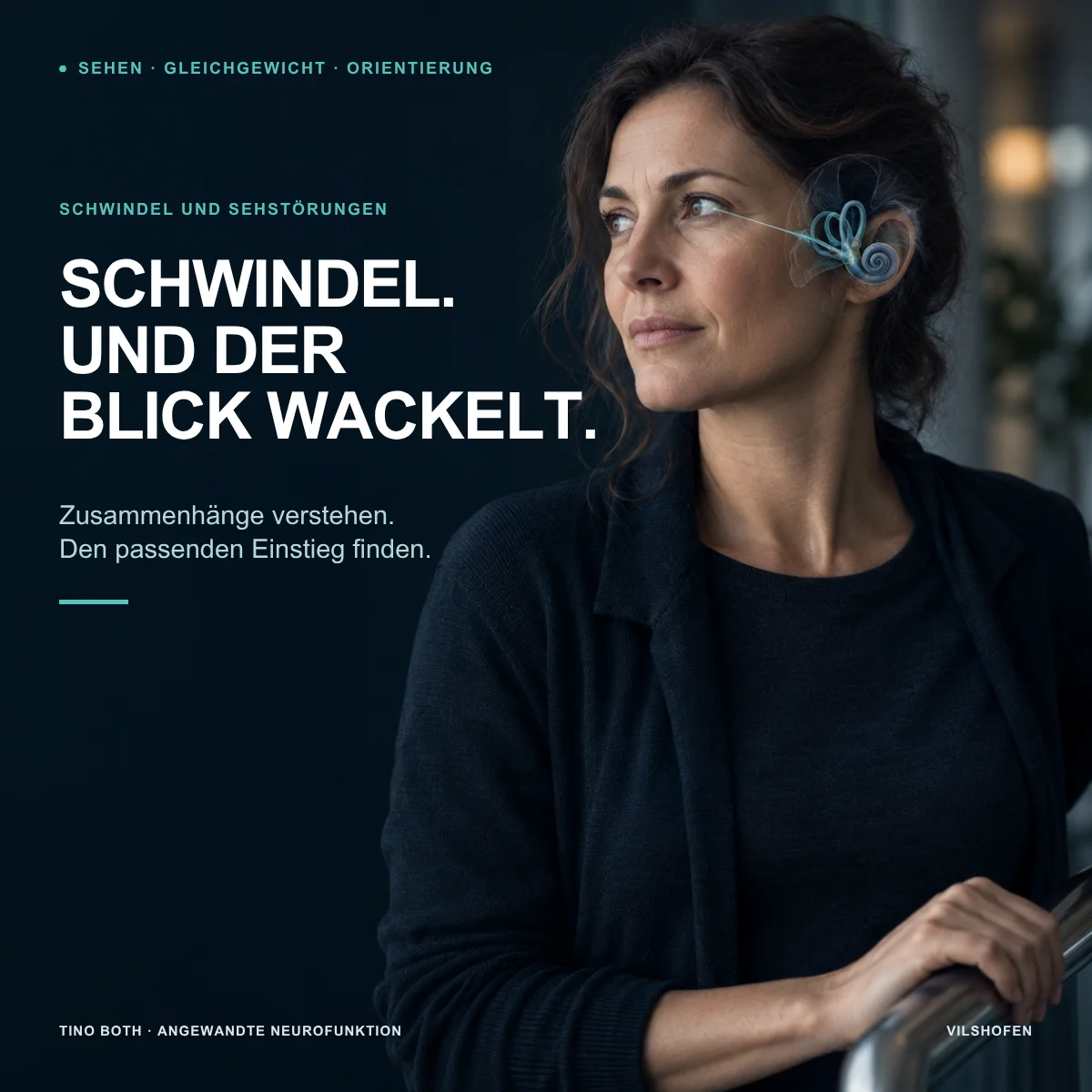
Briefly explained: Dizziness, nausea and visual disturbances can occur together because gaze stability, balance and autonomic responses are connected. The combination can nevertheless have different triggers. What matters is exactly what you see and feel, when it begins and whether new warning signs appear.
Do you become dizzy when walking — and your gaze cannot keep up?If recurring symptoms have already been assessed but still restrict your daily life, we can discuss during the initial consultation whether a functional view of vision, balance and movement in Vilshofen suits you.
Discuss your situation during an initial consultation →
The initial telephone consultation is free of charge.
Discuss your situation during an initial consultation →
The initial telephone consultation is free of charge.
With sudden new symptoms, consider safety firstDizziness together with new double vision, speech disturbance, one-sided weakness or pronounced new unsteadiness when standing and walking can be an emergency: Call 112. Sudden vision loss or an unusually severe headache also requires immediate medical help. Do not drive yourself.
Three symptoms — but perhaps the same difficult situation
You turn your head to look for a car. For a moment, the image seems to lag behind, the ground feels unsteady and your stomach feels unsettled. Or you sit quietly at a screen and only scrolling makes your gaze unsteady. Both can be described as 'dizziness with visual disturbances'. This distinction makes a big difference to the next step.
Rather than immediately grouping all symptoms into one problem, a more precise description is worthwhile. Blurred text, two separate images, flashes of light and surroundings that seem to bounce are different visual experiences. A spinning sensation also differs from feeling as though you are about to faint.
Why the eyes, balance and nausea can fit together
When the head moves, the eyes need to stabilise gaze. Information from the balance organs is processed alongside visual signals and body awareness for this. Vestibular disorders can therefore involve apparent movement in vision and nausea as well as dizziness. This combination is described, for example, by University Medical Centre Freiburg: Dizziness and gait disturbances. It does not necessarily mean the eyes, inner ear and stomach are all ill at once.
The reverse conclusion would also be too simple: Not every instance of nausea during viewing is a 'coordination error'. Depending on the course, vestibular conditions, migraine, circulatory problems, vision problems or medication effects may be considered, among other things. The history and examination determine the useful direction — rather than the number of simultaneous symptoms.
Four descriptions that help with interpretationThe image jumps or wobbles during head movement: Describe whether it becomes still again when you stop moving.
Your vision goes dark on standing up: Timing and any feeling of impending fainting are particularly important here.
You see double: New double vision should be assessed promptly, and immediately with acute dizziness or further deficits.
Moving images make you light-headed: Note whether scrolling, traffic or people in your field of view make the difference. This is initially an observation, rather than a classification as a particular illness.
Your vision goes dark on standing up: Timing and any feeling of impending fainting are particularly important here.
You see double: New double vision should be assessed promptly, and immediately with acute dizziness or further deficits.
Moving images make you light-headed: Note whether scrolling, traffic or people in your field of view make the difference. This is initially an observation, rather than a classification as a particular illness.
Unremarkable findings — yet daily life remains difficult
Perhaps the conditions that needed urgent exclusion have already been investigated. Yet walking through a crowded pedestrian area remains demanding. Another question then becomes interesting: Which specific demand does not yet go well? Quietly viewing a target, moving the head and walking at the same time are different tasks.
In Applied Neurofunction, I therefore begin with your most important everyday situation, rather than as many stimuli as possible. From this, we select a safe, repeatable starting task. I observe under which conditions the difficulty occurs and whether one individual change has a useful effect. Medical findings inform this selection.
A possible example: Reading the sign is fine — turning the head becomes difficultFirst, we choose a clearly visible target at a comfortable distance. It can be viewed calmly while sitting. A small head movement is then added if tolerable. Target, distance and lighting stay the same.
If this second task becomes markedly more demanding, we do not immediately need to increase balance demands and walking speed too. We can first choose a smaller head movement or assess a specifically selected visual input. We then compare the original task under the same conditions.
'Less dizziness' is one consideration, but others are interesting too: Does the target stay clearer? Does the head need to be held still less? How quickly does recovery occur? The example shows the decision process, rather than general exercise instructions.
If this second task becomes markedly more demanding, we do not immediately need to increase balance demands and walking speed too. We can first choose a smaller head movement or assess a specifically selected visual input. We then compare the original task under the same conditions.
'Less dizziness' is one consideration, but others are interesting too: Does the target stay clearer? Does the head need to be held still less? How quickly does recovery occur? The example shows the decision process, rather than general exercise instructions.
When gaze and head movement trigger different responsesFor an additional stimulus assessment, I use a reliably testable, pain-free indicator muscle. It does not need to belong to the symptomatic area. Here, I might explore whether head movement alone goes well and whether only simultaneous fixation changes the response. The specific question — here the functional relationship of a particular gaze or head movement — is then assessed through a defined stimulus or suitable contacts.
If non-physiological inhibition appears according to this test method's criteria, I seek additional input that changes the response. Repeated comparisons are made between the stimulus alone and the stimulus plus solution input. Only when this comparison is understandable does the method's integration follow. I then check the original stimulus again without the additional solution input — followed by the agreed gaze or movement task.
This keeps the internal test response connected with the result you can feel. Repeatability, tolerability and development in daily life also matter for further support.
If non-physiological inhibition appears according to this test method's criteria, I seek additional input that changes the response. Repeated comparisons are made between the stimulus alone and the stimulus plus solution input. Only when this comparison is understandable does the method's integration follow. I then check the original stimulus again without the additional solution input — followed by the agreed gaze or movement task.
This keeps the internal test response connected with the result you can feel. Repeatability, tolerability and development in daily life also matter for further support.
What you can observe before the appointment
A brief note on two or three typical situations is usually enough: What were you doing? How long did the feeling last? What exactly changed in your vision? Did nausea occur before, at the same time or afterwards? New medication, a change in glasses and existing findings are helpful details too.
You do not need to deliberately trigger symptoms for this. Sit down or seek support if unsteady; pause activities that risk a fall. Recurring, as yet unexplained or increasing symptoms need medical assessment. Depending on the pattern, a general practice, ENT, neurology or ophthalmology may be suitable points of contact.
Frequently asked questions about dizziness, nausea and visual disturbances
Can dizziness affect vision?Yes. If gaze does not remain sufficiently stable during movement, the surroundings can appear to jump or blur. Other forms of visual disturbance need different assessment. Describe what you perceive as specifically as possible.
Can this combination come from stress?Stress can influence symptoms and make coping harder. It should not be adopted prematurely as the only explanation — especially with new visual disturbances, new severe dizziness or associated neurological signs.
Which appointment is useful first?Unexplained symptoms call for medical assessment first. Acute warning signs warrant an emergency call. Once findings are available and functional difficulties remain, we can discuss additional support.
Do I need to train my eyes or balance?Not automatically both. First, we clarify which task is difficult and which change helps tolerably. A manageable, checkable approach is usually more useful than an indiscriminate package of many exercises.
From a tangle of symptoms to a specific question
You do not need to know already which system is 'to blame'. A good starting point is the situation you want to manage more safely again. When this becomes a clear assessment task, an understandable decision can be made about which next step might be useful for you.
Would you like to feel more secure when walking and looking around?Bring your typical situation and existing findings to the conversation. I explain how we can consider vision, balance and movement together in Applied Neurofunction in Vilshofen.
Arrange a free initial consultation →
The initial telephone consultation is free of charge.
Arrange a free initial consultation →
The initial telephone consultation is free of charge.
Related pages and articles
Dizziness and orientation in everyday lifeSwaying dizziness: When the ground feels unsteady
Visual overwhelm in the supermarket and daily life
Visual overwhelm in the supermarket and daily life
Understanding the visual system more preciselyOculomotor function: Understanding eye movements
Assessing eye movements functionally
Vergence and accommodation: Near and far
VOR: Gaze stability during head movement
OKN and OKR: Moving environments
VOR-C and fixation suppression
Assessing eye movements functionally
Vergence and accommodation: Near and far
VOR: Gaze stability during head movement
OKN and OKR: Moving environments
VOR-C and fixation suppression
Relevant areas of focus in VilshofenVisual disturbances and visual processing
Dizziness and balance
How I work: Angewandte Neurofunktion
Dizziness and balance
How I work: Angewandte Neurofunktion
Sources and further reading
University Medical Centre Freiburg: Dizziness and gait disturbances
Nerdal et al. (2024): Vestibulo-Ocular Reflex Suppression
Nerdal et al. (2024): Vestibulo-Ocular Reflex Suppression