

← All articles
Vision & visual processing
Assessing visual processing: when sharp vision alone is not enough
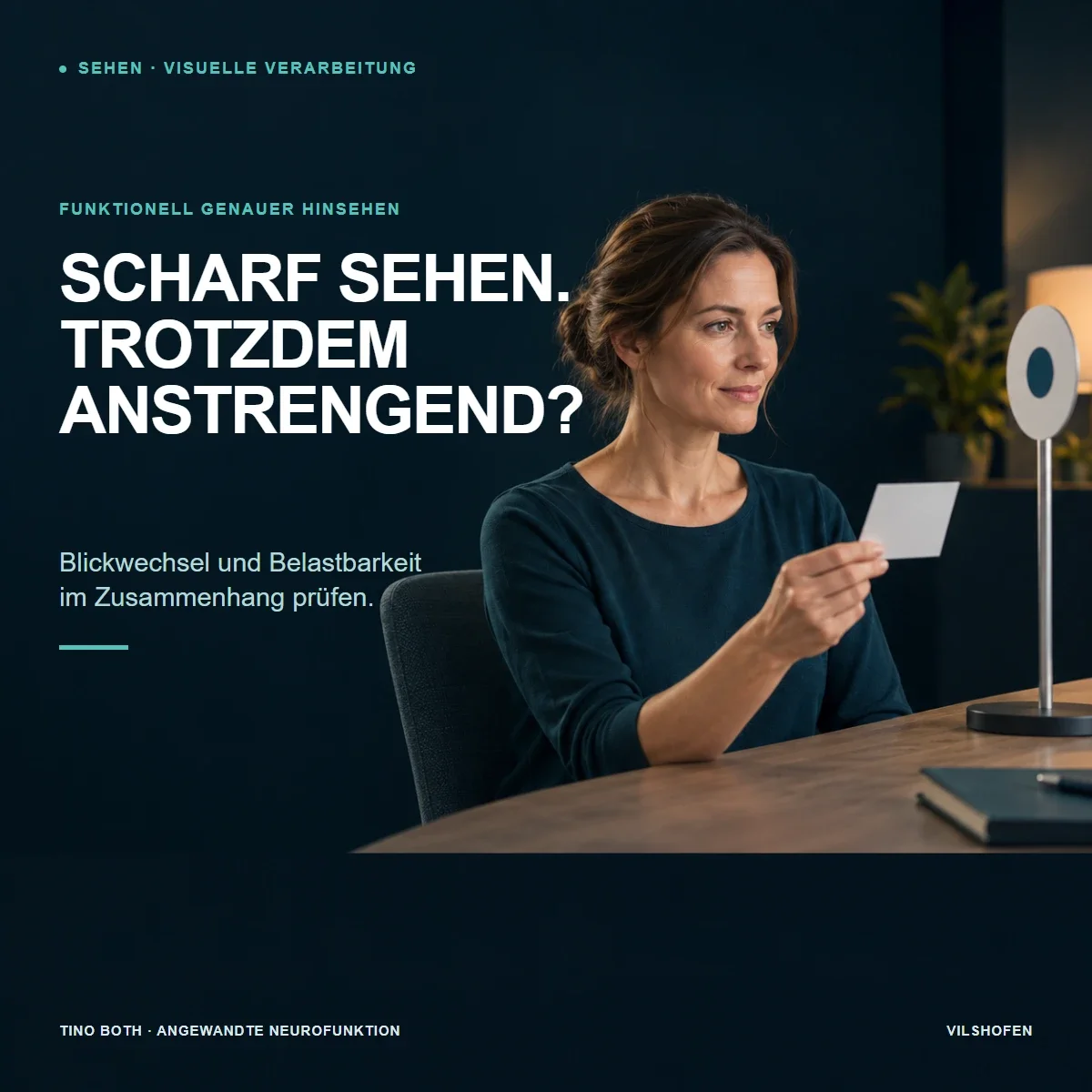
Briefly explained: In a functional assessment of visual processing, I examine how you use your gaze for a specific task. This may include fixation, gaze shifts, near–far switches and cooperation between the eyes. Which assessment makes sense follows from your everyday situation.
Are your vision measurements suitable, yet seeing still takes a lot of energy?In the initial consultation, describe when it becomes difficult: reading, at a screen or shifting your gaze during movement. We clarify whether an additional functional perspective in Vilshofen makes sense for you and which existing findings matter for this.
Book your free initial conversation
The initial telephone consultation is free.
Book your free initial conversation
The initial telephone consultation is free.
You recognise everything. Yet you want to close your eyes.
The print on the screen is clear. But after a while, you need to reread lines. When switching from your phone to the person you are speaking to, you need a moment. Or you look around the room and notice that constant reorientation, rather than sharpness, becomes demanding.
‘I can see well’ and ‘seeing strains me’ are not mutually exclusive. Visual acuity is an important prerequisite. But it does not answer every question about comfortably using vision over time. This is precisely where it helps to describe the difficulty more accurately rather than simply searching for an eye exercise.
What a functional visual assessment additionally considers
Looking at a still targetCan you look at a suitable point comfortably? Does the image stay clear? Does the task become uncomfortable over time? Gaze fixation is the starting point for many further visual tasks.
Switching between targetsDuring reading, the eyes jump from one place to the next. When copying, gaze switches between different distances. Gaze shifts and near–far switches are therefore not the same assessment task.
Connecting vision with movementIn everyday life, your head does not always stay still. Depending on your concern, we consider how a small head movement, standing up or a safe walking task affects gaze and orientation. Difficulty is adjusted gradually.
These areas are not all automatically worked through. If only prolonged reading fatigues you, a different sequence makes sense from unsteadiness in the supermarket. A good appointment begins with your question, not the longest possible test list.
Distinguishing visual acuity, eye coordination and visual endurance
Optical correction and eye health are foundational. Glasses can improve the image; at the same time, both eyes must be coordinated for a shared visual task. A specific example shows why this distinction matters: with convergence insufficiency, near tasks can be demanding even though visual acuity is good. The National Eye Institute highlights this. It is one possible relationship to be assessed ophthalmologically or orthoptically, not an explanation for every form of reading fatigue.
For a functional appointment, this means I want to know which visual aid you use, the distance it is intended for and what has already been examined. We then consider under which conditions you manage the task well and when it becomes harder. Lighting, working distance, breaks and fatigue also belong in this.
The useful question is: ‘what exactly becomes difficult?’‘My eyes are bad’ is very general. ‘When switching from my reference to the screen, I lose my place more often after ten minutes’ gives us a specific task and an assessable direction.
One possible example: the near–far switch falters
Suppose you read a short piece of information up close and then look at a distant target. The letters themselves are not the problem, but the transition: you need time, hold your breath or tense your neck more. We begin in a calm, safe sitting position with your usual suitable visual aid.
Starting task → targeted change → same taskStarting task: A brief, repeatable gaze switch. We keep distance, lighting and target size the same and attend to clarity, effort and time needed.
Targeted change: Depending on the observation, we first simplify one component task, for example with fewer switches or a more favourable distance. A selected visual training stimulus can then be tried at a low dose.
Re-test: The same starting task then follows again. Does it become easier, stay the same or become more unpleasant? Only on this basis do we decide what to pursue further.
We also check how you manage at your own workstation later. Further support therefore includes an everyday assessment: fewer search pauses, a more comfortable gaze switch or a better-tolerated working period. A change during the appointment and an improvement in everyday life are recorded separately.
How I additionally narrow down a specific visual question
Where the question fits, I supplement observation of the visual task with targeted stimulus assessment. A reliable, pain-free indicator muscle is selected first. Within the method, it serves as an indicator of response; the eyes themselves do not need to be tested against resistance for this.
A clearly limited relationship is then assessed using a targeted stimulus. If the muscle shows an unphysiological weakening in response, a suitable solution is sought. Within the method, we repeatedly compare stimulus alone and stimulus together with the solution. After integration, the original stimulus is applied again. Finally, the visual task returns – the same near–far switch, for example. This keeps differentiated testing connected to your actual concern.
What you can observe for an appointment
You do not need to collect self-tests. Instead, note two or three typical situations: near or distant targets, still head or movement, right at the beginning or only after prolonged demand. It also helps to know whether blurring actually occurs or whether the image stays clear while seeing still causes fatigue.
Bring the glasses you use and any relevant existing findings. If you use different distances at work, approximate distances or a photograph of the arrangement are often more informative than saying generally ‘a lot of screen work’. Do not deliberately create symptoms to demonstrate them.
When the eyes should be examined first
New or increasing visual problems, recurrent double vision and eye pain require professional assessment. Sudden loss of vision or a new shadow or curtain in the visual field requires immediate ophthalmological help. If speech disturbances, paralysis or other acute neurological signs also occur, call 112.
Frequently asked questions about functional visual assessment
Can visual acuity be good while seeing is still demanding?Yes. Recognising clear details is not the same task as prolonged reading, frequent gaze shifts or comfortable binocular vision. Which factors are involved depends on the specific situation.
Who assesses cooperation between the eyes?Ophthalmological and orthoptic examinations can assess binocular functions specifically. In a functional perspective, we build on existing findings and include your everyday task.
Are all eye movements tested at every appointment?No. Selection follows your concern and previous observations. A manageable assessment route makes results easier to compare than many unsystematic tests.
Will I receive exercises for home afterwards?If an exercise fits the question and is tolerable, it can become part of the support. This includes a suitable dose and a clear relationship to the task that matters to you.
Measure vision against your everyday life
The goal is not to do well in as many eye tests as possible. It is to understand the demands that actually cause you difficulty. Once ‘seeing is demanding’ becomes a specific, understandable task, the next steps can be chosen much more precisely too.
Would you like to understand more closely where seeing becomes demanding?In the free conversation, we organise your concern and discuss whether an appointment for Angewandte Neurofunktion in Vilshofen is the right next step.
Assess your situation together →
The initial telephone consultation is free.
Assess your situation together →
The initial telephone consultation is free.
Related pages and articles
Understanding visual tasks more closelyUnderstanding oculomotor function: how eye movements guide everyday life
Gaze fixation: why looking steadily can become demanding
Vergence and accommodation explained simply – how the eyes adjust for near and far
Gaze fixation: why looking steadily can become demanding
Vergence and accommodation explained simply – how the eyes adjust for near and far
Assessing and transferring into everyday lifeFunctionally assessing eye movements – why an indicator muscle shows more than observation alone
VOR explained simply – why the vestibulo-ocular reflex keeps gaze stable
Visual overload: why the supermarket can trigger dizziness
VOR explained simply – why the vestibulo-ocular reflex keeps gaze stable
Visual overload: why the supermarket can trigger dizziness
Relevant areas of focus in VilshofenVisual disturbances and visual processing
Dizziness and balance
My approach: Angewandte Neurofunktion
Dizziness and balance
My approach: Angewandte Neurofunktion
Sources and further reading
National Eye Institute: Convergence Insufficiency – information about binocular near vision and targeted examination.