

← All articles
Neuroathletic training & performance
Neuroathletic training in ball sports: Seeing, deciding and responding appropriately
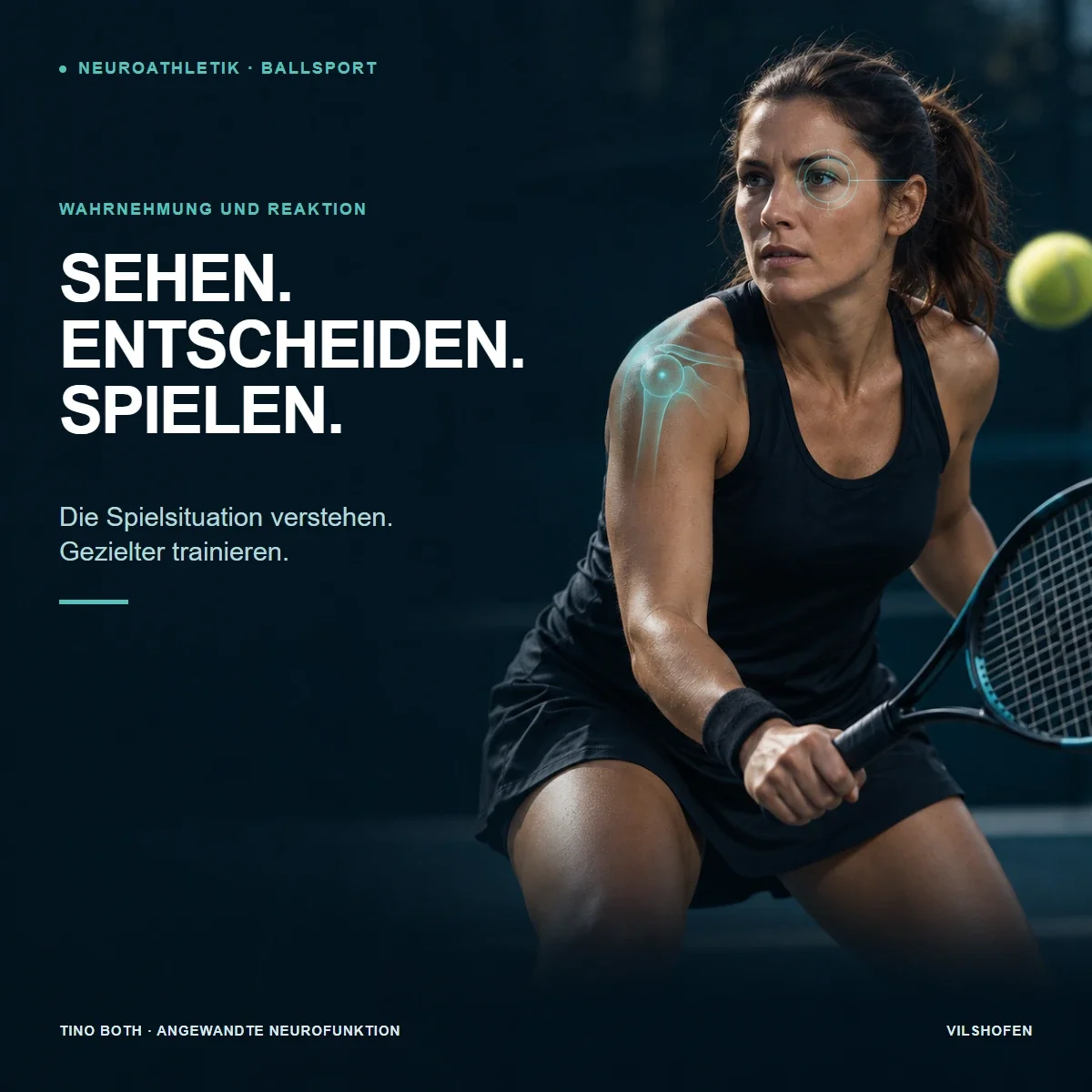
Briefly explained: Neuroathletic training in tennis, handball and other ball sports considers how you recognise relevant information and translate it into suitable movement. What matters is whether a clearly defined game situation works better afterwards, rather than how well an isolated eye exercise goes.
Does it work in practice — but your response is late under time pressure?Describe the game situation: The return, receiving the ball or the moment before a pass. We discuss whether an individual neuroathletic assessment in Vilshofen can provide a useful approach for your training.
Discuss your sporting question →
The initial telephone consultation is free of charge.
Discuss your sporting question →
The initial telephone consultation is free of charge.
You are fast enough. Yet sometimes you are late to the ball.
The first step comes a moment too late. You still reach the ball, but the contact point is awkward. Or in handball, you notice an unmarked teammate only when the gap has closed again. 'Train more speed' then seems obvious. But a more precise question is worthwhile: Was the movement slow — or was the decision late?
This makes a difference to training. A fast initial acceleration helps only to a limited extent if you notice the relevant information late. Conversely, an early decision does not produce a good movement path if braking, positioning or stroke technique cannot keep up. We need a task in which these differences can be observed.
Response begins before the first step
For a return, several cues are available: The opponent's movement, ball contact and subsequent flight path. You need to select what matters now, judge a direction and adapt your movement to it. Team sports add teammates, opponents and tactical options. Not every visible stimulus deserves equal attention.
Three different questions behind 'too slow'Recognising: When do you notice the decisive information?
Deciding: Is the appropriate action clear in good time?
Executing: Does the chosen movement succeed with suitable direction, force and technique?
Deciding: Is the appropriate action clear in good time?
Executing: Does the chosen movement succeed with suitable direction, force and technique?
Neuroathletic training can vary individual demands specifically. A ball with a predictable flight path demands something different from a surprising change of direction. A reaction light demands something different from a real opponent's movements. I therefore choose assessments according to the question they should answer, rather than how spectacular they look.
What the eyes, balance and body awareness contribute
See the ball without losing sight of the gameAt ball contact, a precise view of the ball can matter. At other stages, you need information from the wider visual field. We therefore distinguish looking directly, shifting gaze and perceiving other movements. 'More peripheral vision' is not a universal goal for every situation.
Stay oriented while movingHead and body position change when approaching, turning or stopping. Information from the eyes, balance organs and body helps coordinate movement and orientation. A task may go well standing quietly, while the same decision becomes difficult after a change of direction.
Bring the right information into suitable movementUltimately, sporting output matters: Such as a controlled contact point, an appropriate movement path or timely release of the ball. A change in the perceptual task therefore needs to be connected again with the actual movement.
An example: The return is inaccurate with balls to the side
We begin with a manageable number of comparable feeds. Speed and target area remain the same initially. You describe what becomes difficult; we observe the first step, contact point and placement, for example. Success rate and movement quality are more informative than merely feeling you responded especially quickly.
From the observed difference to a targeted trial1. Starting point: A specific return task is defined and repeated.
2. Narrow down the demand: We compare announced and unannounced feed directions, for example. Speed remains similar.
3. Choose suitable input: If gaze shifts stand out, a short, simpler visual-target task may be useful. If positioning is the problem, we choose another starting point.
4. Identical retest: You repeat the original return task. We compare precision and effort as well as speed.
5. Check transfer: Only then do we increase unpredictability and consider whether the difference remains in a sequence closer to actual play.
2. Narrow down the demand: We compare announced and unannounced feed directions, for example. Speed remains similar.
3. Choose suitable input: If gaze shifts stand out, a short, simpler visual-target task may be useful. If positioning is the problem, we choose another starting point.
4. Identical retest: You repeat the original return task. We compare precision and effort as well as speed.
5. Check transfer: Only then do we increase unpredictability and consider whether the difference remains in a sequence closer to actual play.
A better second result can also arise from repetition or a clearer understanding of the task. We therefore consider several rounds and further training sessions later. A useful exercise should fit your sporting training, rather than simply create a brief moment of insight.
Why a better test result is not yet better play
There is research on perception and decision training, but results depend greatly on the task and training form. A systematic review of team sport distinguishes improvements in trained tasks from transfer to sporting performance. A critical analysis of general perceptual and cognitive training correspondingly cautions against automatically inferring sporting benefit from progress in abstract exercises.
For my work, this means we need a comparison close to the sport. If you improve in a screen task but the return is unchanged, relevant transfer is still missing. We then change the selection or integration of the exercise. Technique, tactics, strength and regular sport practice remain the foundation.
What you can observe before an appointment
Choose one recurring situation rather than a general weakness. Does it happen only at high ball speeds? After switching sides? With many people moving simultaneously? Or only towards the end of training? The difference between a predictable exercise and an open game situation is particularly helpful.
You do not need extra self-tests for this. A short description or suitable training video can be enough. If your coach has already observed something, we are happy to include that perspective. The goal is an addition that can be implemented practically, rather than a second training plan competing with the first.
When sporting performance is not the only issueNew double vision, marked dizziness or symptoms after a collision need professional assessment first. A possible concussion requires a structured, medically supervised approach; a reaction test does not replace this assessment.
Frequently asked questions about neuroathletic training in ball sports
Is neuroathletic training useful only for competitive athletes?No. The question can be adapted to your playing level. In recreational sport too, a clearly selected situation can be more useful than non-specific 'reaction training'. Effort and goal should suit your training.
Can I simply train my reactions with an app?You can practise the particular task in it. Whether this helps your sport must become apparent in a suitable game situation. A faster finger tap and a well-placed return are different performances.
Do I always need to fixate on the ball in tennis?No, the gaze task changes with the phase of play. Ball contact, orientation and tactical overview make different demands. One rigid gaze rule for the entire rally falls short.
How do I know whether an exercise suits me?We establish beforehand which task should change. We then compare the same situation under conditions as similar as possible and check transfer later. A pleasant feeling alone is insufficient.
The next step begins with a game situation
Perhaps you need a more precise question rather than more exercises. What happens between perceiving a situation and your first useful movement? An individual comparison can help begin precisely there — with an addition that must prove useful on the court or pitch.
Would you like to complement your training more specifically?During the initial consultation, we clarify your sporting goal and the appointment process. The service in Vilshofen is also available to athletes from Passau, Deggendorf and the rest of Lower Bavaria.
Find a suitable start to neuroathletic training →
The initial telephone consultation is free of charge.
Find a suitable start to neuroathletic training →
The initial telephone consultation is free of charge.
Related pages and articles
Perception and decision-making in sportVisual training in sport — why good vision is more than visual acuity
Reaction training in sport — why fast responses are more than fast muscles
Neuroathletic training and balance in sport — why balance is more than standing on one leg
Reaction training in sport — why fast responses are more than fast muscles
Neuroathletic training and balance in sport — why balance is more than standing on one leg
Complement training specificallyNeuroathletic training for strength sports — when tension, stability and strength cannot be accessed reliably
Neuroathletic exercises: Why general exercises are often insufficient
Neuroathletic training for sports clubs — modern performance assessment in team training
Neuroathletic exercises: Why general exercises are often insufficient
Neuroathletic training for sports clubs — modern performance assessment in team training
Relevant areas of focus in VilshofenNeuroathletic training and performance optimisation
How I work: Angewandte Neurofunktion
How I work: Angewandte Neurofunktion
Sources and further reading
Systematic review and meta-analysis (2024): Perception and decision training in team sport
Fransen and colleagues (2024): Transfer of general perceptual and cognitive training to sporting performance
Fransen and colleagues (2024): Transfer of general perceptual and cognitive training to sporting performance