

← All articles
Neuroathletic training & performance
Reaction training in sport – why fast reactions involve more than fast muscles
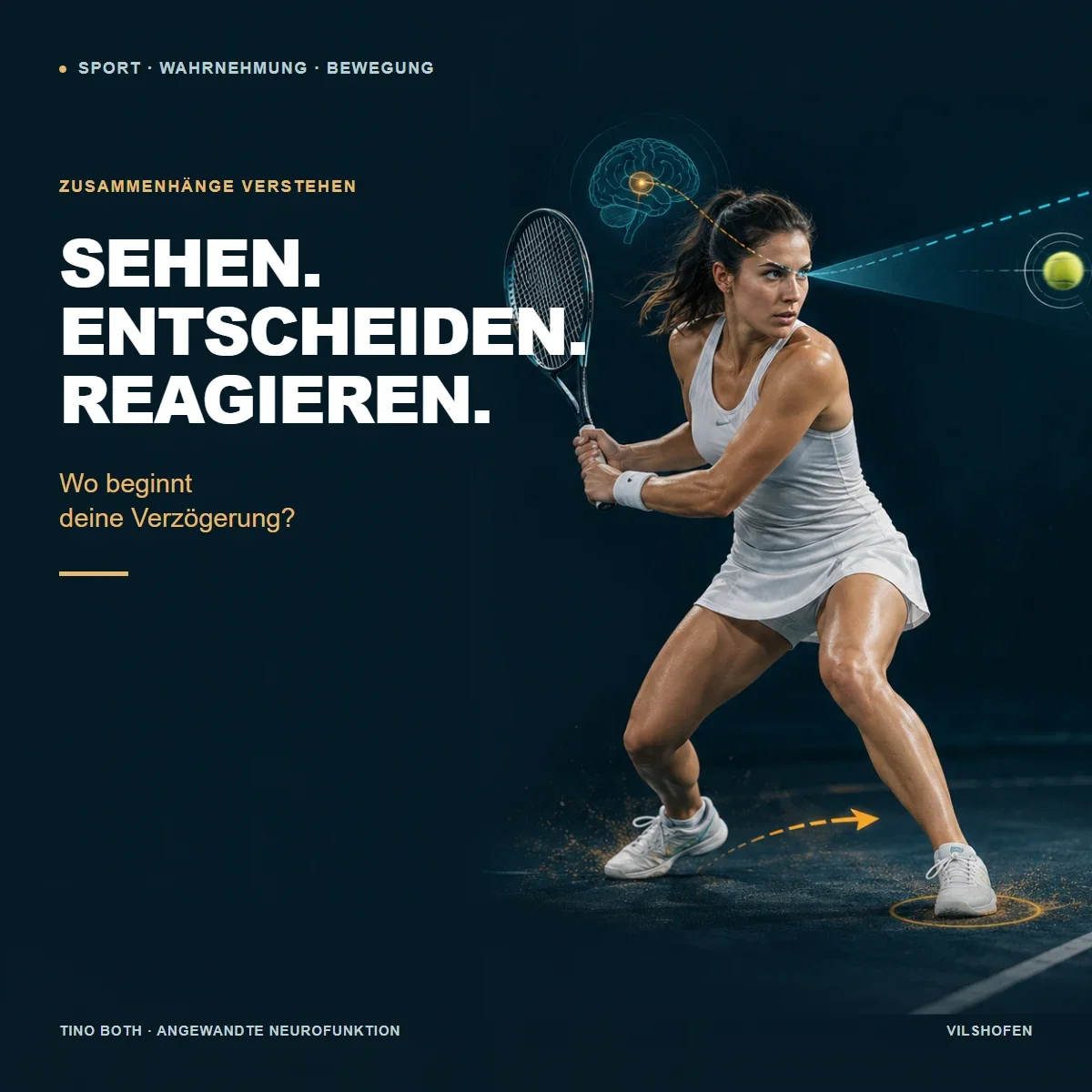
Briefly explained: Reaction training involves more than pressing a button as quickly as possible. In sport, you need to recognise a stimulus, select the correct action and execute it. Which of these demands is difficult determines the appropriate exercise.
Do you react later in a game than you could?In the free initial telephone consultation, you describe your sporting goal. We establish whether an individual appointment or a workshop in Vilshofen would be a suitable addition for you or your team.
Arrange a free initial telephone consultation →
Arrange a free initial telephone consultation →
You are fast – but sometimes still too late
Your first step is powerful and your sprint time is good. You still recognise the open side only when the opponent is already moving. More sprint training might then not be the only appropriate answer. Reaction begins with what you perceive in time.
In sport, we distinguish between a familiar signal with a familiar response and a situation in which you first need to choose. Anticipation also plays a part: experienced athletes use early cues before the action is fully visible.
Considering recognition, decision-making and action separately
In a simple reaction, the response is clear in advance. In a choice reaction, you need to select from several possibilities. In a game, it is also often unclear which signal matters at that moment. A quick false start then offers little help.
That is why I am interested in more than time alone. How many responses were correct? Which direction was confused? Was the stimulus visible, but interpreting it difficult? Or do both succeed, with the delay occurring only in the movement?
Why the eyes alone do not provide game awareness
Gaze shifts help you switch between important targets. Peripheral perception allows you to notice cues beside the central gaze target. Gaze stability becomes important when your head is moving.
These functions work together with attention, knowledge of the sport and movement experience. A light signal on a wall is therefore not equivalent to an opponent’s feint. Transfer must suit the sport.
A possible assessment approach: the stimulus is seen – but correctly interpreted only late
Starting situationA tennis player seems to react more slowly to the left. We do not immediately test her sprint. First, while looking at a central target, she names a symbol shown to the side. She then uses that symbol to choose between two actions. Only in the third comparison is the first step added. This allows perception, interpretation and movement to be observed separately.
Make targeted distinctionsFor example, a brief, light vibration on the sole of the foot can be assessed as a possible body-related input. This initially seems surprising: we change a piece of body information and then test the same visual task. I keep the gaze target, quadrant and distance the same. Another variation would be a small guided hand movement; the two stimuli are initially compared separately.
Compare againIf recognition changes, the decision with a step follows again. Only if the benefit is also present there does this become a useful addition to tennis training. Responding faster without the correct decision would not be progress.
Football, combat sports and ball sports demand different cues
Football: take in the space before receiving the ball, recognise an open side and prepare the next action. The stimulus is the whole game situation, as well as the ball.
Combat sports: distinguish distance, rhythm and early cues from the shoulder, hip or a weight shift. Recognising a pattern earlier means you do not have to react frantically at the last moment.
Tennis, handball, basketball, badminton and table tennis: flight path, the opponent’s position, space and timing are weighted differently. A suitable training task represents a meaningful part of these demands.
Orientation and body position are part of the task
The correct decision needs to be translated into movement. After a turn or contact, the demands differ from those of standing quietly. Balance and body awareness can therefore be relevant to the same reaction task.
I would not immediately make the combination as difficult as possible. The signal can initially be compared while standing safely, then with a small step, and later with a suitable additional demand.
What reaction lights can and cannot do
Lights, balls and random signals can be useful tools. They do not automatically make every training session closely resemble the sport, however. If the actual problem is recognising an opponent’s early movement, an improved light-system score is insufficient evidence.
A useful re-test compares the same starting conditions, stimulus positions and response rules. The sequence can vary so that the test does not simply measure memorisation. A sporting task relevant to the goal then follows.
How this becomes an individual addition
If a particular input is repeatedly helpful, it can lead to a short preparatory task. It is dosed so that it does not cause fatigue or symptoms before the main training.
In Vilshofen, we can explore the question behind a delayed reaction in an individual appointment or an agreed club format. The goal remains the action in sport, rather than a collection of increasingly complicated exercises.
Frequently asked questions
Are reaction lights useful?They can be used to create a task. Whether they fit your sporting goal depends on the stimulus, decision and movement demand.
Can a quick button press predict my reactions in a game?Only to a limited extent. In a game, perception, selection, timing and sport-specific movement come together.
What is compared in the re-test?Time as well as correct decisions, movement execution and transfer to the actual sporting task.
Sources and further reading
Related pages and articles
Explore sport and perception furtherNeuroathletic training and performance optimisation
Neuroathletic training in competitive sport: a more targeted addition
Neuroathletic training in football – see faster, react faster, make better decisions
Gaze stability in sport – why stable eye movements affect performance
Taking a functional look at visual disturbances and visual processing
Taking a functional look at dizziness & balance
My approach: Angewandte Neurofunktion
Neuroathletic training in Lower Bavaria: athletes, clubs, coaches
Return to play: neuroathletic training after injuries
Neuroathletic training in competitive sport: a more targeted addition
Neuroathletic training in football – see faster, react faster, make better decisions
Gaze stability in sport – why stable eye movements affect performance
Taking a functional look at visual disturbances and visual processing
Taking a functional look at dizziness & balance
My approach: Angewandte Neurofunktion
Neuroathletic training in Lower Bavaria: athletes, clubs, coaches
Return to play: neuroathletic training after injuries
What would be a helpful next step for you?A specific sporting task is a good starting point.
Request your free initial telephone consultation here →
Request your free initial telephone consultation here →