

← All articles
Neuroathletic training & performance
Neuroathletic training after injuries – taking a functional look at return to play
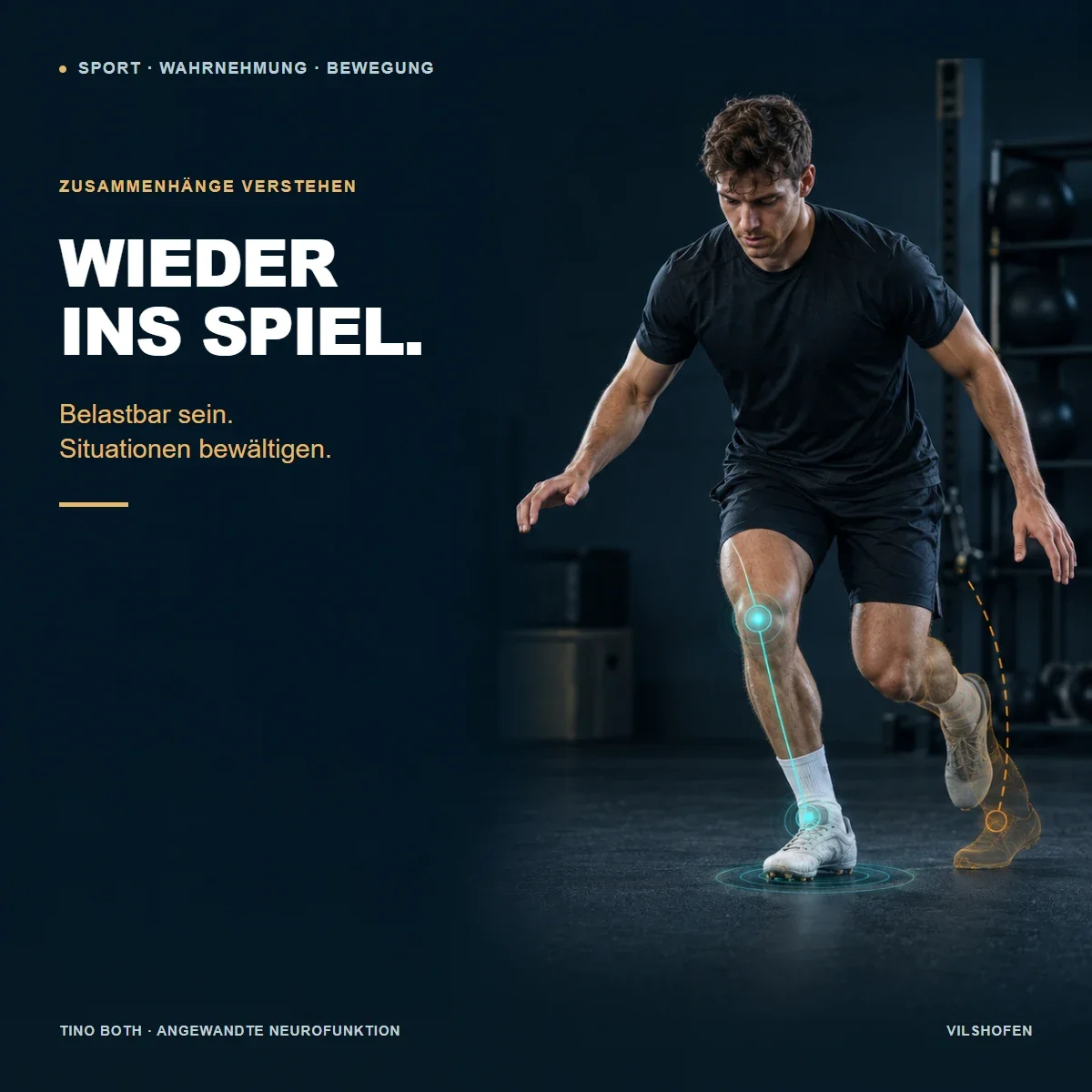
Briefly explained: After an injury, being pain-free does not automatically mean being ready to compete. Alongside tissue healing and load tolerance, orientation, reaction and confidence also matter. Neuroathletic training can complement a coordinated return.
You are back in training, but do not yet feel confident in a game?In the free initial telephone consultation, you describe your sporting goal. We establish whether an individual appointment or a workshop in Vilshofen would be a suitable addition for you or your team.
Arrange a free initial telephone consultation →
Arrange a free initial telephone consultation →
Back in training – but not yet settled back into the game
Your strength scores are better. The movement has medical clearance. You still hesitate when changing direction, however, or do not yet trust your leg after a landing. These differences are part of returning to sport and deserve specific consideration.
Return to play is not a single good test. It is a coordinated process: from initial participation through returning to the sport to the desired performance level. Medical professionals, the coaching team and the athlete need to consider the demands together.
Load tolerance and a complex sporting task are not identical
A controlled jump differs from landing after body contact. A planned sprint differs from accelerating in response to a late signal. Gaze shifts, speed, fatigue and decisions change the task.
Neuroathletic training can gradually include these additional demands. This does not automatically assume that every uncertainty is a nervous system disorder. What matters is which combination is still difficult and how it can be adapted safely.
Body awareness after an injury
Joint position, skin contact and the perception of loading can feel different after an injury. Protective behaviour and experience also play a part. An athlete therefore needs more strength as well as suitable opportunities to experience movement with control again.
I initially compare manageable demands. If standing succeeds without head movement but not when the head turns, this is a different question from standing that is already unsteady under basic loading.
A possible assessment approach: the ankle holds up – the gaze shift creates unsteadiness
Starting situationAfter medically cleared ankle rehabilitation, an athlete stands steadily on one leg. When she looks towards a teammate to the side, she puts the other foot down. I begin by comparing the same stance with a steady gaze, eye movement and a small head movement, rather than choosing an even more unstable surface. We protect against falls during the task.
Make targeted distinctionsIf head movement is particularly difficult, we initially assess gaze stability while sitting safely. A small, well-tolerated range of movement can be an initial training stimulus. The same standing comparison then follows. This helps us distinguish whether the load on the leg itself or the additional orientation task makes the difference.
Compare againThe next step is transfer: initially a controlled step, followed later by a sport-specific situation. Clearance for training and competition remains a joint decision with the treatment and support team.
Three typical starting regions
Ankle: after a sprain, areas of interest include foot contact, balance, changes in loading and later unpredictable demands. Not every feeling of instability has the same background.
Knee: strength and mobility matter. Landing, deceleration, changing direction and decision-making under sporting time pressure are also involved. Progression follows the agreed rehabilitation plan.
Shoulder: alongside local load tolerance, the trunk, shoulder position, gaze and head movement can be considered during an overhead task. A controlled movement attempt comes before complex throwing loads.
Confidence is a practical question
‘I still do not feel confident enough’ should neither be dismissed nor automatically treated as a psychological problem. The experience of an injury can shape expectations of a movement. Physical prerequisites also remain relevant.
A useful comparison may involve a task with a reliable signal and one with a small degree of unpredictability. Demands are increased only when the simpler variation is well supported. Tests of courage are not a necessary part of this approach.
Which function is reassessed after an input
A targeted stimulus might involve gaze stability, clearer foot contact or a suitable orientation task. The same starting test and a comparison in a sporting context then follow. Execution, effort and sense of safety all belong in the assessment.
A short-term improvement is not immediately equated with unrestricted readiness to compete. Repeatability, the response to loading and interaction with previous rehabilitation determine further use.
An addition to coordinated rehabilitation
I work with Angewandte Neurofunktion in Vilshofen. If a specific sporting question remains after an injury, we can discuss in an initial consultation whether an additional functional assessment would be suitable.
Return to competition and the medical assessment of load tolerance remain coordinated with your treatment and sporting support teams.
Frequently asked questions
Does being pain-free already mean being ready to compete?No. Load tolerance, sporting demands and coordinated clearance need to fit together.
Why is vision also considered after a leg injury?A sporting task can demand additional gaze shifts and orientation. Specific comparisons explore whether this is relevant.
Who decides on a return to competition?The decision is coordinated with medical and sporting support. A single functional re-test does not replace this decision.
Sources and further reading
Related pages and articles
Explore sport and perception furtherNeuroathletic training and performance optimisation
Neuroathletic training in competitive sport: a more targeted addition
Neuroathletic training in football – see faster, react faster, make better decisions
Gaze stability in sport – why stable eye movements affect performance
Reaction training: see, decide, act faster
Taking a functional look at pain & functional symptoms
Taking a functional look at dizziness & balance
My approach: Angewandte Neurofunktion
Neuroathletic training in Lower Bavaria: athletes, clubs, coaches
Neuroathletic training in competitive sport: a more targeted addition
Neuroathletic training in football – see faster, react faster, make better decisions
Gaze stability in sport – why stable eye movements affect performance
Reaction training: see, decide, act faster
Taking a functional look at pain & functional symptoms
Taking a functional look at dizziness & balance
My approach: Angewandte Neurofunktion
Neuroathletic training in Lower Bavaria: athletes, clubs, coaches
What would be a helpful next step for you?A specific sporting task is a good starting point.
Request your free initial telephone consultation here →
Request your free initial telephone consultation here →