

← All articles
Neuroathletic training & performance
Neuroathletic training for competitive athletes in Bavaria – when the final few per cent are missing
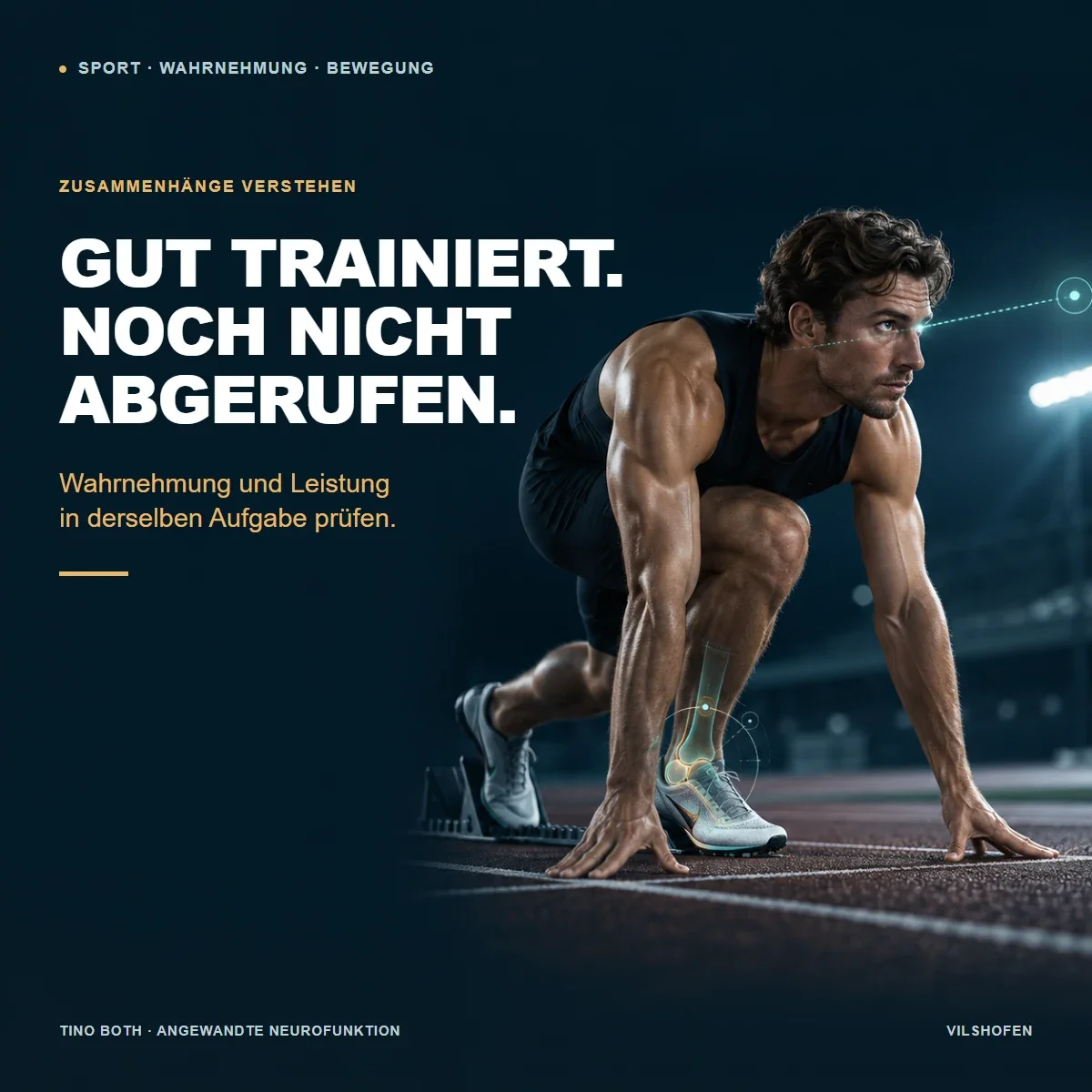
Briefly explained: In competitive sport, neuroathletic training can integrate perception and movement control into existing training more specifically. What matters is whether the target sporting task improves, rather than a striking individual test.
Strength and technique are sound – but a particular situation still is not?In the free initial telephone consultation, you describe your sporting goal. We establish whether an individual appointment or a workshop in Vilshofen would be a suitable addition for you or your team.
Arrange a free initial telephone consultation →
Arrange a free initial telephone consultation →
The basic scores are sound – one combination is not yet
In competitive sport, strength, technique and load planning have often already received intensive attention. There are still situations in which an athlete cannot reliably access their performance level: after a turn, under pressure from opponents or when switching quickly between several targets.
This is precisely where a targeted assessment of perception and function can provide an additional perspective. Not every performance limit can be explained neurofunctionally. The work therefore begins with a precisely defined task.
What else can be considered
In sport, vision involves more than visual acuity. Gaze shifts, peripheral perception, moving targets and gaze stability face different demands depending on the sport. Head movement and body position influence orientation at the same time.
A good assessment initially separates these demands. An athlete may recognise a symbol reliably while sitting, but use the same information later after a fast movement. This difference matters more for selection than a blanket label such as ‘poor reaction’.
Not every unusual detail needs training
Screening can reveal many differences. A finding becomes relevant when it fits the goal, situation and course of events. Otherwise, the list of exercises simply grows without the sporting task improving.
I therefore assess with a selected starting marker, apply a suitable stimulus and repeat the comparison. An improved individual response is then transferred to the sporting action.
A possible assessment approach: good sprint scores, but a delay after looking over the shoulder
Starting situationAn athlete starts quickly in response to a familiar signal. After a look over the shoulder, acceleration appears more hesitant. I therefore compare the same starting task first without an addition, then with a gaze shift alone, and finally with a small head turn. The goal is to find the difficult combination, rather than demand the maximum from the athlete.
Make targeted distinctionsIf gaze stability shows a relevant finding, it is trained specifically at a low dose. The identical starting comparison then follows, with the same starting position and signal. Time, false starts and subjective confidence all belong in the assessment.
Compare againIf only an isolated eye test improves, but the start does not, the sporting benefit remains unclear. The coach is therefore involved in deciding whether and where the addition fits into the warm-up or technique training.
What different sports demand
In football and handball, scanning ahead, decisions and body contact need to work together. In tennis, early cues, flight path and timing matter. Combat sports add distance, deception and changes in orientation.
Strength sports and weightlifting demand precise body positions under load. In running and endurance sports, the surface, rhythm and gaze stability can be relevant. These differences argue against a standard programme of the same eye exercises for everyone.
Working with the coaching team and training plan
An individually helpful stimulus can be integrated into a warm-up, technique preparation or a separate short session. Team options include workshops, targeted screening days and further training for coaches.
The effort needs to match the benefit. A complex drill that causes fatigue before competition is not automatically useful because it looks demanding. The course over several training days matters as much as the immediate response.
Dosing additional demands after injuries
An athlete may tolerate loading again yet still feel uncertain during unpredictable actions. Familiar and variable tasks, gaze shifts and orientation are then compared gradually.
Medical clearance and the existing rehabilitation plan remain the foundation. Neuroathletic training can help describe additional sporting demands more precisely and integrate them appropriately into further progression.
Performance optimisation needs a clear benchmark
We should state beforehand what should improve: fewer incorrect decisions, a more reliable first step, more stable landings or a better-tolerated sporting combination. ‘Optimising the nervous system’ alone is too vague for this.
An assessable question therefore sits at the centre of my work in Vilshofen. Athletes and coaches from Lower Bavaria can establish in an initial consultation whether an individual appointment or a group format would be suitable.
Frequently asked questions
Does neuroathletic training replace strength or technique training?No. It can add to specific questions of perception and control, and should fit into existing training.
Does an athlete need to train every sensory function?No. Selection depends on the goal and the demands observed.
How do I recognise a benefit?Through repeatable changes in the relevant sporting task, rather than an improved isolated test alone.
Sources and further reading
Related pages and articles
Explore sport and perception furtherNeuroathletic training and performance optimisation
Visual disturbances & visual processing
Dizziness and balance
My approach: Angewandte Neurofunktion
Appointment options
Neuroathletic training in Lower Bavaria: athletes, clubs, coaches
Return to play: neuroathletic training after injuries
Reaction training: see, decide, act faster
Visual disturbances & visual processing
Dizziness and balance
My approach: Angewandte Neurofunktion
Appointment options
Neuroathletic training in Lower Bavaria: athletes, clubs, coaches
Return to play: neuroathletic training after injuries
Reaction training: see, decide, act faster
What would be a helpful next step for you?A specific sporting task is a good starting point.
Request your free initial telephone consultation here →
Request your free initial telephone consultation here →