

← All articles
Neuroathletic training & performance
Neuroathletic training in Lower Bavaria – a contact for athletes, clubs and coaches
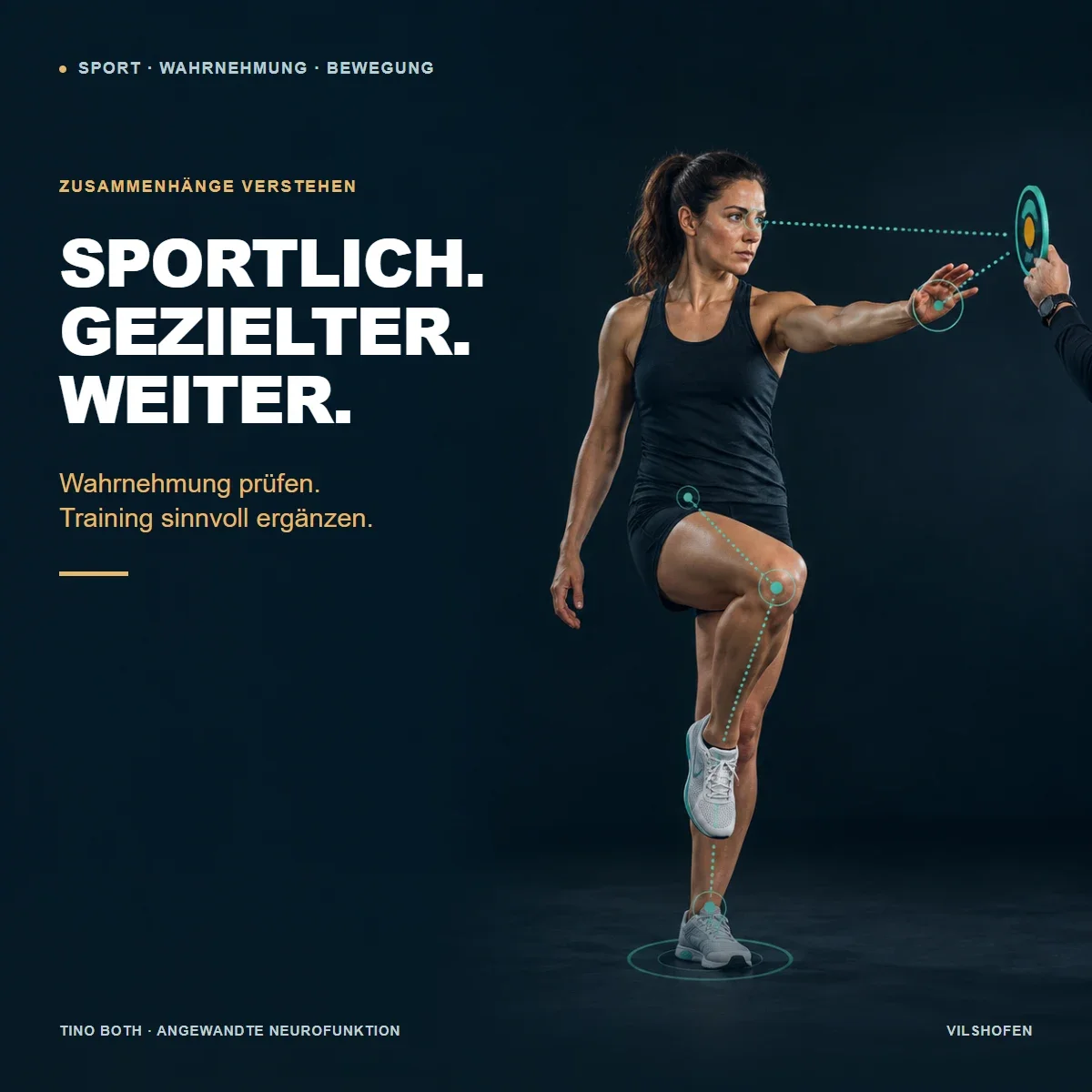
Briefly explained: Neuroathletic training complements sports training with targeted assessment of vision, balance and body awareness. In Vilshofen, I work with individual athletes, clubs and coaching teams – starting with a specific sporting task.
Which movement or game situation is holding you back at the moment?In the free initial telephone consultation, you describe your sporting goal. We establish whether an individual appointment or a workshop in Vilshofen would be a suitable addition for you or your team.
Arrange a free initial telephone consultation →
Arrange a free initial telephone consultation →
You are training – but a particular situation remains difficult
You can change direction when you know what is coming, but in a game you are too late. On a quiet surface you are stable, but after a turn you need an extra step. These differences offer a useful starting point for neuroathletic training: understanding a specific task better, rather than a general aim of ‘more performance’.
In Vilshofen, I work with athletes, clubs and coaching teams from Lower Bavaria. Existing strength, technique and endurance training is retained. I add a targeted consideration of perception and movement control.
Which information your sport demands
Visual information helps you judge the ball, opponents, space and speed. The balance system provides information about head movement and orientation relative to gravity. Proprioception – awareness of your own body – helps you perceive joint positions and movement.
These areas work together. In an assessment, however, it helps to separate the demands initially: is shifting gaze difficult, is it the head movement, or does the difficulty arise only when combined with a quick step? This leads to a more precise training decision.
A different focus for each sport
Football: scanning ahead, peripheral perception, gaze shifts and decisions before receiving the ball. Combat sports: distance, early movement cues, timing and orientation after evasive movements.
Tennis, handball and basketball: ball flight, changing targets and coordination between recognising and acting. Strength sports: body position, breathing and orientation under a controlled load.
Running and endurance sports: rhythm, changing surfaces and gaze stability during movement. Youth sport: playful coordination, suitable tasks and enjoyment of trying things out. There is therefore no identical neuro programme for everyone.
A possible assessment approach: why does changing direction work only when you know what is coming?
Starting situationA footballer can safely perform a predetermined change of direction. As soon as a partner indicates the direction at a late stage, the first step falters. I therefore separate the tasks initially: does he recognise the signal in time? Does he name the correct side? Can he then make the step? The same starting position and comparable signals make the difference visible.
Make targeted distinctionsIf information from the sides is particularly difficult, I assess peripheral perception while the gaze rests on a central target. A brief visual or body-related stimulus suited to the finding is added individually. We then repeat the perception task first and the change of direction afterwards. This turns ‘You need to be faster’ into a specific training question.
Compare againIn a club, this can lead to a short individual warm-up. We assess whether it is useful through the sporting task and again later in training – not simply because an unfamiliar exercise looks good.
How an individual appointment might be structured
Your goal comes first. As a starting marker, we might choose stable standing, a change of direction or a sport-specific movement. We then assess possible component demands and add a targeted stimulus.
This may be a visual task, a small head movement stimulus, a clear contact on the skin or a joint, or other suitable body information. Breathing and mental demands may also be involved. The identical re-test initially shows how you respond to this selection.
What clubs and coaches can take away
Options for clubs include workshops, team sessions, introductory talks, screening days or further training for coaching teams. What matters is that the content suits the participants’ age, sport and everyday routine. An additional task should have an understandable purpose, as well as looking interesting.
A coach does not then need to assess every function in every athlete. A clear sequence is more helpful: choose a goal, narrow down the demand, dose the stimulus, compare and transfer it to the sporting task.
After injuries and at performance plateaus
When medically approved loading is possible again, but confidence or orientation is missing, an additional assessment of more complex demands may be useful. Tissue healing and a coordinated return to sport remain the foundation.
A precise goal is also worthwhile at a plateau: which aspect of performance should change, and under what conditions? More practice does not automatically mean more benefit if a different demand has actually remained unclear.
Working together locally
I am based in Vilshofen an der Donau, also serving athletes and clubs from Passau, Deggendorf, Plattling, Osterhofen and the wider Lower Bavaria region. For group formats, we discuss the location, duration and content separately.
You can describe your concern in the initial consultation. This helps establish whether an individual appointment, a workshop or another first step is appropriate.
Frequently asked questions
Does our club need a completely new training concept?No. Small additions, whose benefit is assessed through an existing sporting task, are often useful.
Is a workshop or an individual appointment better?A workshop is suited to learning together. An individual question can be explored more closely in an individual appointment.
Where does the work take place?I am based in Vilshofen. Formats for clubs and coaching teams are discussed to suit their particular circumstances.
Sources and further reading
Related pages and articles
Explore sport and perception furtherNeuroathletic training and performance optimisation
Neuroathletic training in competitive sport: a more targeted addition
Neuroathletic training in football – see faster, react faster, make better decisions
Gaze stability in sport – why stable eye movements affect performance
Reaction training: see, decide, act faster
Return to play: neuroathletic training after injuries
Neuroathletic training in combat sports – perceive faster, react better, move more steadily
Taking a functional look at dizziness & balance
Taking a functional look at visual disturbances and visual processing
My approach: Angewandte Neurofunktion
Neuroathletic training in competitive sport: a more targeted addition
Neuroathletic training in football – see faster, react faster, make better decisions
Gaze stability in sport – why stable eye movements affect performance
Reaction training: see, decide, act faster
Return to play: neuroathletic training after injuries
Neuroathletic training in combat sports – perceive faster, react better, move more steadily
Taking a functional look at dizziness & balance
Taking a functional look at visual disturbances and visual processing
My approach: Angewandte Neurofunktion
What would be a helpful next step for you?A specific sporting task is a good starting point.
Request your free initial telephone consultation here →
Request your free initial telephone consultation here →