

← All articles
Neuroathletic training & performance
Neuroathletic training in combat sports: reaction begins before the punch
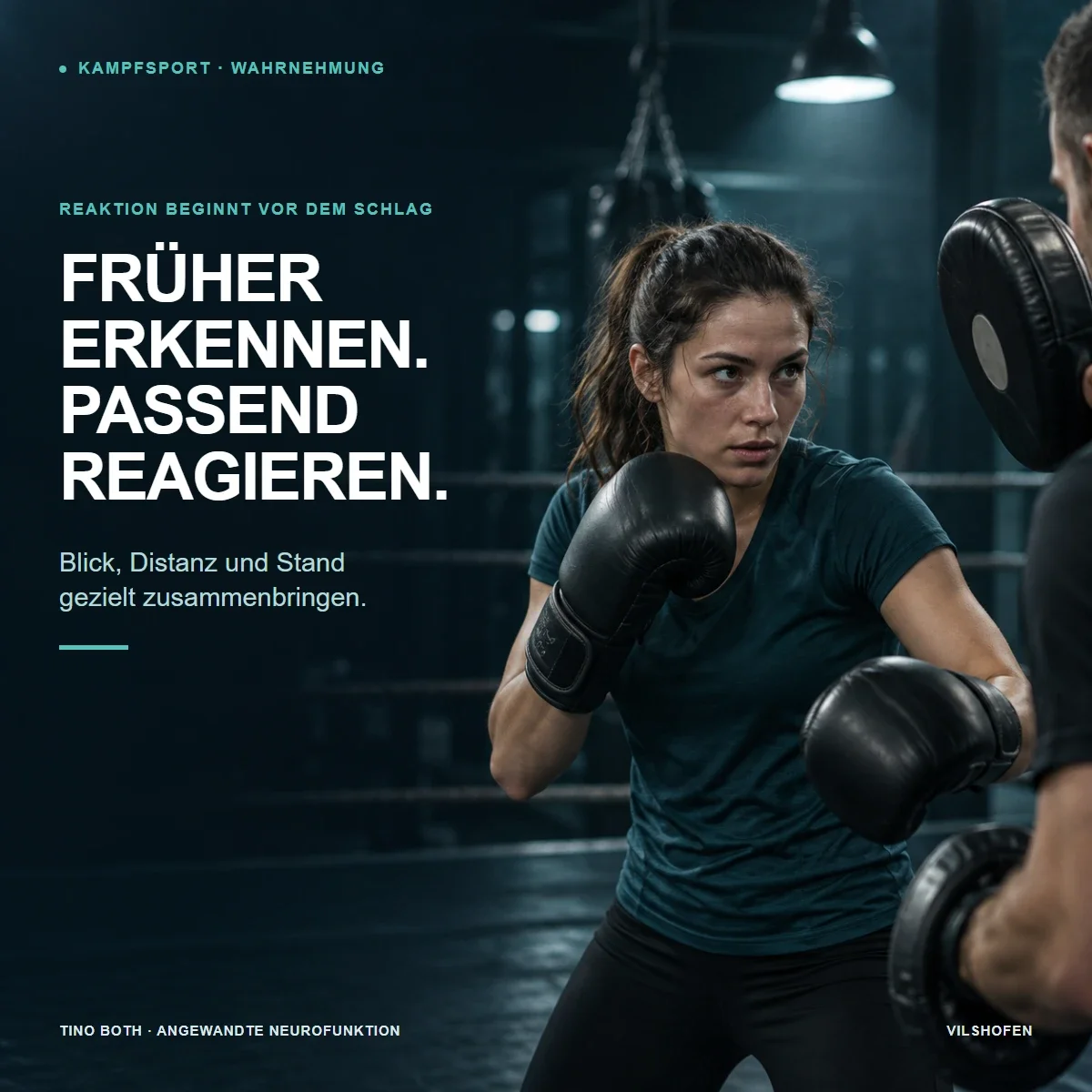
Briefly explained: Neuroathletic training in combat sports considers how perception, orientation and body control support a sporting action. Reacting late does not necessarily mean you are slow: perhaps you recognise the relevant cue late, the response is unclear, or your starting position makes movement difficult. These are precisely the differences that can be explored in a sporting context.
Fast on the pads – but still a step too late in sparring?Describe the situation in which your reaction does not match the technique you have trained. We establish whether an individual assessment of perception, gaze control and movement offers a useful approach to training.
Discuss your combat sport concern in an initial consultation →
The initial telephone consultation is free.
Discuss your combat sport concern in an initial consultation →
The initial telephone consultation is free.
The punch is fast. The decision before it is not always.
You can perform a familiar combination quickly. As soon as your opponent acts freely, the task changes: you need to recognise what is beginning, distinguish a feint from a real action, and move appropriately from your current position. Fast hands alone do not solve this part.
Reaction in combat sports therefore involves more than the time between a light signal and a button press. A reaction device can measure a clearly defined component task. Whether you make timely use of your opponent’s distance, weight shift or movement onset becomes apparent only in a situation designed accordingly.
Three different reasons for a late response
The cue reaches you lateYou keep your gaze on a single point for a long time and notice another movement starting only late. What becomes interesting here is which information you actually use – not how quickly you can move your eyes at random.
The cue is there, but the response is still undecidedA familiar signal is followed by the practised technique. With several possibilities, you need to choose and sometimes stop a movement you have already prepared. This decision-making demand belongs in the assessment.
You know what to do, but your stance is unhelpfulYour weight distribution or joint position does not suit the intended action. A reaction that appears slow may then also relate to the repositioning required. More speed without a suitable starting position does not automatically improve the sequence.
Recognising earlier does not mean looking at everything at once
Experienced combat athletes use preparatory movement information before an action is fully executed. This is called anticipation. A systematic review of anticipation in combat sports describes differences between experienced and less experienced athletes. This supports the importance of sport-specific perception, but does not provide a blanket promise of success for any particular supplementary training.
In practice, this means that the right cue at the right time matters more than looking around frantically. Which gaze strategy fits depends on the sport and situation. Boxing at a distance makes different demands from grappling. One fixed, prescribed gaze position would be too broad an approach.
How a functional assessment in a sporting context begins
I first want to know where the action breaks down. A brief description or suitable training footage can help: does it happen on a particular side, when moving backwards, after a change of direction, or only with several choices? Fatigue and your current training load also belong in this context.
We then choose a safe, repeatable task. For example, a familiar response on a striking pad is compared with a simple choice task. Speed, distance and permitted responses are initially specified. We observe speed as well as strike quality, incorrect decisions and stance control.
Possible example: two signals, one clear responseYou respond reliably to a single pad signal. As soon as you need to choose between two familiar responses, mix-ups occur. We initially reduce the speed, keep the starting position constant and compare the tasks. A visual or coordination stimulus with a clear rationale is then tried briefly. The same signals and conditions return in the re-test. Only when the selection succeeds in a way we can understand does the task become more open again.
One faster attempt is not enough to make a training decision. Repetitions show whether the response is becoming more accurate or whether there was simply more guessing. Speed and the number of errors belong together. This avoids treating a lucky hit as evidence that an exercise is suitable.
Gaze control and balance in the specific movement pattern
A clearly visible stationary target, a gaze shift and a quick head movement involve different functions. If your gaze becomes unclear during an evasive movement, a separate look at head-eye coordination may be useful. If the technique falters mainly from a particular stance, that stance deserves attention.
A position at the edge of the training area can, for example, present different demands from free movement in the centre. We can recreate the relevant angle, weight distribution and available movement direction at a controlled speed. This retains the connection to the actual action, rather than merely improving an arbitrary balance score.
The sporting task determines the benefitBetter single-leg standing is interesting. For your combat sport, it also matters whether the relevant evasive movement, distance adjustment or technical response benefits from it.
How this becomes a training component
Neuroathletic stimuli are not added as the longest possible extra list. An entry point might be a short gaze task, a suitable change of body position or a clearly dosed coordination demand. Selection and scope depend on the previous observation and the re-test.
The component is then linked back to technique and decision-making. A controlled movement can become a choice task, followed later by a situation that is closer to the sport. Collaboration with your specialist coach remains valuable: they know the technical and tactical demands that a general functional test cannot fully represent.
In my work in Vilshofen, this complements existing training. The aim is not to devalue strength, conditioning or technical repetitions. It is to describe a previously unclear limitation more precisely and choose the next training step specifically.
What you can observe before an appointment
A specific comparison is helpful: a fixed combination versus free choice, a fresh start versus a later stage of training, moving forwards versus evading. Note whether you recognise the signal late, confuse the response or cannot move out of the position. These are different tasks, even if they all feel like being ‘too slow’.
Do not try new supplementary exercises without assessing them first, directly before hard sparring. Stop a variation that causes dizziness, blurred vision or marked unsteadiness. You need neither maximum speed nor blows to the head for a useful comparison.
After blows to the head, other priorities apply
Headache, dizziness, nausea, confusion or new visual problems after a blow can indicate a concussion. Do not continue fighting or use eye exercises to test a return; seek medical assessment instead. After a concussion, return to sport is gradual and professionally supervised. Increasing drowsiness, repeated vomiting, seizures or neurological deficits are emergency signs.
Frequently asked questions about neuroathletic training in combat sports
Does neuroathletic training automatically make my punches faster?No. The assessment explores which component demand is limiting you. Technique, strength, distance, perception and decision-making may contribute in different ways. The benefit needs to be evident in your sporting task.
Are reaction lights useful?They can provide a defined reaction task. Whether progress transfers to sparring depends on how similar the information and response practised are to the actual situation.
Is this also suitable for judo or other grappling sports?The basic question of perception and movement control remains relevant. Tests and exercises must suit the sport, however; a boxing example is not transferred unchanged to grappling.
Do I already need a high level of performance?No. What matters is a specific goal and an appropriate load. In recreational sport too, a differentiated assessment can help make your training more targeted.
Beyond getting faster – act appropriately earlier
The most interesting question is often not whether you can punch even faster. It is: which information and position do you need to make your existing technique available at the right moment? This is where neuroathletic training becomes specific.
Do you have a recurring situation that does not run smoothly?Tell me your sport, training goal and the moment when it becomes difficult. In the free consultation, we discuss whether a functional appointment in Vilshofen is suitable for you.
Take a more targeted look at your training →
The initial telephone consultation is free.
Take a more targeted look at your training →
The initial telephone consultation is free.
Related pages and articles
Perception and movement in sportNeuroathletic training in ball sports: see, decide and respond appropriately
Neuroathletic training in strength sports: use strength and movement with control
Neuroathletic training and balance in sport – why balance involves more than single-leg standing
Neuroathletic training in strength sports: use strength and movement with control
Neuroathletic training and balance in sport – why balance involves more than single-leg standing
Understanding gaze control more closelyGaze fixation: why stable vision matters for everyday life, reading and orientation
Saccades: why gaze shifts matter for reading and orientation
VOR explained simply – why the vestibulo-ocular reflex keeps gaze stable
Saccades: why gaze shifts matter for reading and orientation
VOR explained simply – why the vestibulo-ocular reflex keeps gaze stable
Relevant areas of focus in VilshofenNeuroathletic training and performance optimisation
Visual disturbances and visual processing
My approach: Angewandte Neurofunktion
Visual disturbances and visual processing
My approach: Angewandte Neurofunktion
Sources and further reading
Zhang et al.: Perceptual anticipation in combat sports (2022) – systematic review and meta-analysis.
CDC HEADS UP: Returning to Sports – return to sport after concussion.
CDC HEADS UP: Returning to Sports – return to sport after concussion.