

← All articles
Neuroathletic training & performance
Balance in sport: Why standing on one leg alone is not enough
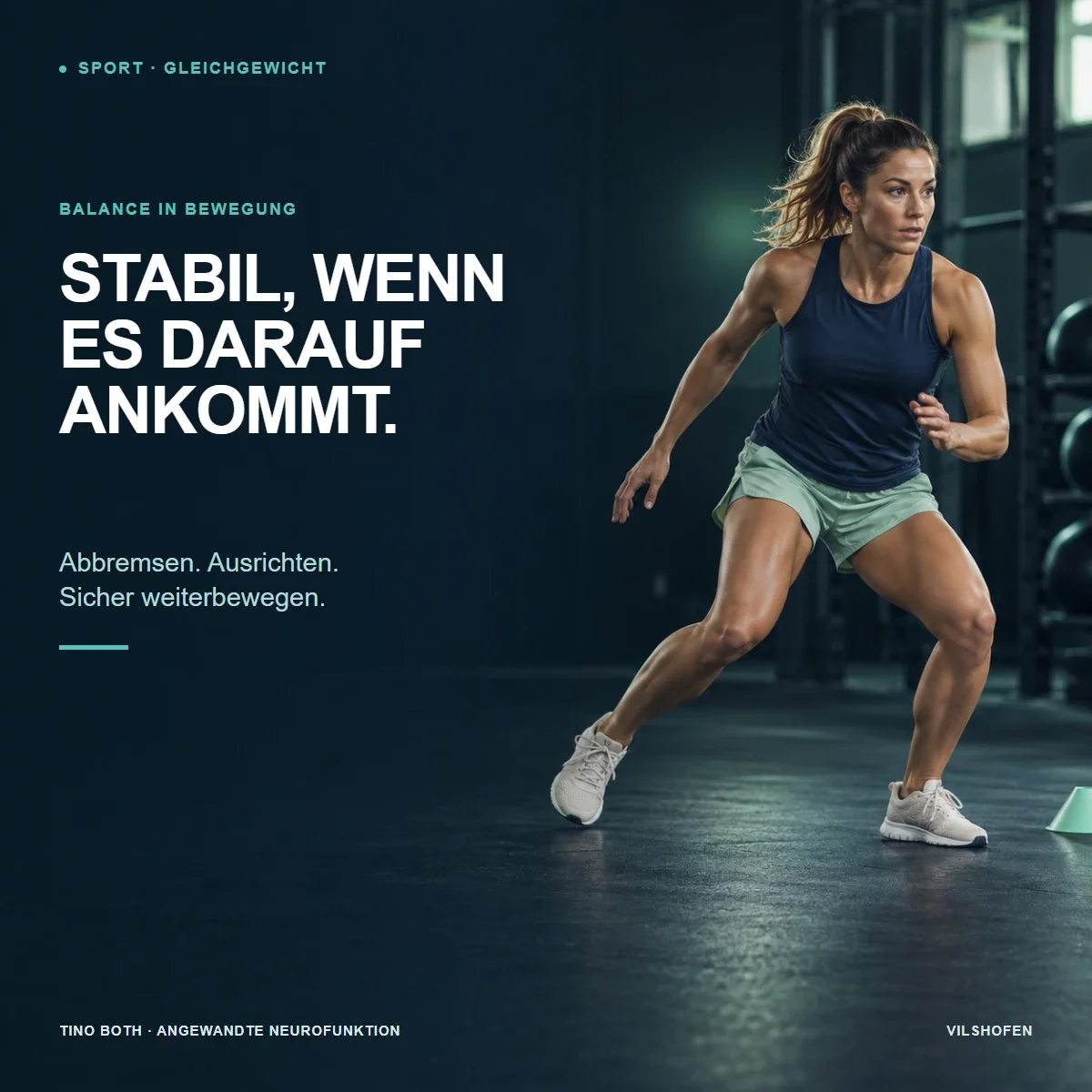
Briefly explained: Balance in sport means controlling the body for the next action — during landing, braking or responding. Strength, movement technique and sensory information work together. Good single-leg standing shows one ability, but does not fully represent these changing demands.
Stable when standing quietly, yet unsteady when changing direction?During the free initial consultation, describe the movement in which you lack control. We clarify whether a functional assessment close to your sport in Vilshofen can usefully complement existing training.
Discuss your sporting balance →
The initial telephone consultation is free of charge.
Discuss your sporting balance →
The initial telephone consultation is free of charge.
The stopwatch says good. The game feels different.
You can stand on one leg for a long time. The squat also goes cleanly in training. But when stopping sideways, you need an extra step. After landing, it takes too long before you can act again. Or you become unsteady as soon as you stop looking at the ground.
This is not a contradiction. Standing still, controlling a planned movement and responding to an unexpected situation make different demands. The useful question is therefore more than 'How good is my balance?' It is also 'In which task do I lack control — and under which condition?'
What kind of balance does your sport need?
HoldingYou stabilise a position, such as when aiming or before a movement. This differs from a rapid transition. Single-leg standing can be a useful component test here.
Preparing and braking movementYou know you are about to jump, land or change direction. Your body can prepare. Foot placement, absorbing force and timing belong to the task.
Responding to a changeA ball bounces differently or an opponent changes direction. Movement now needs adjustment. Perceiving the information and using it in time is part of this.
This distinction has consequences for training. A meta-analysis of the specificity of balance training found much greater improvements in practised than unpractised tasks. The study base at the time was small. Nevertheless, it provides an important indication: Transfer should be checked rather than assumed from one single balance result.
Why gaze is involved in stopping
With a lateral step, you need to do more than control your weight. You need information about where you are and what happens next. The eyes take in relevant targets and movement in the surroundings. The balance system signals head movement, while feedback from feet, joints and muscles also represents body position.
This information does not replace capable legs. It helps control movement appropriately for the situation. Someone looking only at their own foot may be solving a different task from the game. Conversely, a gaze shift alone is not yet training close to the sport if the actual movement is not considered afterwards.
More wobbling does not automatically mean more benefitAn unstable surface changes the task. That can be intentional. But it is not inherently the next stage for every sport. A controlled lateral step on firm ground may be closer to your goal than increasingly difficult standing on a balance device.
How 'unstable' becomes a specific assessment
First, we agree on a safe starting movement. For someone who tolerates sporting exertion, this could be a small lateral step followed by a controlled stop. After injury, selection follows current progression of activity and existing requirements. A maximal jump is unnecessary simply to make the test look impressive.
We record how we assess the task: Do you need an extra step? Can you briefly control the position? How does the demand feel? Starting width, speed, shoes and surface stay the same. Several attempts show how much your performance varies anyway.
A possible example: Stability while looking forwardsYou can control the small lateral step well while looking down. With a defined target in front of you, execution changes. We first assess the simpler visual task in a quiet position and choose a small, tolerable preparation from it. You then repeat the same lateral step with the same visual target. Only when this comparison is understandable does the task become closer to actual play.
Not every immediate change belongs to the applied stimulus. An extra attempt, a more precise explanation or warming up can also help. I therefore compare repeatedly and observe whether an approach remains useful over several sessions. An unchanged response is information too: Perhaps another factor matters more today.
How assessment becomes training
A usable plan connects specific preparation with the movement you want to improve. Perhaps the same step remains initially while the visual target becomes clearer. Later, an announced signal may determine direction. A less predictable task follows only afterwards. Difficulty and speed do not increase simultaneously with every other demand.
Strength training, technique and sporting practice remain part of the approach. Neurocentred training adds the question of which perceptual demand is currently relevant. It does not make adequate strength incidental or automatically make a difference between sides a problem. What matters is whether that difference affects the specific task.
How to recognise progress useful in daily practiceYou can perform the movement with more control, need fewer compensatory steps or move into the next action sooner after stopping. It then needs to become apparent whether this also works under your sport's usual conditions — rather than only in the quiet assessment situation.
What you can observe in your own training
Focus on situations, rather than as many errors as possible: Does unsteadiness always occur in the same direction? Only towards the end of a session? Only when simultaneously tracking a ball or person? Such clues help select an assessment. They are not a reason to monitor yourself continually during training.
Do not provoke loss of balance through surprise pushes or jumping with closed eyes. Safe conditions, appropriate difficulty and clear stopping rules belong in the exercise. New pain, repeated giving way or dizziness are not solved with greater complexity.
When sporting unsteadiness should be assessed
After a recent injury, with swelling, repeated giving way or persistent dizziness, appropriate medical or physiotherapeutic assessment matters. Sudden new inability to walk with speech disturbance, double vision or one-sided weakness is an emergency: 112. Training assessment comes afterwards, rather than before.
Frequently asked questions about balance in sport
Is single-leg standing enough as a balance test?It can be useful as a component test. Landings, changes of direction and responses also require tasks representing those demands.
Is a wobble board better than firm ground?Not as a rule. The appropriate surface depends on what you want to practise and what you can control. More difficult and closer to the sport are different things.
Can gaze training improve my balance?Visual information is involved in movement control. Whether a particular task helps you should be checked against the relevant movement goal.
How often should I train balance?That depends on the training goal, other demands and tolerability. A short, well-integrated element with a clear task is often more practical than an extensive extra programme without follow-up assessment.
Balance should make your next action possible
Would you like to begin with your sporting movement rather than the next balance device?In Vilshofen, we consider perception and movement together. The first conversation concerns your sporting goal, previous experiences and whether individual functional assessment is a useful addition.
Arrange an initial consultation about sporting stability →
The initial telephone consultation is free of charge.
Arrange an initial consultation about sporting stability →
The initial telephone consultation is free of charge.
Related pages and articles
Explore sporting tasks furtherNeuroathletic training for runners and endurance athletes — moving more efficiently, staying more stable
Neuroathletic training in strength sports: Using strength and movement with control
Neuroathletic training in ball sports: Seeing, deciding and responding appropriately
Neuroathletic training in strength sports: Using strength and movement with control
Neuroathletic training in ball sports: Seeing, deciding and responding appropriately
Gaze and exercise selectionUnderstanding oculomotor function: How eye movements guide daily life
VOR explained simply — why the vestibulo-ocular reflex keeps gaze stable
Neuroathletic exercises: Why general exercises are often insufficient
VOR explained simply — why the vestibulo-ocular reflex keeps gaze stable
Neuroathletic exercises: Why general exercises are often insufficient
Relevant areas of focus in VilshofenNeuroathletic training and performance optimisation
Visual disturbances and visual processing
How I work: Angewandte Neurofunktion
Visual disturbances and visual processing
How I work: Angewandte Neurofunktion
Sources and further reading
Kümmel et al. (2016): Specificity of Balance Training in Healthy Individuals — a systematic review and meta-analysis of transfer to unpractised tasks.
NIDCD: Balance Disorders — the basics of the sensory systems involved and assessment of balance symptoms.
NIDCD: Balance Disorders — the basics of the sensory systems involved and assessment of balance symptoms.