

← All articles
Neuroathletic training & performance
Neuroathletic training in football: why the glance before ball contact matters
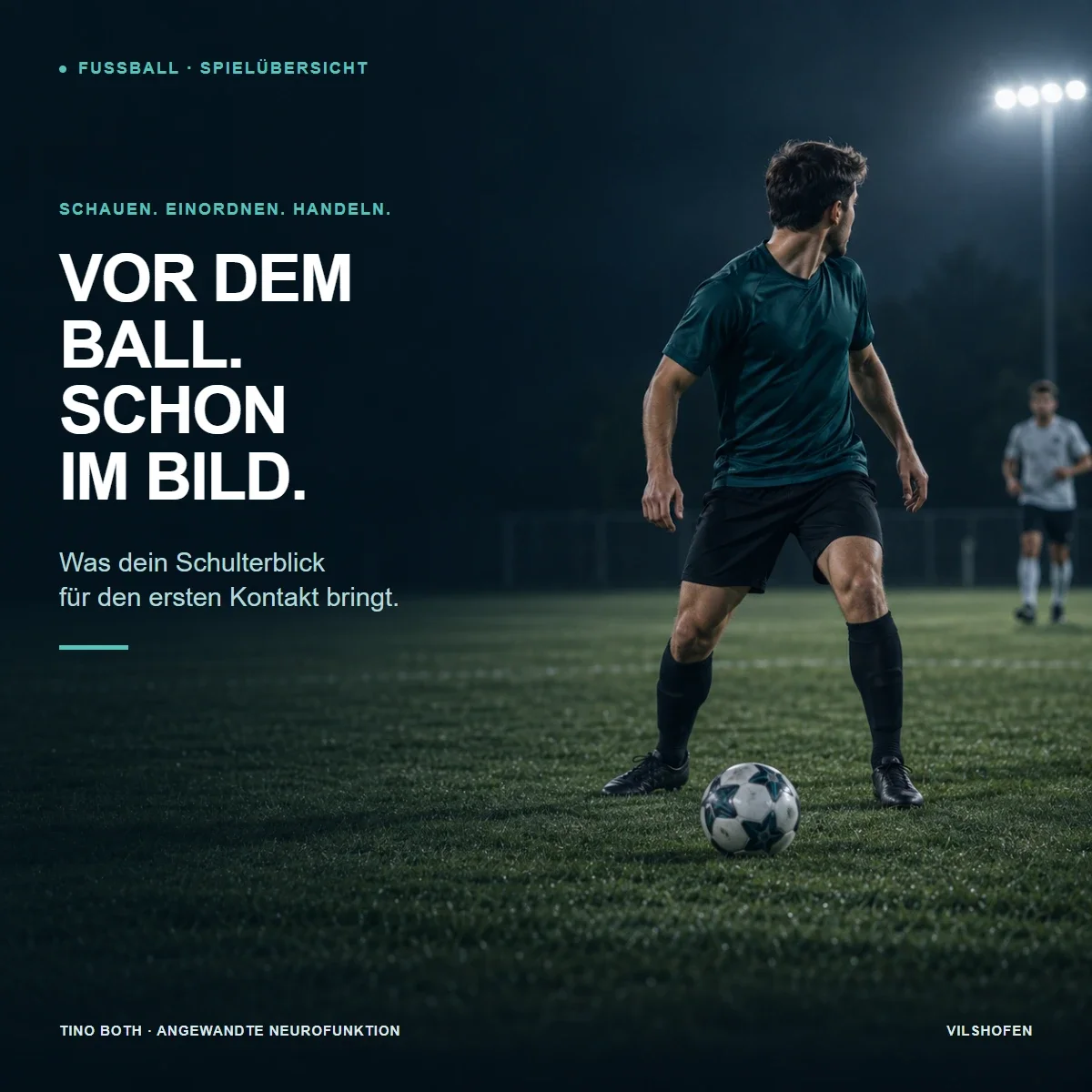
Briefly explained: Neuroathletic training in football explores how perception, orientation and movement control work together. A look over the shoulder is useful only when the information gathered affects the next ball contact. Tests and exercises should therefore consider looking as well as the decision and movement that follow.
It works in training – but you lose awareness under pressure from opponents?If receiving the ball, looking over the shoulder or changing direction do not work together reliably, a closer assessment is worthwhile. In the initial consultation, we clarify your goal and a possible starting point for individual neuroathletic training.
Discuss your football concern →
The initial telephone consultation is free.
Discuss your football concern →
The initial telephone consultation is free.
You look over your shoulder. And still play into pressure.
The coach asks for a look over the shoulder and you do it – yet at the first touch you are still unsure which side has space. Perhaps you saw your surroundings, but the information was too early, too late or not useful for the next action. This distinguishes a visible head turn from actual game awareness.
The solution is not automatically to ‘look even more often’. First, it needs to be clear what you want to know: where is the nearest opponent? Which side is open? Is your teammate continuing to move or staying still? A glance has a task.
What scanning means in football
In football, scanning refers to actively looking around, temporarily directing the gaze away from the ball and towards the surroundings. The FIFA Training Centre explains this information gathering using game situations before ball contact. What matters is the number of head movements as well as their relationship to the situation.
A player surrounded by several opponents needs different information from a full-back with a clear view ahead. The speed of the pass also changes the time window. A blanket target for the number of looks over the shoulder cannot replace this context.
Four component tasks before a good first touch
Taking in informationThe gaze needs to reach the place where a relevant change is happening in time. Teammates, opponents and open space cannot be perceived in the same way as a stationary marker.
Making sense of the situationOpen space is useful only if it remains accessible for the next action. Football knowledge and experience connect what you see with possible decisions.
Finding the ball againAfter looking over the shoulder, attention needs to return at the right time for the pass. Looking away from the ball for too long can make receiving it harder, even though you have seen more of the surroundings.
Translating the decision into movementThe supporting leg, body alignment and first touch determine whether the intended solution is practically available. Perception training should therefore lead back to an action with the ball.
Where neuroathletic training can usefully begin
If a task repeatedly falters, I first consider the functions involved. Can you turn your head comfortably in both directions? Does the image remain clear? Do you receive the ball reliably without looking over the shoulder, but significantly less well with a gaze shift? Or is the information available while the supporting leg does not support the following turn well?
This keeps gaze control, balance and body awareness from becoming abstract buzzwords. They become part of a specific question. The basic principle is: take in information, process it and translate it into action. The visible movement is the comparison point to which we return after a selected stimulus.
Possible example: two open directions of playA pass arrives at a constant speed. Before you receive it, a teammate behind you indicates which of two directions is open. We compare whether you take in the information correctly and direct the first touch appropriately. A single difficulty is then changed – for example, allowing more time for the look over the shoulder or reducing the turning angle. A brief, specifically selected training stimulus can then be assessed against the same starting task.
We assess whether you are faster as well as whether the response is correct and the ball remains controllable. More incorrect decisions at a higher speed are not progress. Once the foundation succeeds, the fixed cue can be replaced with a more realistic teammate or opponent situation.
The supporting leg is part of game awareness too
Once you have recognised the space, you need to be able to begin the action from a stable position. A separate comparison of standing and landing control may therefore be useful. For example, a position beside the ball can first be adopted slowly and held before adding a pass.
For athletes who can tolerate the load, a supervised variation may involve a small step or hop into the planned standing position. Control and the ability to act afterwards are observed, as well as minimising wobbling. If there is pain, a recent injury or an unstable joint, the task is adapted accordingly. A good test does not need spectacular difficulty.
Not every exercise needs to look like football – but its benefit shouldAn individual visual stimulus can be assessed away from the ball. Whether it is useful as a training component is also shown through a suitable ball or movement task.
From the test to training on the pitch
A helpful response during an appointment is a starting point. The component then needs to fit into everyday training. A few suitable tasks are chosen and reassessed repeatedly, rather than collecting new stimuli every day. Duration, speed and additional decisions are not increased at the same time.
The FIFA practical examples of passing and receiving connect scanning, body alignment and action with the ball. This is also a useful benchmark for selecting additional tasks: information should prepare an action, rather than merely produce a good test score.
In my work in Vilshofen, this perspective can complement existing club and athletic training. A clear division of tasks helps collaboration: technical and tactical instructions remain within football training; the individual functional approach explores which prerequisite deserves a closer look in your case.
What players and coaches can observe
Compare familiar situations without immediately inferring a cause: receiving from the right or left, an open or closed body position, a fresh start to training or a later phase. Is it a missed piece of information, an incorrect decision or the execution? This description helps more than saying ‘the head is too slow’.
Especially after injuries, it should also be clear which loading has already been approved. A good response to an additional exercise replaces neither a gradual increase in loading nor an assessment of readiness to play. New uncertainty is a reason to examine the conditions more closely, rather than automatically increase speed.
When training should pause
After a collision or blow to the head with headache, dizziness, confusion or new visual problems, stop playing and do not use reaction tests to decide on a return. A possible concussion requires medical assessment. Repeated giving way or significant new joint pain also deserves assessment before adding demanding changes of direction.
Frequently asked questions about neuroathletic training in football
Is scanning simply a look over the shoulder?The look over the shoulder is the visible movement. Scanning should provide relevant information that informs a decision in time. Simply ticking off the movement is insufficient.
Do eye exercises automatically improve my game awareness?No. Game awareness includes perception, experience, attention and tactical understanding. A visual training stimulus is therefore linked to a specific game task and assessed there.
Is neuroathletic training also of interest to amateur players?Yes, if there is a specific goal and the task fits the performance level. An elaborate extra programme is not necessarily required.
What is different for young players?Tasks should be age-appropriate, manageable and close to the game. Enjoyment, understanding and clean execution take priority over complicated multitasking or comparisons with professional scores.
A glance is valuable when it makes the next action easier
You do not need as many unusual exercises as possible. You need an understandable connection between what you perceive and what you intend to do with the ball. This is precisely where an individual training approach can be assessed.
Would you like to connect receiving the ball and orientation more specifically?Bring a specific game situation as your question. In the initial consultation, we discuss whether a functional assessment in Vilshofen suits your training goal.
Free initial consultation about football training →
The initial telephone consultation is free.
Free initial consultation about football training →
The initial telephone consultation is free.
Related pages and articles
Movement and stability in a game contextNeuroathletic training in ball sports: see, decide and respond appropriately
Neuroathletic training in strength sports: use strength and movement with control
Neuroathletic training and balance in sport – why balance involves more than single-leg standing
Neuroathletic training in strength sports: use strength and movement with control
Neuroathletic training and balance in sport – why balance involves more than single-leg standing
Gaze shifts and orientationSaccades: why gaze shifts matter for reading and orientation
Smooth pursuit: how the eyes track moving targets
VOR explained simply – why the vestibulo-ocular reflex keeps gaze stable
Smooth pursuit: how the eyes track moving targets
VOR explained simply – why the vestibulo-ocular reflex keeps gaze stable
Relevant areas of focus in VilshofenNeuroathletic training and performance optimisation
Visual disturbances and visual processing
My approach: Angewandte Neurofunktion
Visual disturbances and visual processing
My approach: Angewandte Neurofunktion
Sources and further reading
FIFA Training Centre: Karl Aksum on scanning – a sport-specific perspective on scanning.
FIFA Training Centre: John Peacock – Passing and receiving – connecting orientation and receiving the ball.
CDC HEADS UP: Returning to Sports – return after concussion.
FIFA Training Centre: John Peacock – Passing and receiving – connecting orientation and receiving the ball.
CDC HEADS UP: Returning to Sports – return after concussion.