

← All articles
Neuroathletic training & performance
Neuroathletic training for sports clubs: Integrating perception into team training
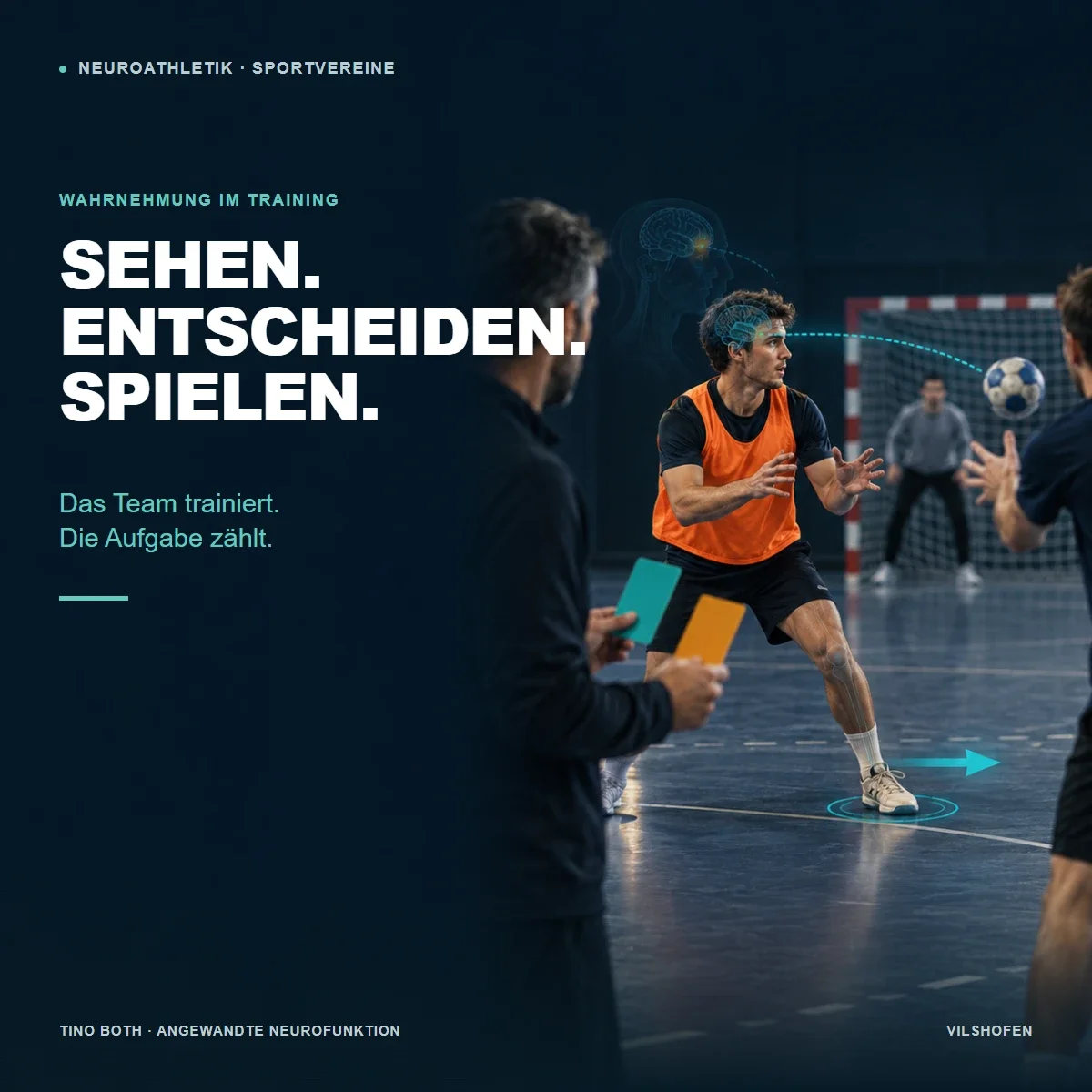
Briefly explained: Neuroathletic training for sports clubs complements technique, tactics and strength and conditioning with targeted questions about perception, orientation and movement control. The approach becomes practical when a specific game situation is broken down into assessable subtasks and then brought together again in a way that relates to the sport.
Do you train a lot — but certain errors persist under pressure?During the free initial consultation, describe your sport, age group and a typical situation. We discuss whether a practical workshop, a session for coaches or an individual functional assessment would be useful for your club.
Discuss neuroathletic training for your club →
Discuss neuroathletic training for your club →
Quick players, yet late decisions
The sprint test looks good. Strength and endurance are being trained. Yet a player arrives a step too late at the decisive moment. Or a movement that is reliable in technique training becomes inaccurate under pressure from an opponent. This is frustrating for coaches, because “run even faster” may not address the task.
In a game, an athlete must recognise relevant cues, select options and execute the movement appropriately. These demands are closely connected, but are not identical. A slow decision cannot be explained solely by a sprint time. Equally, a technical error does not prove that a sensory organ is functioning poorly.
What changes with a neuroathletic perspective
We ask not only how fast or strong someone is, but under which information conditions a movement succeeds. Does the player see their teammate early enough? Do they lose their overview after a glance over the shoulder? Does a secure landing become unsteady only when an additional decision is required?
This does not replace your coaches' experience. It makes observations more precise and helps select a suitable addition. A team does not need as many tests as possible for this, but a clear sequence: One question, one baseline task, one targeted change and a comparable re-test.
A possible example from team training
Suppose a handball team often loses time during a simple passing sequence. Some players pass reliably as long as the target is predetermined. As soon as a second passing option appears at short notice, wrong decisions increase. The team therefore does not automatically need a faster reaction programme.
Three conditions make the difference visibleFixed target: The player passes to an announced partner. We assess execution and accuracy.
Recognising the target: One of two partners gives a clearly visible signal. At first, the player only names the correct partner without passing.
Recognising and passing: The player now passes in response to the same signal. Positions, distance and signal remain the same.
If recognition is quick but combining it with the pass is difficult, that leads to a different training question from a lateral signal that is noticed late.
Recognising the target: One of two partners gives a clearly visible signal. At first, the player only names the correct partner without passing.
Recognising and passing: The player now passes in response to the same signal. Positions, distance and signal remain the same.
If recognition is quick but combining it with the pass is difficult, that leads to a different training question from a lateral signal that is noticed late.
In the next step, only one condition changes: Less speed, a clearer signal timing or a simpler body position, for example. The original task then follows again. If a visual pattern recurs, a brief, suitable perception task may be added. Whether it is useful is assessed again in the passing sequence.
Two players with the same visible error may therefore need different next steps. One mainly needs greater confidence in the decision. For the other, it is worth looking more closely at lateral recognition or orientation after a head movement. A shared training goal does not exclude individual adaptations.
Reaction is more than the time until the first step
Tapping a light signal, starting on a call and reading an opponent's movement are different tasks. In a game, an athlete often has to decide whether to react at all. Feints and changing running routes do not make a quick wrong response more valuable.
I therefore consider accuracy, errors and decisions alongside speed. A good training task retains a relevant part of the real situation. Research into visual anticipation in sporting situations examines, for example, how movement information can be used earlier. General “brain training” cannot be equated with this.
Gaze stability and peripheral perception in the team
Orientation must be maintained during head movement. At the same time, looking at the ball must not displace all other information. In football, the focus may be on scanning before receiving the ball; in basketball, recognising an open passing option; and in ice hockey, orientation at high speed.
For an initial comparison, gaze direction, head movement and movement through space can be considered separately. The demands are combined only afterwards. If a player becomes uncertain when glancing over their shoulder, another complicated dual task is not automatically the appropriate starting point.
Balance and body awareness: More than an unstable surface
Changes of direction, landings and body contact require adaptation. Information from skin, muscles and joints helps organise body position and movement. A static balance comparison can open up a question, but does not represent every demand of a contest with an opponent.
A useful next comparison might be a controlled landing with and without a simple gaze shift. Or a change of direction with a direction known in advance and later varied. This makes clear which additional demand changes the movement. Difficulty is not increased solely by adding ever more uncertainty.
A neuro warm-up that fits your routine
A brief addition with a clear taskKeep the existing warm-up: Temperature, movement range and gradually increasing the load remain important.
Select one perceptual demand: For example, briefly orient yourself before a pass or change direction in response to a clear signal.
Start simply: Familiar rules, enough space and controlled speed.
Observe the response: Does the target task become easier, stay the same or become harder? Adapt the demand for individual players.
Return to the sport: The benefit needs to appear in the subsequent training task, not only in isolated preparation.
Select one perceptual demand: For example, briefly orient yourself before a pass or change direction in response to a clear signal.
Start simply: Familiar rules, enough space and controlled speed.
Observe the response: Does the target task become easier, stay the same or become harder? Adapt the demand for individual players.
Return to the sport: The benefit needs to appear in the subsequent training task, not only in isolated preparation.
Not every exercise has to produce a better test result immediately to have longer-term training effects. For a stimulus intended to prepare someone in the short term, however, an immediate comparison is helpful. Learning and training goals also require observation across several sessions. These two timescales should not be confused.
After injuries: Returning to play remains a shared task
Following an injury, tolerance of exertion, confidence and certainty in action may be at different stages. Perhaps a planned movement succeeds, but the same action in response to an unexpected signal does not yet. Perhaps visual contact with an opponent is more demanding than a technically identical individual exercise.
Such observations can inform the build-up in coordination with medical and therapeutic care. Clearance for training or competition does not depend on a single neuroathletic re-test. A pain-free moment does not replace assessment of tolerance of exertion or a gradual return.
Youth teams: Curiosity instead of lists of deficits
Children and teenagers need clear rules, suitable difficulty and experiences of success. They should not leave a workshop believing their nervous system is faulty. For young athletes, manageable catching, rhythm, orientation and reaction games that are varied gradually are suitable.
A task must fit the stage of development. The American Academy of Pediatrics describes readiness for sport as an interaction of physical, mental and social prerequisites. This also matters for a neuroathletic training offer: Complexity alone does not make an exercise suitable for children or effective.
How a workshop for your club can be structured
From the club's concern to practical implementationBeforehand: Discuss the sport, age group, group size, training setting and a specific goal.
Introduction: Use a clear task to show how perception and action are connected.
Practical comparisons: Small groups assess a few suitable baseline tasks and changes.
Re-test: Assess the same task again, including errors, effort and individual differences.
Transfer: Decide together where a useful addition fits into the warm-up, technique section or a game-based activity.
Next steps: Agree how coaches would recognise a practical benefit over the next sessions.
Introduction: Use a clear task to show how perception and action are connected.
Practical comparisons: Small groups assess a few suitable baseline tasks and changes.
Re-test: Assess the same task again, including errors, effort and individual differences.
Transfer: Decide together where a useful addition fits into the warm-up, technique section or a game-based activity.
Next steps: Agree how coaches would recognise a practical benefit over the next sessions.
The exact scope is agreed with you. A session for coaches differs from a session with a youth team or an individual assessment of an injured athlete. Personal symptoms are not discussed in front of everyone in a group. Matters requiring an individual appointment or medical assessment remain outside the general team programme.
What should be clear about “performance assessment”
Functional comparisons can complement existing performance data. However, they are not automatically standardised diagnostic assessments with reliable reference values. I therefore discuss what we observe and which decision can usefully follow. “Responded differently in this task today” is more precise than “measured the entire nervous system”.
With repeated tests, familiarity, motivation and how someone feels on the day can influence the result. A study of peripheral perception tests in sport shows why practice effects need to be considered. For your everyday training, that means comparable conditions and several observations, instead of treating one impressive round as proof.
Which clubs might find the approach useful?
Team and racket sports with many decisions under time pressure are obvious examples. Martial arts, running groups, gymnastics and strength sports also have specific demands on orientation and movement. What matters is not the sport appearing on a list, but whether a useful question can be drawn from your training.
For clubs in Vilshofen, Passau, Deggendorf and Lower Bavaria, a telephone conversation can first clarify which format fits your setting. The aim is an addition that your coaches understand and can continue to an appropriate extent — rather than a parallel programme that nobody can fit into regular training.
Frequently asked questions
Do we need expensive equipment?For many basic comparisons, a safe training space, simple targets, balls and clear tasks are enough. Technical equipment is useful only when it answers a specific question better.
Do all players have to do the same exercises?A shared task is possible. Difficulty and dose can still differ. Anyone who develops symptoms does not simply continue because the rest of the group tolerates the exercise well.
Is this only for elite sport?No. Amateur clubs and youth teams can also benefit from more precise task selection. The goal and scope must fit everyday training.
Does it replace strength and conditioning or physiotherapy?No. It complements the existing work with functional questions about perception and movement. Strength, endurance, technique, tactics and necessary therapy retain their place.
What should we prepare for an enquiry?The sport, age and approximate group size, along with a specific concern, are enough to begin. It also helps to know how much time you can realistically allow in your normal training routine.
Which moment in a game causes your team difficulty?If you would like to explore this question together, we discuss a suitable approach. I contribute the perspective of Applied Neurofunction; you contribute your sporting experience and knowledge of the team.
Free initial consultation for your club →
Free initial consultation for your club →
Relevant further pages and articles
Perception and sporting tasksNeuroathletic training in football — see faster, react faster, make better decisions
Gaze stability in sport — why stable eye movements influence performance
Reaction training in sport — why fast reactions involve more than fast muscles
Neuroathletic training after injuries — a functional perspective on return to play
Neuroathletic training in martial arts — perceive faster, react better, move more steadily
Gaze stability in sport — why stable eye movements influence performance
Reaction training in sport — why fast reactions involve more than fast muscles
Neuroathletic training after injuries — a functional perspective on return to play
Neuroathletic training in martial arts — perceive faster, react better, move more steadily
The offer and further areas of focusNeuroathletic training & performance optimisation
Neuroathletic training in Lower Bavaria — a contact for athletes, clubs and coaches
Neuroathletic training for elite athletes in Bavaria — when the final few per cent are missing
A functional perspective on dizziness & balance
A functional perspective on visual disturbances and visual processing
My approach: Angewandte Neurofunktion
Neuroathletic training in Lower Bavaria — a contact for athletes, clubs and coaches
Neuroathletic training for elite athletes in Bavaria — when the final few per cent are missing
A functional perspective on dizziness & balance
A functional perspective on visual disturbances and visual processing
My approach: Angewandte Neurofunktion
Sources and further reading
Accelerating Visual Anticipation in Sport Through Temporal Occlusion Training: A Meta-Analysis.
Peripheral Vision Tests in Sports: Training Effects and Reliability of Peripheral Perception Test.
American Academy of Pediatrics: Is Your Child Ready for Sports?
Peripheral Vision Tests in Sports: Training Effects and Reliability of Peripheral Perception Test.
American Academy of Pediatrics: Is Your Child Ready for Sports?