

← All articles
Complex symptoms & the autonomic nervous system
Sympathetic nervous system always active? Understanding tension and regulation
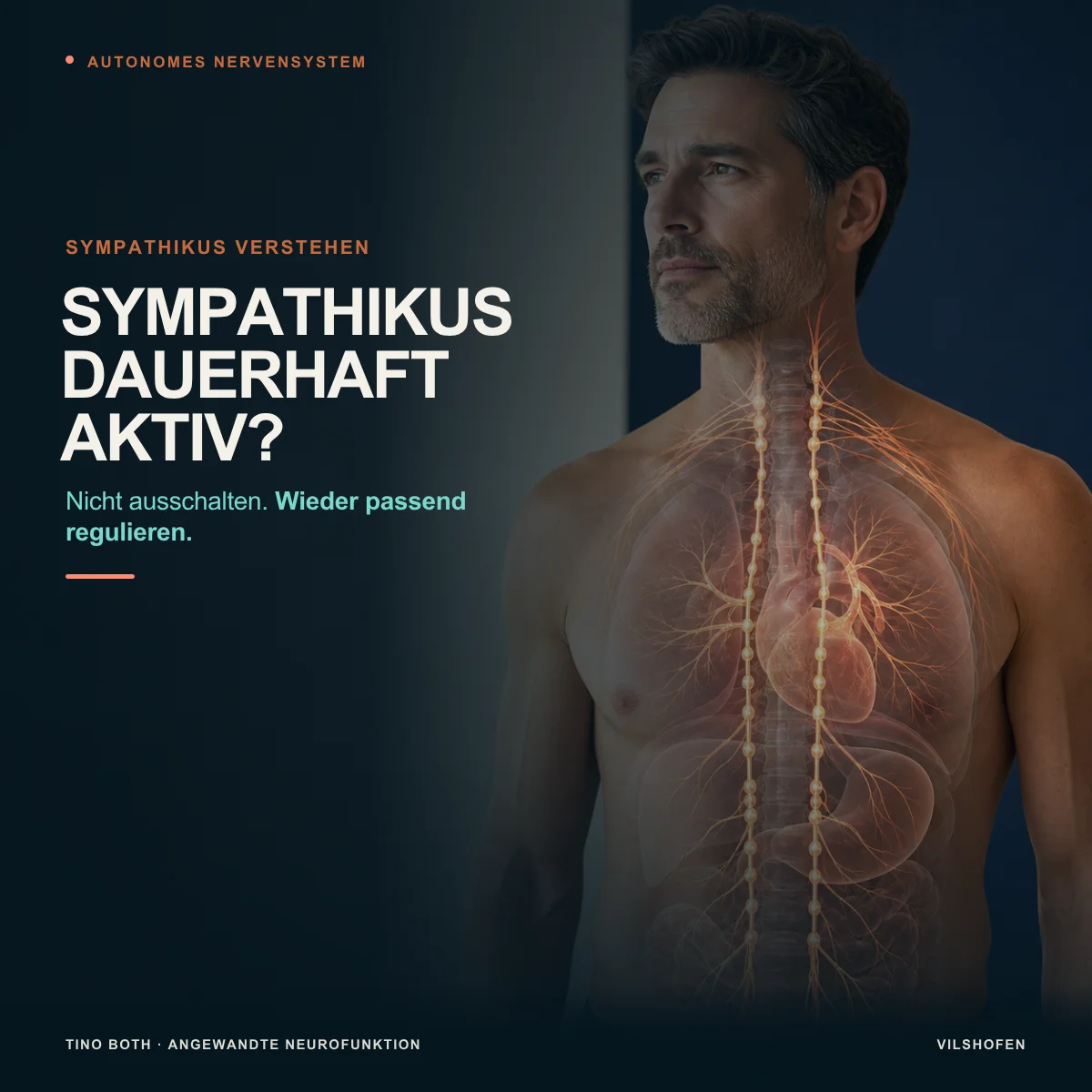
Briefly explained: “Sympathetic system always active” often describes feeling constantly tense. Palpitations, restlessness or difficulty falling asleep may fit, but are not specific to it. The sympathetic system need not be switched off: regulation fitting load, rest and daily circumstances is what is needed.
Do breaks do little to ease your tension?Tell me when your body struggles to settle and what has been examined. In an initial consultation, discuss whether a functional view of your demand and response patterns in Vilshofen is useful.
Discuss your next step for support →
The initial telephone consultation is free.
Discuss your next step for support →
The initial telephone consultation is free.
Tired, yet unable to wind down
The day is over, but your body seems still in the middle of it. You lie in bed exhausted and notice every small heartbeat change. Perhaps you tried breathing exercises or more deliberate relaxation. If unsuccessful, another task quickly emerges: now relaxing must work too.
This is where a closer look helps. “Always in stress mode” is an understandable description, but not yet a precise explanation. Which response predominates? Does it happen when lying down, standing up, after a busy working day or without an obvious trigger? These differences guide useful next questions.
What the sympathetic nervous system actually does
The autonomic nervous system helps regulate circulation, digestion and temperature, among other functions. The sympathetic system helps adapt the body to demands. It is no system error and is not active only during psychological stress. An overview is provided by Physiology of the Autonomic Nervous System.
The common accelerator-and-brake image may help initially but does not reflect every organ response or everyday situation. “More parasympathetic activity” is therefore not a universal training aim. Sport needs appropriate activation, followed by appropriate recovery. The ability to meet demands suitably matters more than maximum calm at all times.
Activation differs from dysregulationA faster pulse on stairs differs from a racing heart without relevant exertion. Tension before an important task differs from a persistent state restricting sleep and daily life. Context helps determine meaning.
Which symptoms people often search for under this term
Many search for “overactive sympathetic nervous system” because they connect restlessness, tense muscles, sweating, palpitations or inability to switch off. Others describe poor sleep, varying digestive symptoms or severe exhaustion after everyday demands.
This list cannot reveal the state of a particular nerve pathway. Symptoms can have different, medically relevant causes. The US health portal MedlinePlus describes how autonomic disorders may affect different body systems. Personal assessment therefore follows course and findings, rather than counting matching symptoms on a list.
Why a general relaxation tip does not always fit
An exercise can feel pleasant yet miss the specific difficulty. If changing from sitting to standing primarily triggers symptoms, the question differs from restlessness in visually overloaded surroundings. If watching your breathing increases tension, even more focus on every breath is not automatically the right starting point.
I therefore want to understand which demands your system currently needs to handle. How much load stands against realistic recovery? Which situations are well tolerated? Which changes precede symptoms? A specific task emerges instead of the broad instruction to “calm the whole nervous system”.
A possible starting point: compare one small situation precisely
Ask “What changes here?” rather than “How relaxed are you?”Suppose simple head movement feels unremarkable on a calm day but much more tiring in busy surroundings. Choose a safe, tolerable baseline task and record its feeling and performance. Then change one condition first, for example a visual reference point, and repeat the same task.
A general sense of overload becomes a testable question. The comparison guides the next step without assuming all tension comes from vision.
A general sense of overload becomes a testable question. The comparison guides the next step without assuming all tension comes from vision.
The comparison may also show the chosen input makes no useful difference. Do not increase exercise quantity simply because it sounds theoretically good. Choose another question or simplify the task. Your experience and observed function belong together.
Autonomic regulation: why I ask more than whether the sympathetic system is active
You want to understand why your body struggles to settle. The blanket explanation “too much sympathetic activity” does not yet produce an individual approach. In Angewandte Neurofunktion, I distinguish suitable component questions: a particular organ reference, a shared autonomic relay point or a connection between areas?
For this, I additionally use a painlessly and reliably testable indicator muscle. Compare its response under defined contact combinations. Organ-related and central contact assignments are working hypotheses within my methodology. The significance of an identified approach is then checked again against your baseline function.
A possible example: an organ reference responds, but which next step fits?Suppose, within an already narrowed organ-related question, muscle response changes when a kidney reference is combined with a contact for the upper abdominal ganglia region. Ganglia are peripheral nervous-system relay points. Initially, this contact is an assessment lead, rather than a finished explanation.
Within this testing logic, examine connections with further organ references. Suppose comparisons with liver, stomach, pancreas and bowel remain unremarkable. Only the spleen reference changes the response. Cross-check this difference through a second muscle contact assigned within my methodology.
The next question becomes narrower: which addition changes this exact contact combination? I am no longer seeking an unspecific exercise to “calm the autonomic nervous system”.
Within this testing logic, examine connections with further organ references. Suppose comparisons with liver, stomach, pancreas and bowel remain unremarkable. Only the spleen reference changes the response. Cross-check this difference through a second muscle contact assigned within my methodology.
The next question becomes narrower: which addition changes this exact contact combination? I am no longer seeking an unspecific exercise to “calm the autonomic nervous system”.
One, several or no further organ references: three assessment routesOne additional reference responds: stay with this particular combination and seek a suitable additional input.
Several references respond: prioritise the shared ganglion level. Reworking the same overarching question for every organ would make little sense.
No further reference responds: pursue the original connection to the ganglion level itself. There is no need to force a second organ into the picture.
Several references respond: prioritise the shared ganglion level. Reworking the same overarching question for every organ would make little sense.
No further reference responds: pursue the original connection to the ganglion level itself. There is no need to force a second organ into the picture.
The solution search also does not end at the first small difference. In a possible sequence, several central contact variations do not change the response, another only partly, and only a further one stably. Repeatedly compare the original combination with and without this addition. Integration follows only afterwards, then reassess the baseline combination and previously notable ganglion question.
This autonomic question differs from mechanical loading of a vessel during movement. I consider whether differentiation produces a helpful approach, for example for a previously selected tolerable breathing or movement task and how you feel afterwards. A changed muscle response alone does not tell whether everyday tension eases; we also follow that over time.
For you, this means: you need not identify which system is “to blame” yourself. Start from your concern and assess step by step which observations actually help, instead of deriving the entire approach from “stress”.
What you can observe without constant checking
A brief description of typical transitions often helps more than constant pulse measurement: how do you feel after a meal, on standing, after focused work or in the evening? What changes on days with enough recovery? Note a few notable patterns without deriving a fixed explanation yourself.
An appointment must connect meaningfully to real demands. If daily life allows barely any breaks, that belongs in the conversation as much as a difficult perceptual or movement task. One exercise should not obscure missing sleep, persistent overload or necessary medical care.
When symptoms should be medically assessed
Persistent or new racing heartbeat, repeated fainting, pronounced circulatory difficulties or marked performance decline warrant medical assessment. Chest pain, acute breathlessness or sudden neurological deficits require rapid help, through 112 in an emergency.
Common questions about constant sympathetic activation
Can I simply switch off the sympathetic system?That would not be a useful aim. It belongs to normal regulation. What matters is whether activation and recovery suit the situation and what makes an appropriate transition difficult.
Does low HRV show sympathetic overactivity?One watch reading cannot answer that. Measurement conditions and individual differences matter. A device score does not replace assessment of actual symptoms.
Must a breathing exercise calm me immediately?No. Aim, tolerance and appropriate dose matter. If an exercise increases restlessness, simply intensifying it is unsuitable. Another starting point may be more useful.
What is the aim of a functional appointment?Turn a general symptom pattern into a specific tolerable question. Targeted inputs and repeated comparisons help find an individual approach and assess its practical significance.
Looking for an understandable starting point rather than another general tip?In an initial telephone consultation, discuss your situation, existing assessments and a possible approach in Vilshofen. You can then decide whether the service suits you.
Discuss your situation personally →
The initial telephone consultation is free.
Discuss your situation personally →
The initial telephone consultation is free.
Related pages and articles
Understand autonomic regulation more closelyUnderstanding the autonomic nervous system: sympathetic, parasympathetic and functional symptoms
Autonomic dysregulation: understanding symptoms and connections
Activating the vagus nerve: why breathing, cold and humming do not always provide the answer
Autonomic dysregulation: understanding symptoms and connections
Activating the vagus nerve: why breathing, cold and humming do not always provide the answer
Understanding everyday demandsRestlessness, sleep problems and exhaustion: when the nervous system does not switch off
Smell sensitivity: why perfume, smoke and food smells suddenly become too much
Visual overload: why a supermarket may trigger dizziness
Smell sensitivity: why perfume, smoke and food smells suddenly become too much
Visual overload: why a supermarket may trigger dizziness
Related areas in VilshofenAutonomic regulation and complex symptoms
Visual difficulties and visual processing
My approach: Angewandte Neurofunktion
Visual difficulties and visual processing
My approach: Angewandte Neurofunktion
Sources and further reading
StatPearls: Physiology of the Autonomic Nervous System
MedlinePlus: Autonomic nervous system disorders
MedlinePlus: Autonomic nervous system disorders