

← All articles
Complex symptoms & the autonomic nervous system
Smell sensitivity: when perfume and food smells become too much
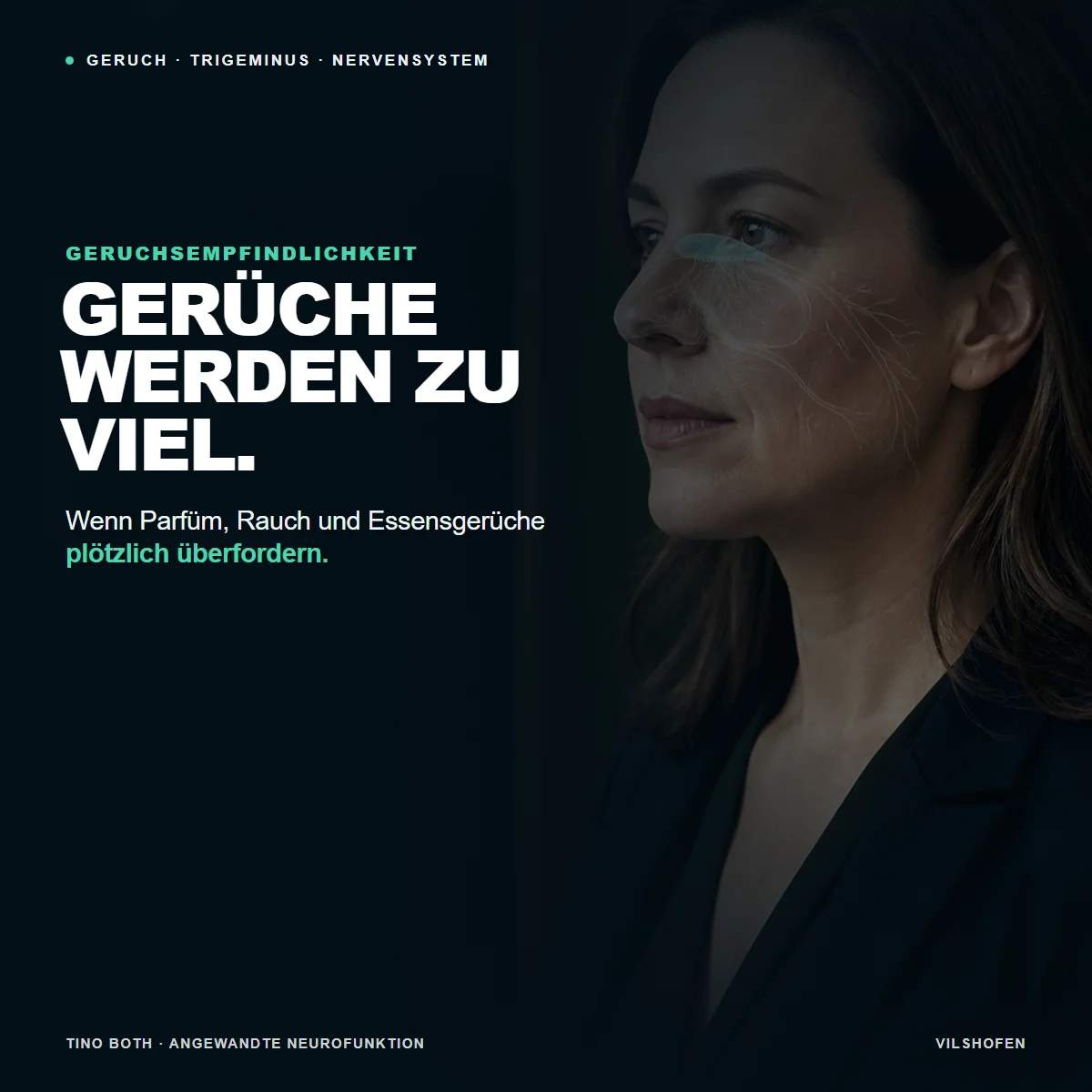
Briefly explained: When perfume, smoke or food smells suddenly become barely tolerable, different things may be involved: altered smell perception, strong aversion, irritation or, for example, a migraine-associated symptom. What you actually perceive and which symptoms accompany it matter.
Do you now avoid rooms because smells overwhelm you?Describe the situations limiting you and what has been assessed. Discuss whether an individual functional view of stimulus processing and physical responses in Vilshofen is a sensible next step.
Discuss your smell sensitivity in an initial consultation →
The initial telephone consultation is free.
Discuss your smell sensitivity in an initial consultation →
The initial telephone consultation is free.
Just a scent to others, but a barely tolerable room for you
Someone in the lift wears strong perfume. The office has just been cleaned. Cooking smells spread through the home, and suddenly you feel sick or your head hurts. Perhaps nobody else notices anything unusual. This can be unsettling, particularly when told simply to focus less on it.
Your experience cannot be measured by how pleasant others find the same scent. Yet “smell-sensitive” does not explain exactly what happens. This distinction matters for the next step: do you actually smell more, does something smell different than before, or do you react particularly unpleasantly to a familiar smell?
Distinguishing hyperosmia, osmophobia and altered smell
A smell seems unusually intenseHeightened smell sensitivity is called hyperosmia. In daily life, “That smells very strong” alone cannot establish a changed perception threshold. Intensity and unpleasantness are different properties of a smell.
A familiar smell is barely tolerableOsmophobia describes pronounced aversion or intolerance towards smells. It can occur with migraine. Detecting smaller scent quantities than others is not necessarily central.
Familiar things suddenly smell different, or smells appear without a sourceIf coffee smells unusually burnt or rotten, for example, this is called parosmia. A smell without an actual source is phantosmia. These changes raise different questions from sensitivity to strong perfume. The NIDCD explains these differences and professional assessment.
Smelling and irritation are different
Not everything noticed in the nose is exclusively smell information. Many substances also stimulate sensory nerve endings of the trigeminal system. Cooling, stinging and burning belong to these sensations. A professional review by Hummel and Frasnelli describes this interaction.
I therefore ask which smell bothers you, whether eyes burn, the nose feels irritated, nausea occurs or headache accompanies it. These descriptions guide different next steps. Smoke and irritating fumes are also more than a perceptual training task. Reducing exposure and ensuring suitable air quality can help independently of the functional approach.
The possible role of migraine
Smells may be particularly unpleasant for people with migraine. Sensitivity may appear during attacks or be reported between them. An observational study from 2022 investigated smell sensitivity outside attacks. It shows an association, rather than one common cause for every scent response.
The sequence helps your description: is the smell unpleasant first and headache begins later? Or do you realise afterwards that you were already light-sensitive, exhausted or sound-sensitive on those days? A brief note may offer more in medical discussion than assuming every notable scent is the sole trigger.
What I want to understand in a functional assessment
Daily life is the starting point. Is it mainly a particular room situation, proximity to a scent source or days when several sensory impressions are tiring together? What works better in a comparable situation? Derive a small tolerable question from this. Nobody needs to endure an unpleasant scent or demonstrate their limit.
Find a useful comparison rather than provoke as much as possibleA good starting point is specific, repeatable and tolerable. Depending on circumstances, it may first be a movement or perception task without smell. A mild smell stimulus, if useful at all, is used only by agreement and without forcing symptoms.
Which information matters to you remains open. Perhaps a visually busy environment combined with smell stands out first. Perhaps general capacity varies most through the day. Change only one condition where possible so your response remains understandable.
How I narrow a tolerable question more precisely
From targeted stimulus to a repeated everyday comparisonA reliable indicator muscle: first choose a muscle test that is pain-free and readily assessable under baseline conditions.
A defined question: use a tolerable stimulus or suitable contact combination to examine a selected functional relationship in the additional assessment.
Check the response: if the previously stable muscle response changes, seek a suitable combination that alters it. Repeatedly compare stimulus alone and stimulus with additional input.
Integrate and recheck: after integration, recheck the original stimulus without added input. Then consider whether the agreed functional baseline has also changed.
A defined question: use a tolerable stimulus or suitable contact combination to examine a selected functional relationship in the additional assessment.
Check the response: if the previously stable muscle response changes, seek a suitable combination that alters it. Repeatedly compare stimulus alone and stimulus with additional input.
Integrate and recheck: after integration, recheck the original stimulus without added input. Then consider whether the agreed functional baseline has also changed.
The approach stays guided by a specific question. Not every notable test leads to an exercise, and not every short-term change already creates more everyday freedom. Check tolerance and progress too. The aim is an appropriate next step rather than the largest collection of stimuli.
What you can observe without testing smells
Briefly note a situation arising anyway: what was the source? What exactly did you feel? How quickly did the response begin and what else was happening? Distinguishing “smells intense”, “burns” and “gives me headache” is especially helpful. New medication, a preceding infection or clearly altered smell perception also belong in discussion with the responsible medical professional.
You need not keep a scent diary of every room. Choose a few typical situations and notice when things are well tolerated too. Practical relief can be simple: avoid a scent source, take a break or choose more tolerable surroundings. This is not personal failure.
When medical assessment matters
New, persistent or clearly altered smell perceptions should be medically assessed, often initially by a GP or ENT specialist. Recurring headaches make migraine assessment relevant. Breathlessness, marked swelling or possible poisoning require rapid medical help; call 112 for immediate danger.
Common questions about smell sensitivity
Does smell sensitivity automatically mean migraine?No. Migraine is one possible connection, not the only explanation. Type, course and accompanying symptoms matter.
Can I react sensitively although others barely smell anything?Yes. Detection, intensity and unpleasantness differ. Comparison with others therefore does not explain your individual response.
Should I repeatedly expose myself to strong scents?No. Forced exposure is not a useful general starting point. Smoke and irritating fumes are particularly unsuitable training stimuli. Smell training recommended where appropriate has a specific indication and is different.
What should I bring to the first discussion?A brief description of typical situations, existing findings and relevant changes suffices initially. You need neither prepare scent samples nor deliberately trigger symptoms.
Would you like more freedom in everyday life?Discuss which situations restrict you and whether my approach fits your question. The focus is a tolerable, understandable starting point.
Arrange a free initial consultation →
The initial telephone consultation is free.
Arrange a free initial consultation →
The initial telephone consultation is free.
Related pages and articles
Migraine and sensory sensitivityUnderstanding migraine: why it is much more than headache
Light sensitivity in migraine: why screens, patterns and supermarkets can overwhelm
Vestibular migraine: when dizziness stands out more than headache
Light sensitivity in migraine: why screens, patterns and supermarkets can overwhelm
Vestibular migraine: when dizziness stands out more than headache
Stimulus processing and regulationVisual overload: why a supermarket may trigger dizziness
Autonomic dysregulation: understanding symptoms and connections
Sympathetic system always active? Typical symptoms and why the nervous system does not simply switch off
Autonomic dysregulation: understanding symptoms and connections
Sympathetic system always active? Typical symptoms and why the nervous system does not simply switch off
Related areas in VilshofenAutonomic regulation and complex symptoms
Visual difficulties and visual processing
My approach: Angewandte Neurofunktion
Visual difficulties and visual processing
My approach: Angewandte Neurofunktion
Sources and further reading
NIDCD: Smell disorders, possible triggers and assessment
Hummel and Frasnelli (2019): The intranasal trigeminal system
Study (2022): Smell sensitivity between migraine attacks
Hummel and Frasnelli (2019): The intranasal trigeminal system
Study (2022): Smell sensitivity between migraine attacks