

← All articles
Pain & functional symptoms
Vestibular migraine – when dizziness is more noticeable than headache
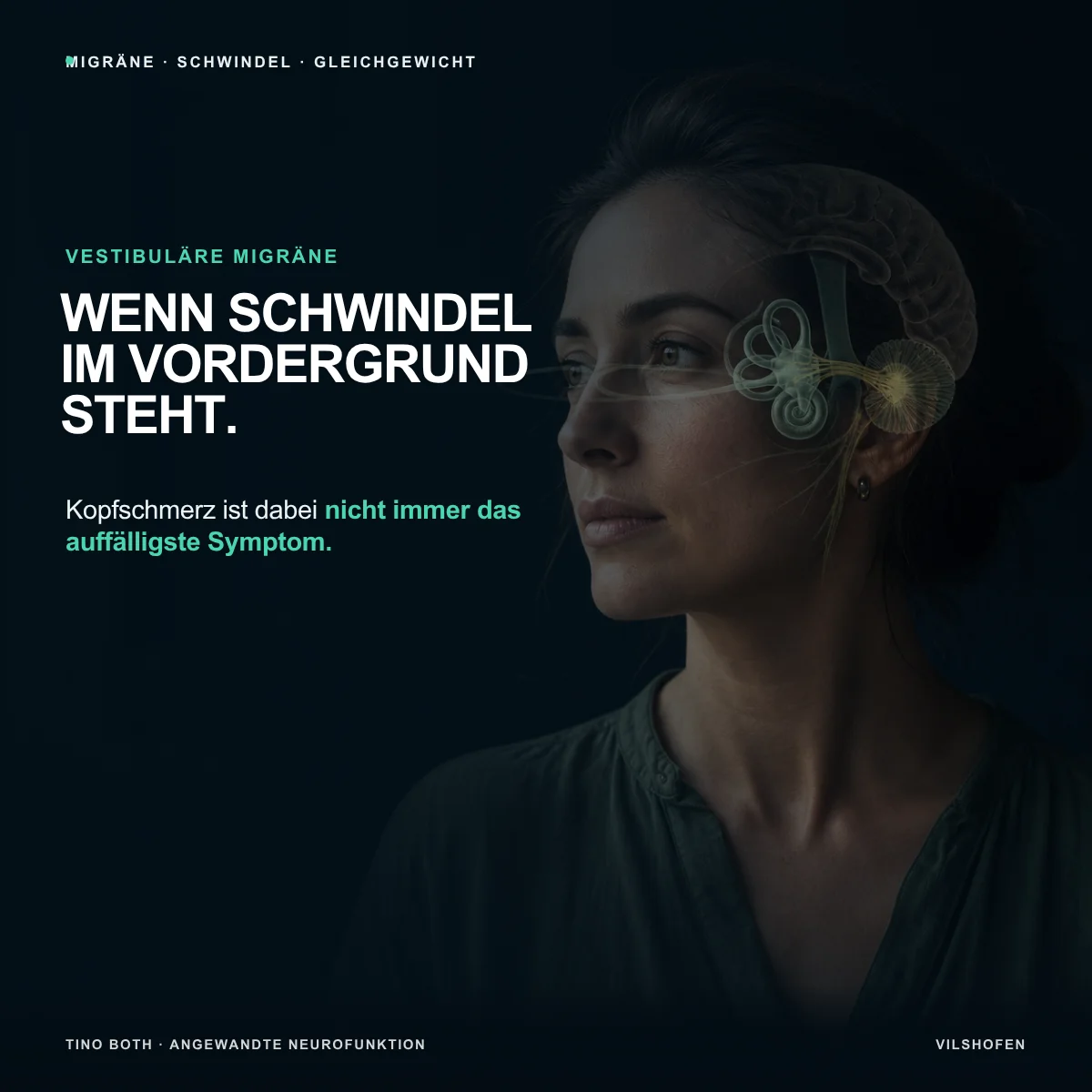
Vestibular migraine can feel like a balance problem, a visual disturbance or marked intolerance of movement. The typical migraine headache does not have to be the main feature of every episode.
Some people suddenly experience pronounced spinning vertigo. Others describe swaying, light-headedness, an unsteady floor or the feeling that head movements and visual impressions no longer fit together properly.
Supermarkets, crowds, escalators, car journeys, passing scenery or moving content on a screen can become particularly demanding. Nausea, sensitivity to light and sound, exhaustion or a strong desire for quiet are also common.
Because a pronounced headache is not always present, the connection with migraine can easily be missed. Symptoms may initially be attributed to the inner ear, circulation, the eyes or the cervical spine.
Briefly explainedVestibular migraine is a form of migraine in which recurring vestibular symptoms are the main feature. These include spinning or swaying vertigo, position-dependent dizziness, visually induced dizziness and symptoms during head movements.
According to international criteria, an episode can last between five minutes and 72 hours. Headaches can occur, but are not required in every episode of dizziness.
According to international criteria, an episode can last between five minutes and 72 hours. Headaches can occur, but are not required in every episode of dizziness.
What does vestibular migraine mean?
‘Vestibular’ refers to balance, head movement and spatial orientation.
The vestibular system processes information about head movement, acceleration and gravity. Together with the eyes, neck and body awareness, it helps the nervous system stabilise the gaze and orient the body in space.
In vestibular migraine, symptoms from this functional area occur repeatedly. They may take the form of classic spinning vertigo, but also swaying, unsteadiness, intolerance of movement or disturbed spatial orientation.
The term does not mean that the balance organ is necessarily damaged. It describes a characteristic pattern of vestibular symptoms and migraine features.
Headache may be absentFor a diagnosis, not every episode of dizziness has to be accompanied by a headache. Sensitivity to light and sound or a visual aura can also establish the required connection with migraine.
The main introductory article Understanding migraine – why it is much more than a headache explains the different phases of migraine and associated symptoms in greater detail.
What can the dizziness feel like?
Vestibular migraine can cause a wide range of dizziness and orientation symptoms.
The term dizziness covers several sensations. To interpret it, it is therefore important to describe as precisely as possible what is actually experienced and in which situation the symptoms arise.
Spontaneous spinning or movement vertigoYour own body seems to turn or move even though you are still. The surroundings may also appear to rotate, sway or flow.
Position-dependent dizzinessSymptoms occur when lying down, sitting up, turning over in bed, bending down or holding the head in a particular position. This can make vestibular migraine resemble positional vertigo.
Visually induced dizzinessLarge moving surfaces, crowds, supermarket shelves, passing scenery, videos or scrolling movements trigger dizziness, nausea or spatial uncertainty.
Dizziness during head movementTurning, tilting or moving the head quickly can trigger symptoms. Some people therefore increasingly hold their head stiffly or move more cautiously.
Light-headedness with nauseaInstead of a distinct spinning sensation, spatial orientation is disturbed. The head feels light-headed, movement becomes unpleasant and nausea develops.
These different forms can occur individually or together. Their duration also varies: some episodes last only a few minutes, others several hours or days.
The article Spinning vertigo, swaying dizziness or light-headedness – why the type of dizziness matters explains how these sensations differ.
Which criteria suggest vestibular migraine?
The diagnosis is based on recurring episodes, a history of migraine and typical migraine features.
The international criteria of the Bárány Society and the International Headache Society describe a clear pattern. A definite diagnosis of vestibular migraine requires the following features:
At least five episodesThere must be recurring vestibular symptoms of moderate or severe intensity.
Duration between five minutes and 72 hoursThe vestibular episode itself falls within this time window. Exhaustion, sensitivity to movement or other after-effects may persist for longer.
A history of migraineMigraine with or without aura is present now or has occurred in the past.
Migraine features in at least half of the episodesThese include a typical migraine headache, sensitivity to both light and sound, or a visual aura.
No better alternative explanationThe pattern is not better explained by another vestibular or neurological condition.
In probable vestibular migraine, the recurring vestibular episodes are also present, but only one of the two central migraine features is met: either a history of migraine or typical migraine symptoms during the dizziness attacks.
There is no single conclusive testThe diagnosis is based primarily on the characteristic course. Vestibular examinations, hearing tests or imaging can be important in distinguishing other conditions, but do not confirm vestibular migraine through a single specific measurement.
Why can dizziness be more noticeable than headache?
Vestibular symptoms and migraine features do not always have to occur at the same time or with the same intensity.
A throbbing headache may dominate one episode, while another mainly involves dizziness, nausea and sensitivity to light. Some people know migraine headaches from earlier stages of life, but later develop predominantly vestibular symptoms.
In addition, sensitivity to light and sound or a visual aura may be enough to establish the diagnostic connection with migraine. A typical headache is therefore not necessarily part of every individual episode.
This often causes uncertainty: someone may know migraine only as a headache and suspect a completely different problem when new symptoms develop. In fact, its presentation can change over a lifetime.
Another reason is that dizziness itself can be very distressing. People who feel unsteady while walking, can hardly move their head or immediately become nauseous in visual environments often notice these limitations more strongly than a moderate headache that is present at the same time.
Is the dizziness a migraine aura?
Vestibular migraine and migraine aura are different phenomena.
A typical migraine aura usually develops gradually and generally lasts between five and 60 minutes. Vestibular episodes, by contrast, can last considerably longer and fall precisely within this time window in only a smaller proportion of those affected.
The dizziness also does not necessarily occur immediately before the headache. It can develop before, during, after or independently of a headache phase.
Vestibular migraine is therefore not simply classified as a balance aura. Some people can experience both vestibular migraine and a classic visual or sensory aura, but these are different phenomena.
Why moving environments can be so overwhelming
Visual movement needs to fit together with head movement, balance and body awareness.
When walking, travelling in a car or shopping, the nervous system processes large amounts of moving visual information. Shelves pass by on either side, people move in different directions, your own head turns and the body must remain stable in space at the same time.
Normally, visual, vestibular and proprioceptive information is combined into a unified spatial perception. In vestibular migraine, this processing may be more sensitive during or between attacks.
The visual environment may then be given too much weight. Moving patterns, optic flow or numerous peripheral stimuli can intensify dizziness, nausea and unsteadiness, even when the eyes themselves are structurally healthy.
Typical difficult situations• Supermarkets and long rows of shelves
• Crowds and public spaces
• Escalators and lifts
• Car journeys and passing scenery
• Scrolling, videos and computer games
• Flickering or strongly contrasting light
• Large patterns or rapid movements in the visual field
• Crowds and public spaces
• Escalators and lifts
• Car journeys and passing scenery
• Scrolling, videos and computer games
• Flickering or strongly contrasting light
• Large patterns or rapid movements in the visual field
The article When visual stimuli become overwhelming – why supermarkets, crowds and patterns become demanding explores this connection in more detail.
What role do the VOR and optokinetic processing play?
Gaze stabilisation and processing moving surroundings are central demands when dealing with dizziness.
The vestibulo-ocular reflex, or VOR, stabilises the gaze while the head moves. When the head turns to the right, the eyes move appropriately to the left so that a target remains as stable as possible on the retina.
The optokinetic system is challenged more strongly when large parts of the visual environment move. It helps process optic flow and repeatedly readjust the gaze.
In everyday life, both systems work together. When walking or travelling in a car, the head and body move while the surroundings pass across the retina. If this information is not integrated well, visual instability, nausea, dizziness or neck tension can develop.
No single eye or balance system explains migraine as a wholeThe VOR, OKN, gaze fixation and other oculomotor functions can be relevant to an individual's symptoms. However, they are neither the sole cause nor diagnostic proof of vestibular migraine.
You can find further information in the articles VOR – why the vestibulo-ocular reflex keeps the gaze stable during head movement and OKN and OKR – why moving environments can stabilise and overwhelm at the same time.
Vestibular migraine, nausea and the autonomic nervous system
Vestibular and autonomic responses are closely connected.
Dizziness and nausea often occur together. Vestibular information reaches brainstem networks that are also involved in vomiting, breathing, circulation and autonomic protective responses.
Alongside nausea, an episode may therefore include pallor, sweating, feeling cold, palpitations, inner restlessness or a strong need to withdraw.
In some people, the system remains sensitive after the dizziness phase itself. Movement, light and physical exertion are still not well tolerated, even though the most intense part of the attack has already passed.
These responses do not automatically mean that a separate autonomic dysregulation is also present. They do show how closely balance, migraine and autonomic regulation are connected.
The article Autonomic dysregulation – when the body can no longer switch states properly explains the foundations.
Vestibular migraine and the neck
Neck symptoms may be part of the attack, a consequence of protective movement behaviour or an additional aggravating factor.
People who tolerate head movements poorly often begin to move their head more cautiously. They use the eyes more to direct their gaze, turn the trunk along with it instead of turning the head, and the neck muscles take on additional stabilisation.
This can make the neck feel stiff, tired or painful. At the same time, neck stiffness and neck pain can already be part of an emerging migraine attack.
The neck also provides important information about the position of the head relative to the body. If this information does not fit well with visual and vestibular perception, spatial uncertainty may increase.
Neck symptoms are not automatically the causeIn vestibular migraine, the neck, eyes and balance can interact closely. A blanket claim that dizziness comes exclusively from the cervical spine does not adequately reflect this interaction.
Can ear pressure, tinnitus or changes in hearing be part of it?
Temporary ear symptoms can occur, but need to be distinguished from other inner ear conditions.
Some people report ear pressure, tinnitus or altered hearing during vestibular migraine. Such symptoms are possible, but are not among the central diagnostic criteria.
Distinguishing Ménière's disease is particularly important. In that condition, recurring vertigo attacks, ear symptoms and hearing loss that can be demonstrated by audiometry play a central role.
Especially at the beginning, the two conditions can resemble one another or even occur together. Recurring ear pressure, tinnitus or hearing loss should therefore be included in an ENT or neuro-otological assessment.
Which other causes need to be distinguished?
Recurring dizziness in someone with a history of migraine is not automatically vestibular migraine.
Dizziness can arise from different systems. Its course, duration, triggers, ear symptoms, neurological signs and findings between episodes help distinguish the causes.
Possible differential diagnoses• Benign paroxysmal positional vertigo
• Ménière's disease
• Acute or previous vestibular neuritis
• Orthostatic circulatory problems
• Persistent postural-perceptual dizziness, or PPPD
• Central neurological causes
• Medication effects
• Functional visual-vestibular symptoms
• Several coexisting causes of dizziness
• Ménière's disease
• Acute or previous vestibular neuritis
• Orthostatic circulatory problems
• Persistent postural-perceptual dizziness, or PPPD
• Central neurological causes
• Medication effects
• Functional visual-vestibular symptoms
• Several coexisting causes of dizziness
The article The inner ear and dizziness – when the cause is not only in the ear explains why a differentiated assessment is useful.
What can contribute to vestibular migraine?
Usually, the combined current demands matter more than a single trigger.
Lack of sleep, stress, skipped meals, hormonal changes, physical overload, light, visual stimuli, changes in the weather or alcohol are often described as triggers.
However, the same stimulus does not reliably trigger every episode. A busy supermarket may be well tolerated on a rested day and immediately become too much after poor sleep, a heavy workload or when a migraine is already beginning.
Observing the overall pattern of demands is often more helpful than a rigid list of things to avoid. The moment of dizziness is relevant, along with sleep, meals, the menstrual cycle, stress, visual demands, movement and possible early migraine symptoms.
A diary can help identify recurring patterns. However, it should not lead to avoiding more and more situations that are essentially harmless, because persistent avoidance can further restrict confidence in movement and tolerance of demands.
How is vestibular migraine treated?
Treatment is guided by the migraine, the burden of dizziness and the individual's course.
Depending on frequency and severity, medical acute or preventive treatments may be used. Regular sleep, sufficient fluid intake, reliable meals, tolerable movement and sensible management of demands also often play a role.
Vestibular rehabilitation or neurocentric exercises may help with selected symptoms. However, they should not be applied indiscriminately using the same programme, because head movement, optokinetic stimuli or gaze stabilisation tasks can also markedly provoke a sensitive system.
The key is whether the chosen intervention fits the current function and tolerance. This is precisely where an individually tested approach differs from a general dizziness exercise programme.
When dizziness needs urgent assessment
New or substantially changed symptoms must not be hastily attributed to a familiar migraine.
Prompt or emergency assessment is particularly important for• Sudden, persistent and unusually severe dizziness
• New paralysis, numbness or speech disturbance
• Double vision or new loss of vision
• A marked new disturbance of walking or coordination
• Altered consciousness or a seizure
• An unusually severe or sudden-onset headache
• New hearing loss
• Fever, neck stiffness or feeling seriously unwell
• Symptoms after an accident or head injury
• A first episode or a fundamentally changed symptom pattern
• New paralysis, numbness or speech disturbance
• Double vision or new loss of vision
• A marked new disturbance of walking or coordination
• Altered consciousness or a seizure
• An unusually severe or sudden-onset headache
• New hearing loss
• Fever, neck stiffness or feeling seriously unwell
• Symptoms after an accident or head injury
• A first episode or a fundamentally changed symptom pattern
This list is not exhaustive. What matters above all is whether the familiar pattern changes suddenly or new neurological or general warning signs appear.
Considering vestibular migraine from a neurofunctional perspective
After medical assessment, specific visual, vestibular or body-related functions can be examined to see which trigger a non-physiological response.
In my work, the primary functional approach is Neurofunctional Integration, rather than a standard exercise programme for dizziness or migraine.
Depending on the individual's symptom pattern, gaze stability, eye movements, visual motion, head position, balance, neck information, breathing or other sensory functions can be tested.
1. Test the relevant functionA specific task is assessed directly. This might be a head movement with fixation, an optokinetic stimulus, a saccade, a pursuit movement, a balance task or a particular head and body position.
2. Identify a non-physiological responseA stable indicator muscle is used to examine whether the tested function triggers a reproducible response that is non-physiological in the particular context.
3. Find a functional connectionIf an unusual response is found, testing examines which additional stimulus normalises the output. Different functional connections may be relevant, depending on the individual test.
4. Integrate neurofunctionallyThe connection identified is addressed through Neurofunctional Integration. The aim is to enable the functions involved to communicate better with one another, rather than simply practising the provoking task repeatedly.
5. Re-test directlyAfter integration, the original function and relevant outputs are assessed again. Gaze steadiness, standing balance, mobility, muscle response, breathing or subjective strain may change immediately.
Integration is the central interventionIf the previously unusual response is no longer present after NeuroFI integration, the function concerned often does not need to be trained through long, provoking series of repetitions.
Neurocentric exercises are only used as an addition if transfer to everyday life, tolerance of demands or a specific performance goal still needs support after integration.
Neurocentric exercises are only used as an addition if transfer to everyday life, tolerance of demands or a specific performance goal still needs support after integration.
An immediate change in the re-test does not prove the cause of vestibular migraine. However, it shows that the functional connection identified may be relevant to the individual's nervous system response.
You can learn more about the process on the page Method – Applied Neurofunction and Neurofunctional Integration.
Considering vestibular migraine functionally in Vilshofen and Lower Bavaria
The focus is on individual NeuroFI testing, targeted integration and direct re-testing.
In Vilshofen an der Donau, I work with Applied Neurofunction and Neurofunctional Integration. This approach is intended for people with medically assessed migraine and dizziness symptoms who would like to explore functional connections further as a complementary approach.
Rather than deriving a standard exercise from the symptom, testing examines which specific function produces a non-physiological response and which functional connection can normalise that output again.
Depending on the individual's pattern, visual processing, the VOR, optokinetic stimuli, balance, head movement, neck information, autonomic responses or other sensory functions may be relevant.
The connection identified is integrated neurofunctionally and then re-tested directly. This results in a specific intervention as well as a description of the symptom pattern.
Further informationYou can find more about dizziness and balance on the specialist page Considering dizziness and balance functionally.
For an initial assessment, you can arrange a free initial telephone consultation.
For an initial assessment, you can arrange a free initial telephone consultation.
Conclusion: vestibular migraine is more than dizziness with a headache
Dizziness, visual overload, nausea and intolerance of movement can dominate the presentation.
Vestibular migraine combines recurring vestibular symptoms with a history of migraine and typical migraine features. Headache is only one possible part of the overall picture.
Head movements, moving environments, light and complex visual situations are particularly often poorly tolerated. The eyes, balance, neck and autonomic nervous system need to process these demands together.
After medical assessment, Neurofunctional Integration can provide a complementary way to examine which specific functions trigger non-physiological responses and which connection can be integrated in a targeted way.
The practical neurofunctional sequenceTest the function → identify a non-physiological response → find the relevant functional connection → integrate neurofunctionally → re-test directly.
Frequently asked questions about vestibular migraine
The key questions about dizziness, headache, visual overload and NeuroFI.
What is vestibular migraine?Vestibular migraine is a form of migraine with recurring vestibular symptoms. These can include spinning vertigo, swaying, visually induced dizziness and symptoms during head movements.
Can vestibular migraine occur without a headache?Yes. A typical migraine headache does not have to be present in every episode. Sensitivity to light and sound or a visual aura can establish the connection with migraine.
How long does an episode last?The diagnostic criteria specify a duration between five minutes and 72 hours. After-effects such as exhaustion or sensitivity to movement can last longer.
Why are supermarkets and crowds so demanding?Large moving visual surfaces and many simultaneous stimuli challenge the interaction of the eyes, balance and body orientation. In vestibular migraine, this processing can be particularly sensitive.
Is vestibular migraine the same as a migraine aura?No. Vestibular episodes often last longer and do not necessarily occur immediately before the headache. A classic aura and vestibular migraine are different phenomena.
Can the neck be involved?The neck may be involved through protective movement behaviour, muscle tension and altered head posture. Neck stiffness can also be part of an emerging migraine attack.
Can NeuroFI complement care for vestibular migraine?After medical assessment, NeuroFI can examine which visual, vestibular or body-related functions trigger a non-physiological response. The relevant connection is integrated and then re-tested directly.
Where can I explore vestibular migraine further from a functional perspective?In Vilshofen an der Donau, I offer Applied Neurofunction and Neurofunctional Integration for medically assessed dizziness, migraine, vision and nervous system concerns.
Further pages and articles
Related information on migraine, dizziness, eye movements and autonomic regulation.
Specialist pages and contactPain and functional symptoms
Dizziness and balance
Visual disturbances and visual processing
Complex nervous system disturbances and autonomic dysregulation
Method – Applied Neurofunction and Neurofunctional Integration
Free initial telephone consultation
Dizziness and balance
Visual disturbances and visual processing
Complex nervous system disturbances and autonomic dysregulation
Method – Applied Neurofunction and Neurofunctional Integration
Free initial telephone consultation
Understanding migraine and dizzinessUnderstanding migraine – why it is much more than a headache
Dizziness, nausea and visual disturbances – why the nervous system connects several systems
Swaying dizziness – when the floor feels unsteady
The inner ear and dizziness – when the cause is not only in the ear
Dizziness, nausea and visual disturbances – why the nervous system connects several systems
Swaying dizziness – when the floor feels unsteady
The inner ear and dizziness – when the cause is not only in the ear
Eyes, movement and gaze stabilityVOR – why the vestibulo-ocular reflex keeps the gaze stable during head movement
OKN and OKR – why moving environments can stabilise and overwhelm
Fixation suppression and VOR-C
OCR and subjective visual vertical
When visual stimuli become overwhelming
OKN and OKR – why moving environments can stabilise and overwhelm
Fixation suppression and VOR-C
OCR and subjective visual vertical
When visual stimuli become overwhelming
Professional sources
International diagnostic criteria for vestibular migraine.
International Headache Society: Vestibular migraine – ICHD-3 diagnostic criteria
Lempert T et al.: Vestibular migraine: Diagnostic criteria – Literature update 2021