

← All articles
Pain & functional symptoms
Understanding migraine: symptoms, aura and the phases of an attack
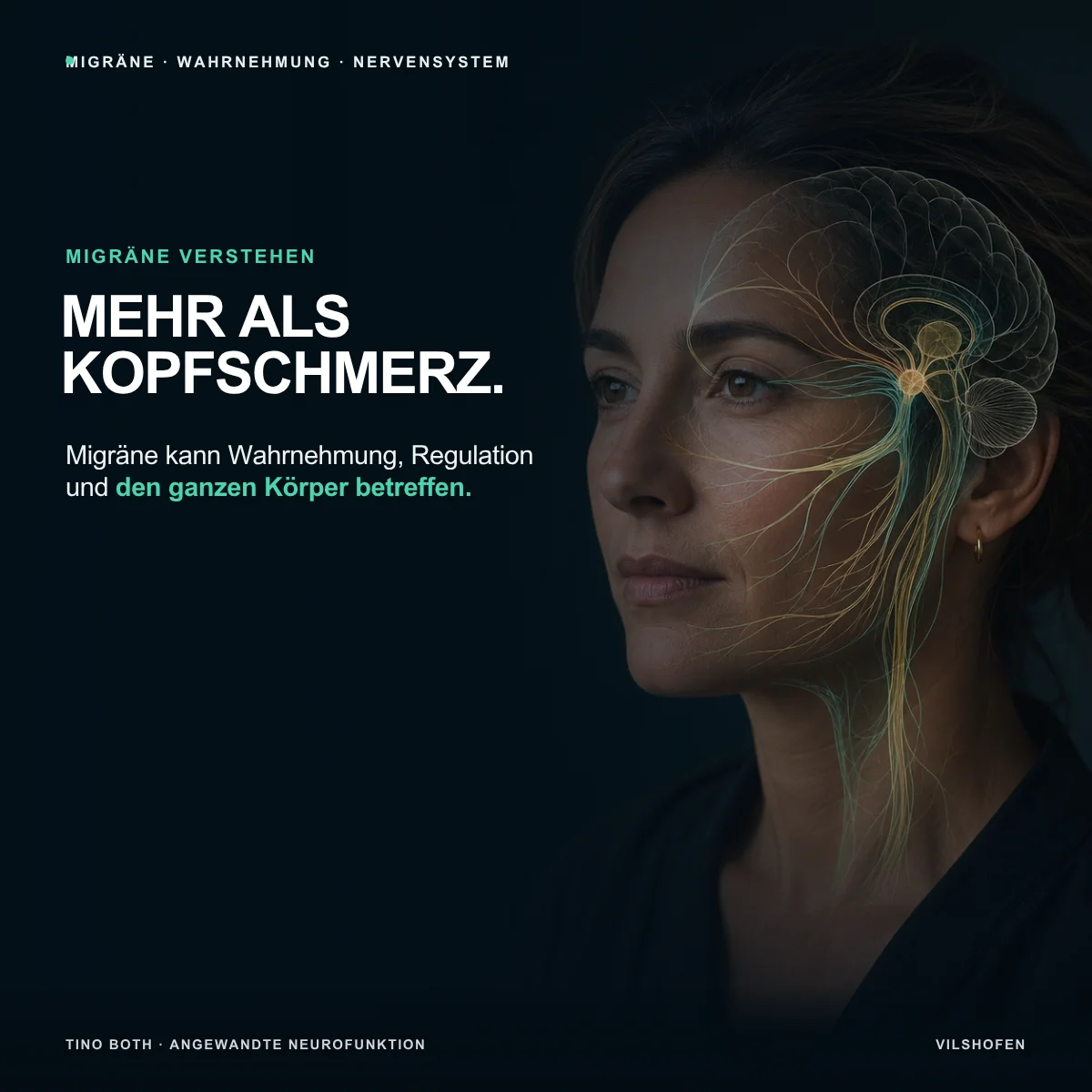
Briefly explained: Migraine is a neurological condition that can involve more than headaches. Nausea, sensitivity to light and sound, an aura or exhaustion can belong to different phases. Recognising the timeline can help you describe symptoms better and plan your next steps more specifically.
Your headaches are being managed – but vision, movement or everyday life remain demanding?In a free initial consultation, we discuss which specific demand limits you between attacks. If your migraine has been medically assessed, we can establish whether a complementary functional assessment in Vilshofen fits your existing plan.
Discuss your everyday difficulties with migraine →
The initial telephone consultation is free.
Discuss your everyday difficulties with migraine →
The initial telephone consultation is free.
The pain has passed. Why do you still not feel back to normal?
You have got through the most intense part of the attack. Yet thinking is still difficult, sounds are irritating and the next appointment feels like too much. Perhaps the day before the headache was already different: unusually tired, unfocused or sensitive to stimuli. Little of this is visible from the outside.
Migraine is therefore difficult to understand if we ask only about the most painful hour. What happens before, during and afterwards is part of the overall picture. Not every attack follows the same course, and not everyone experiences every possible symptom.
How migraine is recognised
Typical features are recurring attacks with moderate to severe headaches, often throbbing and made worse by ordinary movement. Nausea or a combination of sensitivity to light and sound may also occur. Without successful treatment, the headache phase in adults can last four to 72 hours. The International Classification of Headache Disorders, ICHD-3 describes the diagnostic criteria.
The pattern is central to assessment. A single headache, neck tension or tiredness alone does not establish migraine. Equally, not every migraine attack has to be strictly one-sided. If you do not yet have a clear diagnosis or your pattern changes, this should be addressed in a medical examination.
Four phases help explain the course
The following classification is a guide, not a timetable your body has to follow. Phases may overlap or be absent. The American Migraine Foundation's overview of the course of an attack shows that not every attack includes all phases.
1. Early signs: something is already differentHours or even longer before the headache, symptoms such as tiredness, frequent yawning, concentration difficulties or altered sensitivity to stimuli may occur. These early signs are known as the prodrome. Looking back, they can help you recognise the beginning of an attack more clearly.
2. Aura: not every migraine has oneAn aura can involve temporary visual, sensory or language symptoms. A familiar visual pattern often develops gradually, such as shimmering or a moving jagged area. An aura can also occur without a subsequent headache. New neurological symptoms should not be self-classified as an aura.
3. Headache phase: more than pain intensityAlongside the headache, nausea and sensitivity to light and sound can determine the burden of an attack. Everyday activity can become unpleasant. Care therefore needs to consider how much an attack interrupts your daily life as well as a pain scale.
4. Recovery phase: the head is quieter, but you are not yet recoveredAfter the headache, exhaustion or concentration difficulties can remain. This phase is called the postdrome. Being unable to manage your usual demands again is therefore not automatically a sign that you are not trying hard enough. Your return to activity can match how you actually feel that day.
Aura, light sensitivity and dizziness are different observations
These terms are easily mixed together in everyday life. With light sensitivity, a light source becomes unpleasant; with a visual aura, perception itself changes, for example through a shimmering pattern. Dizziness involves orientation, balance or a sensation of movement. Several symptoms can occur together, but they are different observations.
The ICHD-3 describes aura through characteristic features, including its development over time and the resolution of symptoms. The often-cited duration of five to 60 minutes refers to individual typical aura symptoms; it is not advice to wait when deficits occur for the first time.
New deficits need their own assessmentFor sudden speech disturbance, paralysis or loss of vision: call 112. A headache that reaches maximum intensity abruptly, or a headache with fever and neck stiffness, is also an emergency. Having a known migraine does not protect against other conditions.
Why an apparent trigger may already be part of the attack
You are working at a screen, light becomes unpleasant and the headache starts later. Or you reach for something sweet unusually early and then have an attack. Such sequences can quickly appear to show a clear cause. Sometimes, however, sensitivity to stimuli or behaviour has already changed during an early migraine phase.
This does not mean personal triggers are irrelevant. It means looking more closely at the sequence rather than banning a new everyday activity after every attack. A recurring pattern is more useful for a discussion than a long list of individual suspected triggers.
What belongs in a useful migraine diary
Make brief notes on the start and end, associated symptoms, limitations in everyday life and any acute medication taken. If you recognise early signs or a familiar aura, record their timing too. This makes it possible to see whether only one symptom is changing or the overall burden is decreasing.
A good diary does not have to monitor every meal and every light source. It is more important that it remains manageable and that you can use it with the professionals supporting you. If attacks are frequent or the need for acute medication is increasing, the treatment plan should be reviewed. The IQWiG overview of migraine explains acute treatment, prevention and living with the condition.
Where a functional perspective can provide a useful addition
Medical migraine care addresses the condition and its attacks. Alongside this, my work focuses on a specific functional difficulty: does screen work quickly become tiring even between attacks? Does looking at a target during head movement remain unpleasant? Does a particular neck movement feel restricted? These tasks can be considered individually rather than grouping all symptoms under a single label.
The framework is Input → Processing → Output. An input might be visual information or a head movement. The observable response may be a change in mobility, a different sense of effort or a task that becomes easier to tolerate. We choose only questions that fit your concern; not every sensory system needs its own programme for every person.
A possible example: shifting your gaze remains demanding between attacksFirst, we define a short, tolerable gaze task. How clear does the target remain? How much effort is involved? A suitable sensory stimulus is then selected and the original task is repeated in exactly the same way.
A gaze task that feels more comfortable in the short term is a useful starting point for this function. For the migraine itself, we also consider the course over several weeks: attack days, limitations and, where relevant, medication days. These two levels answer different questions.
A gaze task that feels more comfortable in the short term is a useful starting point for this function. For the migraine itself, we also consider the course over several weeks: attack days, limitations and, where relevant, medication days. These two levels answer different questions.
How I examine the selected connection more closely
In my work with Angewandte Neurofunktion, I can explore a suitable question further through targeted stimulus and contact testing. A visual task, a mechanically restricted movement and an autonomic question lead to different testing pathways. Autonomic activation, innervation or supply relationships are tested separately, rather than inferred from a mechanical vascular relationship. First, we select an indicator muscle that can be tested reliably and without pain. Only then is a specific stimulus question introduced, for example relating to a particular visual function or movement. The muscle's response under that condition is compared with the stable baseline response.
If an unusual inhibition appears according to the criteria of the supplementary testing, we look for a suitable solution. The comparison is repeated: stimulus alone and stimulus with the solution. After integration, the stable response should also remain when the original stimulus is applied alone. Finally, the original task that matters to you is assessed again.
This makes it understandable how a choice is made. You do not receive the same exercise as everyone else solely because of the word ‘migraine’. At the same time, the question of your attack pattern remains part of your existing medical care. The specific functional assessment and longer-term support are coordinated in a useful way.
What you should take away from an appointment
An interesting moment during testing is not enough on its own. You should understand which task was examined, why a particular approach was chosen and how you can later tell whether it benefits you in everyday life. This also includes a tolerable dose if an exercise is planned, and a clear agreement about when it needs to be adjusted.
For some people, the most important first step is a better understanding of their symptoms. For others, it is a small, specifically tested addition between attacks. A useful plan needs to allow for how you feel on a given day and must not lead you to monitor every normal sensory stimulus as a danger.
Frequently asked questions about migraine symptoms
Can migraine occur without aura?Yes. An aura is not a necessary part of every migraine. There is migraine with and without aura, and even the same person can experience different types of attack.
Why am I still exhausted after the headache?A recovery phase with tiredness or reduced concentration can be part of the course of an attack. If symptoms last unusually long or are new, this should be discussed with a doctor.
Can migraine also occur without a headache?A typical aura can occur without a subsequent headache. However, new visual, language or sensory disturbances must not be independently explained as migraine.
When is an initial functional consultation useful?When your migraine has been medically assessed and a specific difficulty with vision, movement or orientation additionally limits your everyday life. We establish whether an individual complementary approach fits your existing care.
Your everyday life is more than the sum of your attack days
Understanding the course takes symptoms seriously without treating every sensation as a new cause. If you know which symptoms occur together and which task remains difficult between attacks, the next step can be planned more concretely. This is precisely where personal support can begin.
What would you like to find easier again between attacks?Describe that one task and your existing care to me. In the initial consultation, we discuss whether Angewandte Neurofunktion in Vilshofen could be a suitable addition for you.
Arrange a free initial consultation →
The initial telephone consultation is free.
Arrange a free initial consultation →
The initial telephone consultation is free.
Related further pages and articles
Distinguishing migraine more preciselyMigraine with aura – when shimmering, visual field loss and perceptual disturbances occur
Vestibular migraine – when dizziness is more noticeable than headache
Migraine and nausea: why an attack affects more than the head
Vestibular migraine – when dizziness is more noticeable than headache
Migraine and nausea: why an attack affects more than the head
Exploring individual symptomsLight sensitivity in migraine – why screens, patterns and supermarkets can become overwhelming
The neck and migraine: trigger, associated symptom or an additional problem?
Headaches behind the eye – migraine, visual strain or something else?
The neck and migraine: trigger, associated symptom or an additional problem?
Headaches behind the eye – migraine, visual strain or something else?
Related areas of focus in VilshofenPain and functional symptoms
Dizziness and balance
How I work: Angewandte Neurofunktion
Dizziness and balance
How I work: Angewandte Neurofunktion
Sources and further reading
International Headache Society: ICHD-3 – migraine without aura
International Headache Society: ICHD-3 – migraine with aura
American Migraine Foundation: The Phases of Migraine
IQWiG: migraine – overview and treatment options
International Headache Society: ICHD-3 – migraine with aura
American Migraine Foundation: The Phases of Migraine
IQWiG: migraine – overview and treatment options