

← All articles
Pain & functional symptoms
Migraine with aura: when flickering, visual field loss and perceptual disturbances occur
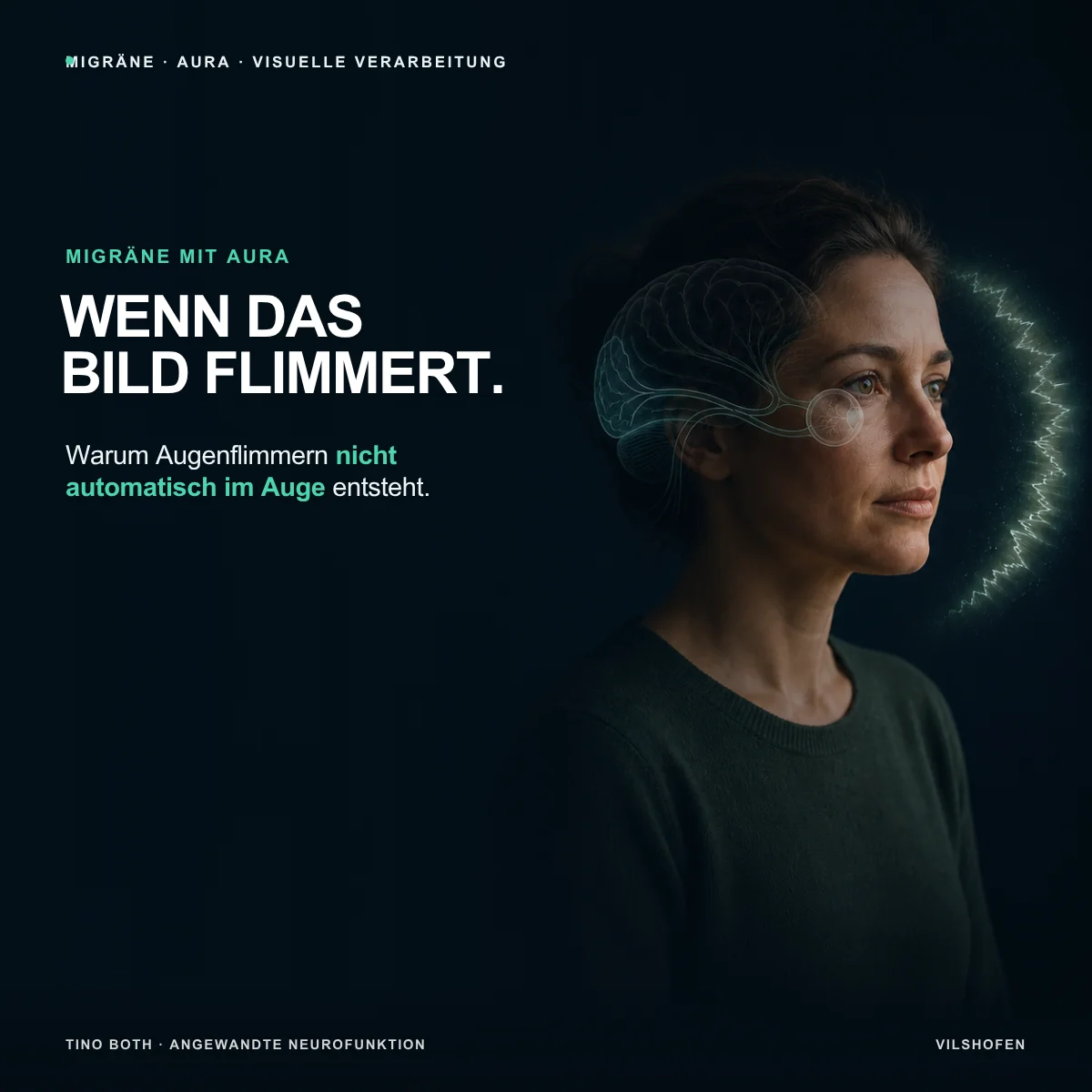
Flickering zigzag lines, moving visual field gaps, tingling in hand or face and suddenly missing words may form part of migraine aura. These symptoms can be frightening, especially the first time.
Some initially notice a small flickering spot that slowly expands. Others see jagged lines, bright arcs or an area where details disappear. For some, tingling spreads from fingers along the arm to the face; others temporarily struggle to find words or understand language correctly.
After several minutes, symptoms recede. Typical migraine headache may follow, though sometimes it is absent entirely.
Aura is therefore more than simple visual flickering. It is a temporary neurological event changing processing in particular brain areas. The perception experienced depends on which networks contribute during aura.
Briefly explainedMigraine aura consists of temporary, fully reversible neurological symptoms. Visual phenomena such as flickering, zigzag lines or visual field gaps are most common. Tingling, numbness and language changes are also possible.
Typical symptoms usually develop over several minutes, often last five to 60 minutes and may occur consecutively. Subsequent headache is common but not essential.
Typical symptoms usually develop over several minutes, often last five to 60 minutes and may occur consecutively. Subsequent headache is common but not essential.
What is migraine aura?
Aura is a temporary neurological-function change that resolves completely.
Migraine with aura is a distinct migraine subtype. It involves repeated attacks with fully reversible visual, sensory, language or other focal neurological symptoms.
Aura often precedes headache but may develop during the pain phase or extend into it. Some experience both attacks with aura and migraine without aura.
Timing particularly supports typical aura. Symptoms often develop and change over minutes instead of starting abruptly at full intensity. Visual phenomena may move through the visual field, tingling slowly travel across arm and face, and several symptoms occur consecutively.
Typical aura features• Symptoms are fully reversible
• They often develop gradually over at least five minutes
• Several aura symptoms may occur consecutively
• An individual symptom usually lasts five to 60 minutes
• Positive phenomena such as flickering or tingling are common
• Headache may begin during aura or follow within an hour
• They often develop gradually over at least five minutes
• Several aura symptoms may occur consecutively
• An individual symptom usually lasts five to 60 minutes
• Positive phenomena such as flickering or tingling are common
• Headache may begin during aura or follow within an hour
Not every attack meets every feature and individual symptoms may persist longer. Classification therefore follows the recurring overall pattern, rather than one sign.
The introductory article Understanding migraine: why it is much more than headache explains other migraine phases and accompanying symptoms.
Which forms of migraine aura exist?
Aura may affect vision, body sensation, language and, in rare subtypes, other neurological functions.
Typical aura comprises visual symptoms, sensory disturbances or language changes. Motor weakness, pronounced brainstem symptoms and truly one-eye visual disturbances belong to separate migraine subtypes.
Visual auraFlickering, flashes, zigzag lines, jagged arcs, moving spots or visual field gaps are among the commonest aura symptoms.
Sensory auraTingling or pins and needles may slowly spread from fingers along the arm, face or tongue. Temporary numbness may follow.
Language or speech disturbancesWords may be hard to find, sentences difficult to form or language temporarily harder to understand. This can feel very unsettling but resolves fully in typical aura.
Rarer aura formsMotor weakness, pronounced dizziness with further brainstem symptoms or truly monocular visual disturbances are not typical aura and are classified as separate subtypes.
Several symptoms may occur within one attack. Aura often starts visually before tingling or language change follows, but order can vary.
What does visual migraine aura look like?
Visual auras often combine bright or flickering phenomena with an area of restricted perception.
Visual aura is the most frequent form. Its appearance varies greatly, so it is not always immediately recognised as migraine.
A classic pattern begins near the centre of gaze as a small bright or blurred area. A jagged flickering line may develop, slowly moving outwards and leaving temporary visual field loss.
Others see flashes, waves, geometric shapes, flickering arcs or a blind spot without prominent light phenomena. Reading, recognising faces and orientation may temporarily become difficult.
Positive visual symptomsSomething absent is perceived additionally: flickering, flashes, zigzag lines, colours or moving patterns.
Negative visual symptomsPart of normal perception disappears. Areas seem empty, grey, blurred or completely obscured.
Positive and negative phenomena often coexist. A flickering or jagged border may surround an area of restricted visual field, for example.
Does aura affect one eye or both?
Typical visual aura usually arises in central visual processing rather than directly in one eye.
Visual aura symptoms usually affect the same visual field in both eyes. A gap only on the right side of perception may subjectively seem to affect the right eye.
In fact, when covering eyes alternately, the phenomenon often remains in both eyes or the same half of the visual field. This suggests change occurs beyond the crossing of the visual pathways, within central processing.
One-eye vision loss is differentA disturbance truly affecting one eye alone does not fit typical visual aura. Retinal migraine is very rare. New temporary loss of vision in one eye should therefore be medically or ophthalmologically assessed.
The distinction between vision in the eye and visual processing in the nervous system is explained further on the focus page Visual difficulties and visual processing.
Why does aura travel through the visual field?
Slow symptom spread fits a temporary activity wave in the cortex.
Cortical spreading depolarisation is an important explanatory model of migraine aura. A wave of altered neuronal activity spreads slowly across the cerebral cortex.
If it passes through visual cortex areas, phenomena may move through the visual field according to the cortex's spatial organisation. Sensory or language-processing involvement may produce tingling, numbness or language changes.
This explains why typical aura is not simply a static image. Symptoms change position, spread or are followed by further perceptual disturbances.
Aura is therefore no longer understood as a simple circulation disturbance or an eye-muscle problem. It is a temporary brain-network event.
How do aura and prodrome differ?
Early migraine symptoms are not automatically aura.
Hours or occasionally days before the main attack, fatigue, frequent yawning, concentration problems, mood changes, cravings, neck stiffness or increasing sensory sensitivity may appear.
These are called prodromal symptoms. They indicate the migraine attack has already begun but are not aura.
ProdromeNon-specific early changes such as fatigue, yawning, neck stiffness, cravings, concentration difficulty or light sensitivity.
AuraTemporary focal neurological symptoms such as flickering, visual field loss, moving tingling or language disturbance.
This distinction matters for supposed triggers too. Cravings, neck tension or light sensitivity may already belong to an emerging attack and then be mistakenly viewed as its cause.
Can aura occur without headache?
Typical aura can run its whole course without subsequent headache.
Some experience typical migraine headache after every aura. Others have attacks both with and without subsequent pain. Some experience only aura without headache.
This is called typical aura without headache. It may comprise visual, sensory or language symptoms resolving fully.
Without familiar migraine headache, assessment is harder because other neurological events may cause similar symptoms. Differentiation matters particularly at first occurrence, with purely loss-of-function symptoms or a clearly changed course.
The later article in this series, Migraine without headache: can aura occur on its own? will explore this form further.
How do migraine aura and stroke or TIA differ?
Timing provides important clues but alone cannot enable safe self-diagnosis.
Aura and circulatory disturbances may resemble each other through visual loss, numbness or language problems. Typical aura symptoms often develop gradually, travel over minutes and include positive phenomena such as flickering or tingling.
With transient ischaemic attack or stroke, neurological deficits often start suddenly and rapidly reach maximum intensity. Negative symptoms such as lost vision, sensation, strength or language often predominate.
The changed pattern mattersNew paralysis, speech disturbances, major sensory loss, sudden visual field deficit or a first aura should not be self-classified using these differences alone. Particularly relevant are new symptoms, abrupt onset, unusually long persistence or marked deviation from the familiar personal pattern.
When should aura be medically assessed?
A familiar recurring pattern differs from first-time or clearly changed symptoms.
Prompt or urgent assessment matters especially with• A first aura or completely new symptom
• Sudden onset at full intensity
• New paralysis or marked muscle weakness
• Persistent language disturbance
• Altered consciousness or seizure
• One-eye vision loss
• New double vision
• Unusually prolonged aura
• Purely loss-of-function symptoms without flickering or tingling
• First onset after age 40
• Symptoms after an accident or head injury
• A clearly changed course compared with previous attacks
• Sudden onset at full intensity
• New paralysis or marked muscle weakness
• Persistent language disturbance
• Altered consciousness or seizure
• One-eye vision loss
• New double vision
• Unusually prolonged aura
• Purely loss-of-function symptoms without flickering or tingling
• First onset after age 40
• Symptoms after an accident or head injury
• A clearly changed course compared with previous attacks
A familiar, medically assessed and consistently similar pattern is often readily recognised. Taking changes seriously matters more than repeatedly problematising every familiar course.
Migraine with aura and visual sensitivity
Visual processing may be more sensitive in migraine even outside aura itself.
Aura arises in the cortex and is not an eye-movement disorder. Visual load, gaze control and moving surroundings may nevertheless matter for people with migraine.
Bright light, strong contrast, flickering lighting, scrolling, patterns or prolonged screen work can become much more tiring during a sensitive phase. This does not automatically mean these stimuli cause aura. They may add demands when the nervous system is already nearer its limit.
Visual perception may remain sensitive after aura too. Reading, rapid gaze shifts and complex surroundings may feel harder although flickering has gone.
The article When visual stimuli overwhelm: why supermarkets, crowds and patterns become tiring explores these connections further.
What role do eye movements play in migraine with aura?
Eye movements do not generate aura but may contribute to individual visual load.
Fixation, saccades, smooth pursuit, vergence and gaze stabilisation allow visual information to be reliably acquired and processed in daily life.
If these functions additionally need substantial regulation, reading, screen work, driving or moving surroundings may cost more energy. This extra load may matter in a sensitive migraine system without being aura's neurological cause.
Distinguish aura and oculomotor function clearlyMigraine aura is a cortical neurological event. Unusual eye movements neither prove nor automatically cause it. Functionally, it may nevertheless help to assess whether particular visual demands produce non-physiological responses between or after attacks.
Find more about these functions in Understanding oculomotor function: why eye movements are a window into the nervous system.
Migraine trigger or already emerging aura?
Not everything occurring shortly before an attack caused it.
Light, stress, sleep deprivation, hunger, hormonal changes, alcohol and weather changes are often described as triggers. The relationship is not always clear.
An emerging attack may already alter concentration, appetite, neck, mood and sensory sensitivity. This can make a particular food, light or situation seem to have triggered aura although neurological change may have begun earlier.
Observing timing is therefore often more useful than an ever-growing prohibition list. When did the first change begin? What differed hours beforehand? Which symptoms regularly develop in the same order?
An aura diary can show• Which symptoms appear first
• How quickly they develop
• How long individual symptoms last
• Whether they occur consecutively
• When headache starts
• Which stimuli already stood out before aura
• How long exhaustion or sensitivity persists
• How quickly they develop
• How long individual symptoms last
• Whether they occur consecutively
• When headache starts
• Which stimuli already stood out before aura
• How long exhaustion or sensitivity persists
A neurofunctional view of migraine with aura
Aura itself is not treated through eye exercises. Individual visual, sensory and regulatory connections can nevertheless be assessed and integrated functionally.
My work focuses on Neurofunctional Integration as the primary functional approach, rather than blanket eye, balance or breathing exercises.
For medically assessed migraine with aura, examine between attacks or after resolution whether particular visual, oculomotor, vestibular, sensory or body-related functions produce a reproducible non-physiological response.
1. Test an individually relevant functionDepending on the personal pattern, assess fixation, saccades, pursuit, vergence, visual fields, light stimuli, head movements, balance, neck information or further sensory functions, for example.
2. Recognise a non-physiological responseThrough a stable indicator muscle, consider whether a defined function triggers a reproducible response that is non-physiological in context.
3. Seek the relevant functional connectionOnce a notable response is found, assess which additional stimulus normalises output. Different functional connections may matter according to the individual test.
4. Integrate neurofunctionallyAddress the identified connection through Neurofunctional Integration. The aim is to make the contributing function more available again, rather than merely repeating a provoking stimulus frequently.
5. Retest directlyAfter integration, reassess original function and relevant outputs. Gaze steadiness, standing, mobility, muscle response, breathing or subjective strain may change, for example.
Integration is the central interventionAura is not “trained away” through eye movement. If a specific visual or sensory function produces a non-physiological response between attacks, the relevant connection can be sought, integrated and retested directly.
Neurocentric exercises are used additionally only when everyday transfer, capacity or a specific performance aim needs support after integration.
Neurocentric exercises are used additionally only when everyday transfer, capacity or a specific performance aim needs support after integration.
Retest change does not prove aura's cause. It shows the identified functional connection may matter for the nervous system's individual response.
Learn more about the approach on Method — Applied Neurofunction and Neurofunctional Integration.
A functional view of migraine with aura in Vilshofen and Lower Bavaria
The focus is individual NeuroFI testing, targeted integration and direct retesting.
I work in Vilshofen an der Donau with Applied Neurofunction and Neurofunctional Integration. This approach serves people with medically assessed migraine who want further functional investigation of visual, sensory or body-related connections.
A standard exercise is not inferred from the symptom. Test which particular function generates a non-physiological response and which functional connection can normalise that output.
Depending on the pattern, visual processing, eye movements, light, balance, neck information, autonomic responses or other sensory functions may matter. The identified connection is integrated neurofunctionally and retested directly.
This produces a specific intervention as well as symptom description. Aura's presence alone cannot establish which connection matters.
Further informationFind more about pain and functional symptoms on the focus page Pain and functional symptoms.
For an initial discussion, arrange a free initial telephone consultation.
For an initial discussion, arrange a free initial telephone consultation.
Conclusion: aura is more than visual flickering
Visual, sensory and language changes arise from a temporary neurological network event.
Migraine with aura may involve flickering, visual field loss, tingling, numbness or language changes. Gradual development, full resolution and limited duration of individual symptoms are typical.
Aura usually arises in central brain processing rather than directly in the eyes. Visual load, eye movements, balance and other sensory functions may nevertheless matter for the individual symptom pattern.
After medical assessment, Neurofunctional Integration may additionally examine which specific functions trigger non-physiological responses and which connection can be integrated specifically.
The practical neurofunctional logicTest function → recognise non-physiological response → find relevant functional connection → integrate neurofunctionally → retest directly.
Common questions about migraine with aura
Key questions about flickering, visual field loss, duration and functional support.
What is migraine aura?Aura consists of fully reversible neurological symptoms. Visual changes are especially frequent, but tingling, numbness or language difficulties are possible too.
How long does aura last?One typical aura symptom usually lasts five to 60 minutes. Consecutive symptoms can make the whole aura correspondingly longer.
Can aura occur without headache?Yes. Typical aura may run its course without headache occurring simultaneously or within the following hour.
Does migraine visual flickering originate in the eye?Typical visual aura usually arises in the brain's visual cortex. It therefore often affects the same visual field in both eyes, rather than one eye alone.
Is every visual disturbance migraine aura?No. Eye disease, circulatory disorders, neurological conditions and other causes may produce similar symptoms. Course and accompanying symptoms matter for assessment.
Can migraine with aura cause language difficulties?Yes. Language aura may temporarily impair word finding, speaking or understanding. New or unusual language disturbances need urgent assessment.
Can NeuroFI complement care for migraine with aura?After medical assessment, NeuroFI can assess between attacks whether specific visual or sensory functions cause non-physiological responses. Integrate the relevant connection and then retest directly.
Where can I explore migraine with aura functionally?In Vilshofen an der Donau, I offer Applied Neurofunction and Neurofunctional Integration for medically assessed migraine, visual, dizziness and nervous-system concerns.
Related pages and articles
Relevant information about migraine, visual processing, eye movements and functional integration.
Focus pages and contactPain and functional symptoms
Visual difficulties and visual processing
Dizziness and balance
Method — Applied Neurofunction and Neurofunctional Integration
Free initial telephone consultation
Visual difficulties and visual processing
Dizziness and balance
Method — Applied Neurofunction and Neurofunctional Integration
Free initial telephone consultation
Understanding migraine and auraUnderstanding migraine: why it is much more than headache
Vestibular migraine: when dizziness stands out more than headache
A functional view of migraine: when inflow and outflow systems at the head matter
Vestibular migraine: when dizziness stands out more than headache
A functional view of migraine: when inflow and outflow systems at the head matter
Vision and visual processingUnderstanding oculomotor function: why eye movements are a window into the nervous system
Why an eye problem often does not feel like an eye problem
When visual stimuli overwhelm
How visual processing can be assessed functionally
Why an eye problem often does not feel like an eye problem
When visual stimuli overwhelm
How visual processing can be assessed functionally
Professional sources
International classification and current professional information about migraine with aura.
International Headache Society: Migraine with aura — ICHD-3 criteria
International Headache Society: Migraine with typical aura
International Headache Society: Typical aura without headache
International Headache Society: Retinal migraine
German Migraine and Headache Society: Guidelines and information about migraine