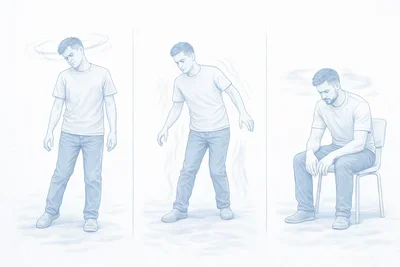
Briefly explained: Spinning vertigo, swaying dizziness and light-headedness describe different sensations, not clear-cut causes. Does the environment spin, does the floor feel unstable or do you feel more foggy? Assessment also considers onset, duration, triggers and accompanying signs. The feeling alone is not enough to establish the background.
Has your dizziness been assessed, but you remain unsteady in everyday life?In the initial consultation, you can describe when things become difficult and which examinations or treatments have already taken place. We clarify whether an additional functional perspective on gaze, balance and movement in Vilshofen fits your situation.
Discuss your everyday situation →
The initial telephone consultation is free.
Discuss your everyday situation →
The initial telephone consultation is free.
‘I feel dizzy’ can mean very different things
For one person, the room briefly spins when turning over in bed. Another feels as if they are on a ship despite firm ground. Someone else describes a cotton-wool head without anything visibly moving. All of this can be meant by dizziness, and sensations sometimes change.
You do not need the perfect technical term. A description as specific as possible is more helpful: what happens, when does it begin, how long does it last and what comes with it? This helps make a conversation during examination more targeted.
Get immediate help for acute dizziness with warning signsSudden severe, unfamiliar dizziness with new inability to walk, double vision, speech disturbances, paralysis or intense unfamiliar head or neck pain is an emergency: 112. Chest pain, fainting or severe breathlessness also require immediate help. New persistent severe dizziness should be assessed urgently by a doctor even without these accompanying signs.
Spinning vertigo: a movement that is not actually happening
In spinning vertigo, it seems as if the room or your own body is turning. This may occur briefly or persist for longer. Nausea and uncertain orientation can accompany it. The term initially describes perception; it does not yet establish which system is involved.
For further assessment, it makes a major difference whether spinning begins only briefly after a particular change of position or has continued uninterrupted for hours. New hearing changes, headaches and accompanying neurological signs also matter. ‘It spins’ is therefore the beginning of the description, not its end.
Swaying dizziness: as if the ground were giving way
Swaying dizziness is often experienced as wobbling, rocking or unstable ground. Perhaps it feels stronger while walking, or even during quiet standing. Some people report that busy surroundings intensify the feeling. Others notice hardly any relationship with vision.
The swaying sensation alone establishes neither a purely physical nor a purely psychological cause. A relationship with stress does not make symptoms imagined either. What matters is examining the entire pattern rather than assigning the sensation too quickly to one explanation.
Light-headedness: more foggy than moving
Light-headedness may feel like a cotton-wool head, reduced alertness or a difficult-to-define sense of uncertainty. Not everyone means the same thing by it. Some describe an impending faint; others concentration difficulties or altered perception. Follow-up questions are particularly valuable here.
Does it occur directly after standing up? Is a racing heart present at the same time? Have medicines changed? Is there a relationship with infection, sleep or eating? Such observations help medical assessment. Your own explanation, such as ‘it must be the neck’, should not cut off important questions prematurely.
Why duration and triggers often reveal more than the label
The GRACE-3 guideline from the Society for Academic Emergency Medicine places particular emphasis on timing and triggers in medical assessment of acute dizziness. The guideline concerns acute situations in emergency care. Its practical idea also helps descriptions: name not just the dizzy sensation, but describe its course as precisely as possible.
Brief and triggered by a particular situationWas dizziness genuinely absent beforehand and did it only begin with the position change? How many seconds or minutes did it remain? A recurring situation is an important clue for examination.
Episodic, without a clear triggerSymptoms come and go without you recognising a particular movement as their onset. Duration, frequency and accompanying signs are then particularly relevant.
Persistent and worsened by movementDizziness is already present at rest; movement makes it more unpleasant. This differs from brief dizziness newly triggered exclusively by a movement.
This distinction helps avoid a common misunderstanding: if every head movement worsens already-existing dizziness, this does not automatically indicate harmless positional vertigo. Special examinations belong in trained hands and are not reliable self-diagnostics.
How a functional perspective can follow assessment
Once medical causes have been assessed and suitable treatments are underway, specific everyday situations can still remain difficult. In Applied Neurofunction, we then consider more than the word dizziness: a tolerable task such as looking steadily, reorienting yourself while sitting or walking under safe conditions.
Visual information, balance signals and perception of body position may play a role. Which area is considered more closely follows from the history and the observed task. Existing vestibular physiotherapy or occupational therapy is included; an additional assessment should fit the care.
One possible example: sitting quietly works, looking around becomes unpleasantWe begin with a safe, well-tolerated starting situation. An easily recognisable target is viewed in stillness. Only when appropriate is the demand gently changed, for example with a small gaze shift. We attend to image clarity, unsteadiness and recovery time. Afterwards, we compare the same starting task again. Further steps are selected according to the response, not a wish to provoke as much dizziness as possible.
This may produce a practical everyday question: is calm seeing already demanding, is the switch the first finding or does the connection with movement become difficult? A suitable exercise is given at a low dose and reviewed over time. It should not accustom you to symptoms through constant overload.
A short note is more helpful than constant self-observation
A few details are enough for the next appointment: approximate onset, duration of an episode, situation beforehand, accompanying signs and what is possible between episodes. Also note relevant medicines and existing findings. You do not need to constantly rate symptoms or repeatedly try to provoke dizziness.
If you are unsteady, avoid risky balance exercises, unsupported standing with closed eyes and training on unstable surfaces. Driving is also not a suitable situation for testing your capacity when orientation is impaired or attacks occur suddenly.
Frequently asked questions about different dizzy sensations
Is spinning vertigo more dangerous than swaying dizziness?Not automatically. Urgency depends on onset, course and accompanying signs. A new severe swaying feeling can be just as urgent as spinning. The right word does not replace assessment.
Can I have different dizzy sensations at once?Yes. Sensations can overlap or change over time. Describe the specific situation and timing as closely as possible instead of committing to one category.
Which doctor should I see for dizziness?Without acute warning signs, a GP practice is often a sensible first contact. Depending on findings, ENT, neurology or other specialties may become involved. Acute warning signs require emergency care.
Can functional training make sense despite unremarkable examinations?It can be interesting as an addition if specific visual, balance or movement tasks remain difficult. Selection follows the individual course and existing care, rather than unremarkable findings alone.
The goal: turn a hard-to-grasp feeling into a clear next question
You do not need to diagnose your own dizziness. If you can describe duration, triggers and accompanying signs better, the next step often becomes clearer. After the necessary assessment, we can also consider more precisely which everyday situations need support.
Would you like to examine your remaining everyday unsteadiness more closely?In the initial consultation, we organise your situation and discuss whether an additional functional assessment in Vilshofen is suitable. Existing examinations and treatments provide the foundation.
Discuss the next suitable step →
The initial telephone consultation is free.
Discuss the next suitable step →
The initial telephone consultation is free.
Related pages and articles
Dizziness and orientationSwaying dizziness explained simply – why the floor moves even though nothing is wobbling
VOR explained simply – why the vestibulo-ocular reflex keeps gaze stable
Visual vertical: why the room can feel tilted
VOR explained simply – why the vestibulo-ocular reflex keeps gaze stable
Visual vertical: why the room can feel tilted
Include the visual system in the pictureUnderstanding oculomotor function: how eye movements guide everyday life
Visual overload: why the supermarket can trigger dizziness
How visual processing (seeing) can be assessed functionally
Visual overload: why the supermarket can trigger dizziness
How visual processing (seeing) can be assessed functionally
Relevant areas of focus in VilshofenDizziness and balance
Walking unsteadiness and balance problems
My approach: Angewandte Neurofunktion
Walking unsteadiness and balance problems
My approach: Angewandte Neurofunktion
Sources and further reading
SAEM: GRACE-3 – Acute Dizziness and Vertigo in the Emergency Department – guideline for medical assessment of acute dizziness.
University Medical Centre Hamburg-Eppendorf: dizziness – overview of symptoms and the diagnostic approach.
University Medical Centre Hamburg-Eppendorf: dizziness – overview of symptoms and the diagnostic approach.