

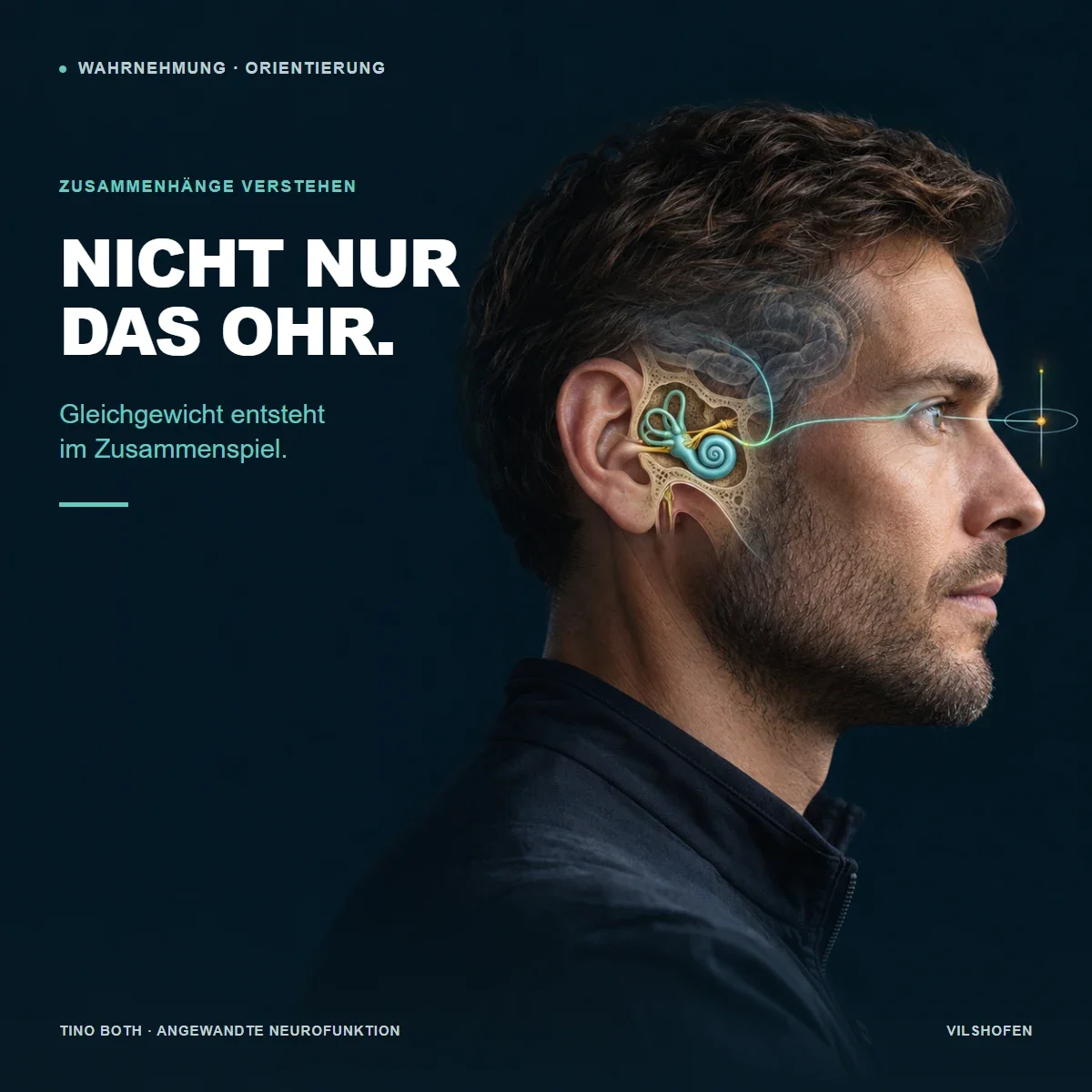
Briefly explained: The balance organ in the inner ear detects head movements and position relative to gravity. For stable orientation, this information needs to fit with vision and body perception. This is another reason dizziness can involve several factors.
Has the inner ear been assessed, but unsteadiness remains?In the free initial telephone consultation, you describe your situation and what matters to you. Together, we clarify whether my Angewandte Neurofunktion in Vilshofen could be a sensible next step for you.
Arrange a free initial telephone consultation →
Arrange a free initial telephone consultation →
In dizziness, medical assessment often first examines the inner ear and balance organ. This makes sense, because the vestibular system is central to orientation, gaze stability and balance. An acute disturbance or inflammation there needs medical assessment and treatment where appropriate. This applies, for example, to acute peripheral vestibular causes such as labyrinthitis or vestibular neuritis.
At the same time, the inner ear does not fully explain every dizziness. The balance organ does not work in isolation. Its information must be transmitted, processed centrally and coordinated with vision, body perception and posture. This is precisely why dizziness can persist even when the cause is not only local to the ear.
Why the inner ear is considered early in dizziness
The inner ear contains the vestibular system, the actual balance organ. It gives the brain information about how the head moves, its position relative to gravity and acceleration in space. This information is fundamental for orientation, balance and stable vision during movement.
That is why assessment rightly first considers whether there is an acute peripheral cause there. If the inner ear is inflamed or the vestibular system is acutely disturbed, dizziness, nausea, unsteadiness and severe impairment can result. Such conditions should not be minimised, but medically assessed.
What the balance organ in the inner ear actually does
The vestibular system consists of three semicircular canals and two macular organs, the utricle and saccule. The semicircular canals detect rotational head movements. The macular organs detect linear acceleration and head position relative to gravity. These signals are transmitted via the eighth cranial nerve and processed in the central nervous system.
An important part of this is the vestibulo-ocular reflex. It ensures the eyes automatically move in the opposite direction during head movements, so gaze remains stable. If this coupling does not work smoothly, dizziness, unsteadiness, blurred vision or an unstable feeling during movement can develop.
One possible assessment route: stable image while sitting, blurred during head movement
Starting situationYou can recognise a symbol well while sitting still. During a small head turn it looks more unsettled. I initially keep distance and target size the same and assess whether speed or movement direction makes a difference. A possible starting marker is the symbol’s clarity together with your feeling of stability.
Make targeted distinctionsAfter medical assessment and, where applicable, in coordination with vestibular therapy, a tolerable variation is selected. This may be a smaller range of movement or slower speed. A well-tolerated task matters first, rather than the longest possible exercise series.
Compare againWe then reassess the original comparison. Only when that works well is an everyday demand, such as brief walking, added. The chain involved is considered step by step instead of attributing all difficulties categorically to the inner ear.
Why dizziness nevertheless need not arise only locally in the ear
Although the inner ear plays a central role, it is only one part of the overall processing chain. The information arising there must be transmitted accurately, processed and coordinated with other sensory systems. This already makes clear why dizziness need not automatically be only a local ear problem.
From a functional perspective, dizziness can therefore be influenced on several levels: local vestibular function in the inner ear, neural transmission, central processing in the brainstem and cerebellum, coupling with eye movements and gaze stability, or coordination with body perception and posture.
Especially when symptoms remain, vary or do not fully fit the findings, a broader view is therefore worthwhile.
How disturbances along the functional chain can have effects
For orientation and balance to work, it is not enough for the inner ear alone to supply information. This information must reach the brainstem, connect with eye movements, translate into posture through vestibular reflexes and be finely coordinated in the cerebellum. It is additionally checked against visual and proprioceptive information.
This is precisely why functional disturbances at different points can produce or intensify similar symptoms. For example, head movements may cause unsteadiness, visual stimuli may worsen dizziness, gaze shifts may become demanding or the body may no longer stabilise smoothly during movement. The inner ear is then part of the story, but not necessarily the entire explanation.
When a functional perspective becomes particularly useful
A functional perspective becomes particularly interesting when acute medical causes have already been assessed but symptoms continue or can only partly be explained. This applies, for example, when dizziness occurs during movement, in visually dense environments, during head movements or together with unsteadiness and gaze problems.
The important question is often not only whether the inner ear is fundamentally involved, but how well the entire chain of vestibular information, gaze stability, central processing and bodily organisation works together.
This broader perspective in particular can help assess dizziness functionally rather than simply give it a local label.
Frequently asked questions
Can dizziness remain despite an unremarkable inner ear examination?Yes. The overall findings, functions examined and situations that remain difficult are decisive.
What do the semicircular canals do?They provide information about rotational head movements. Other receptor organs detect linear acceleration and the relationship with gravity.
Why are the eyes considered too?Head movement and gaze stabilisation are closely coupled. This combination matters for everyday orientation.
When a further assessment matters
Sudden loss of vision, new double vision with neurological findings, speech disturbances, paralysis or acute severe walking unsteadiness are emergency signs: 112. New persistent visual or dizziness symptoms and sudden hearing loss require prompt medical assessment. Known symptoms that change substantially should be assessed again.
Sources and further reading
Related pages and articles
Vision, orientation and balanceDizziness and balance
book an appointment
Reading and screen work: why the eyes become tired
Eyes and neck: visual problems without a blurred image
Visual disturbances despite unremarkable eye findings
Dizziness in particular situations: recognising patterns
Visual disturbances and visual processing
book an appointment
Reading and screen work: why the eyes become tired
Eyes and neck: visual problems without a blurred image
Visual disturbances despite unremarkable eye findings
Dizziness in particular situations: recognising patterns
Visual disturbances and visual processing
What would be a helpful next step for you?You do not need a ready-made explanation. A specific everyday situation and your goal are enough to begin.
Request your free initial telephone consultation here →
Request your free initial telephone consultation here →


Sources and further links
- Inner ear overview: https://www.msdmanuals.com/home/ear-nose-and-throat-disorders/inner-ear-disorders/overview-of-the-inner-ear
- NCBI / StatPearls – Vestibulo-ocular Reflex (VOR): https://www.ncbi.nlm.nih.gov/books/NBK545297/
- NCBI / StatPearls – Vestibular Neuronitis: https://www.ncbi.nlm.nih.gov/books/NBK549866/
- PMC – Gaze Stabilization and Vestibular Disorders: https://pmc.ncbi.nlm.nih.gov/articles/PMC4877687/
- NIDCD – Vestibular System / Balance Research Program: https://www.nidcd.nih.gov/research/extramural/balance-program