

← All articles
Pain & functional symptoms
Understanding functional symptoms – when symptoms are real but not clearly explained
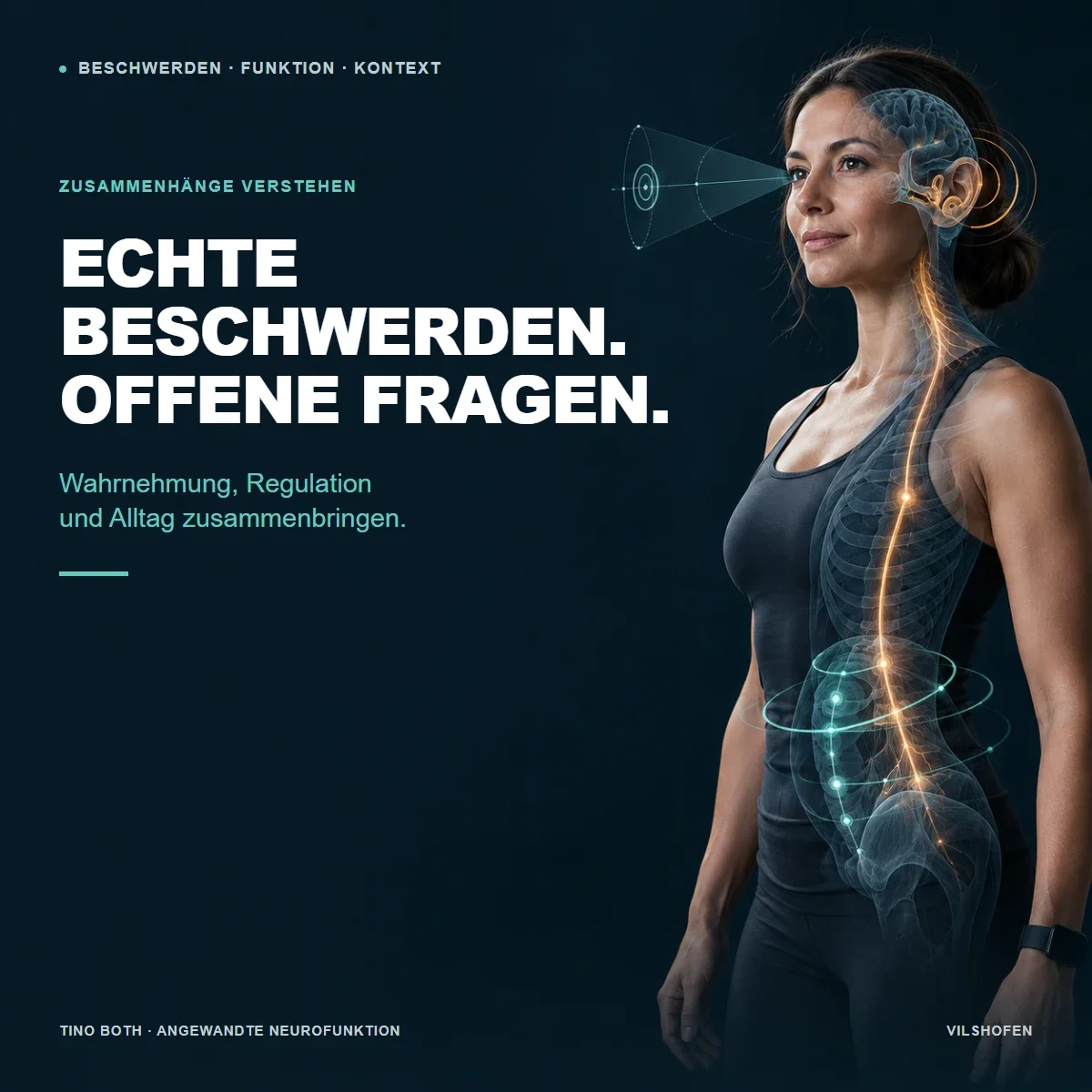
Briefly explained: Functional symptoms are real. The term does not simply describe an unremarkable finding; it directs attention to how bodily functions work together. Assessment is based on the overall symptom picture.
Are your symptoms there, yet you still lack an explanation?In the free initial telephone consultation, you describe your situation and what matters to you. Together, we clarify whether my Angewandte Neurofunktion in Vilshofen could be a sensible next step for you.
Arrange a free initial telephone consultation →
Arrange a free initial telephone consultation →
‘Nothing was found’ does not answer your entire situation
You clearly feel the symptoms. At the same time, examinations do not fully explain why everyday life is so demanding. This can be unsettling. A lack of a clear structural relationship does not make the experience any less real.
However, ‘functional’ is not simply a label for every symptom that remains unexplained. Medical assessment considers patterns, examination and the course of symptoms. Different functional symptom pictures have different features and appropriate treatment routes.
What function means
A structural question might be: is tissue injured? A functional question is: what works under which conditions? Both matter. Seeing during head movement is a different demand from identifying a letter while sitting. Walking in quiet surroundings is different from orienting yourself among moving people.
The model input → processing → output helps break down these tasks. What information is available? Which combination becomes demanding? What changes in observed behaviour or experience? It is a working framework, not an explanation for every symptom.
Many possible symptoms, but no universal shared fault
Pain, dizziness, visual overload, digestive symptoms and exhaustion can occur in different contexts. Several symptoms in one person do not automatically mean that a single contact or a particular nerve explains everything.
We look for a sensible shared starting point without overlooking differences. Circulatory symptoms may involve different questions from pain at a particular shoulder angle. Delayed intolerance of exertion requires a different approach again from a visual task that causes brief fatigue.
One possible assessment route: several symptoms – one manageable starting task
Starting situationYou describe light-headedness, neck tension and screen difficulties together. Instead of triggering everything as strongly as possible in one session, we choose a short, tolerable visual task while sitting. We note when the image becomes unsettled or the neck tightens.
Make targeted distinctionsWe then change one condition: the viewing distance, a calm external target or arm support, for example. A component function that shows a finding is examined more closely. Where needed, contact-based testing supplements direct observation; a suitable indicator muscle is first compared without and then with the specific assessment question.
Compare againThe original visual task remains the measure. If several symptoms respond more favourably, that is interesting for the next selection. If only one responds, the other is not simply considered resolved as well. This creates a sequence that fits your capacity.
Physical and psychological are not opposites
Attention, distressing experiences and expectations can influence bodily responses. Conversely, pain and uncertainty affect mood, sleep and social participation. This does not mean you cause your own symptoms.
In my Angewandte Neurofunktion, mental contexts can play a role alongside movement and sensory perception. Your concern, your consent and a well-tolerated framework are decisive. Distressing experiences do not need to be relived as intensely as possible to explore a functional question.
How I make a long symptom list smaller
We do not begin with a testing marathon. We choose a relevant marker: a short visual task, stable standing or a specific movement, for example. We then change one condition at a time and examine the same marker again.
If direct assessment does not answer every question, contact-based testing may be added. A suitable indicator muscle is identified first. The assessment question, a potentially supportive stimulus and the later re-test are kept clearly distinct.
What you can observe before an appointment
Note two or three typical situations: what are you doing, when does the symptom begin and what changes it? Include helpful conditions too. This information is often more useful than trying to find the correct diagnosis yourself.
When there is markedly delayed deterioration after activity, the moment during an exercise is not the only thing that matters. The subsequent course must also be included in planning. Functional work should fit your actual capacity.
Frequently asked questions
Are functional symptoms imagined?No. Even without an adequate structural explanation, symptoms can substantially affect everyday life.
Is an unremarkable MRI already the diagnosis?No. A single unremarkable finding does not automatically explain what type of symptoms are present.
Do I need to have every possible test first?Not indiscriminately. Which assessments make sense should be agreed with a doctor based on the symptom picture.
When a further assessment matters
New paralysis, acute chest pain with breathlessness or sudden severe neurological symptoms are emergency signs: 112. Pain after an accident, new bladder or bowel problems, fever or a marked unexplained deterioration require prompt medical assessment.
Sources and further reading
Related pages and articles
Continue readingTaking a functional look at pain & functional symptoms
Dizziness & balance
Visual disturbances and visual processing
Complex nervous system disturbances and autonomic dysregulation
Book an appointment directly
Complementing physiotherapy: when symptoms persist
Pain location and cause: why they can differ
Chronic pain: what is maintaining it today?
Understanding types of pain: tissue, nerves and processing
Pain despite an unremarkable MRI: what helps next
Dizziness & balance
Visual disturbances and visual processing
Complex nervous system disturbances and autonomic dysregulation
Book an appointment directly
Complementing physiotherapy: when symptoms persist
Pain location and cause: why they can differ
Chronic pain: what is maintaining it today?
Understanding types of pain: tissue, nerves and processing
Pain despite an unremarkable MRI: what helps next
What would be a helpful next step for you?You do not need a ready-made explanation. A specific everyday situation and your goal are enough to begin.
Request your free initial telephone consultation here →
Request your free initial telephone consultation here →
Sources and further links
- AWMF – S3 guideline on functional bodily symptoms: https://www.awmf.org/service/awmf-aktuell/funktionelle-koerperbeschwerden-1
- Summary in Deutsches Ärzteblatt – functional bodily symptoms: https://www.awmf.org/uploads/tx_szleitlinien/051-001k_S3_Funktionelle_Koerperbeschwerden_2019-08.pdf
- Patient guideline – understanding and managing functional bodily symptoms: https://register.awmf.org/assets/guidelines/051-001p1_S3_Funktionelle_Koerperbeschwerden_2020-01-abgelaufen.pdf