

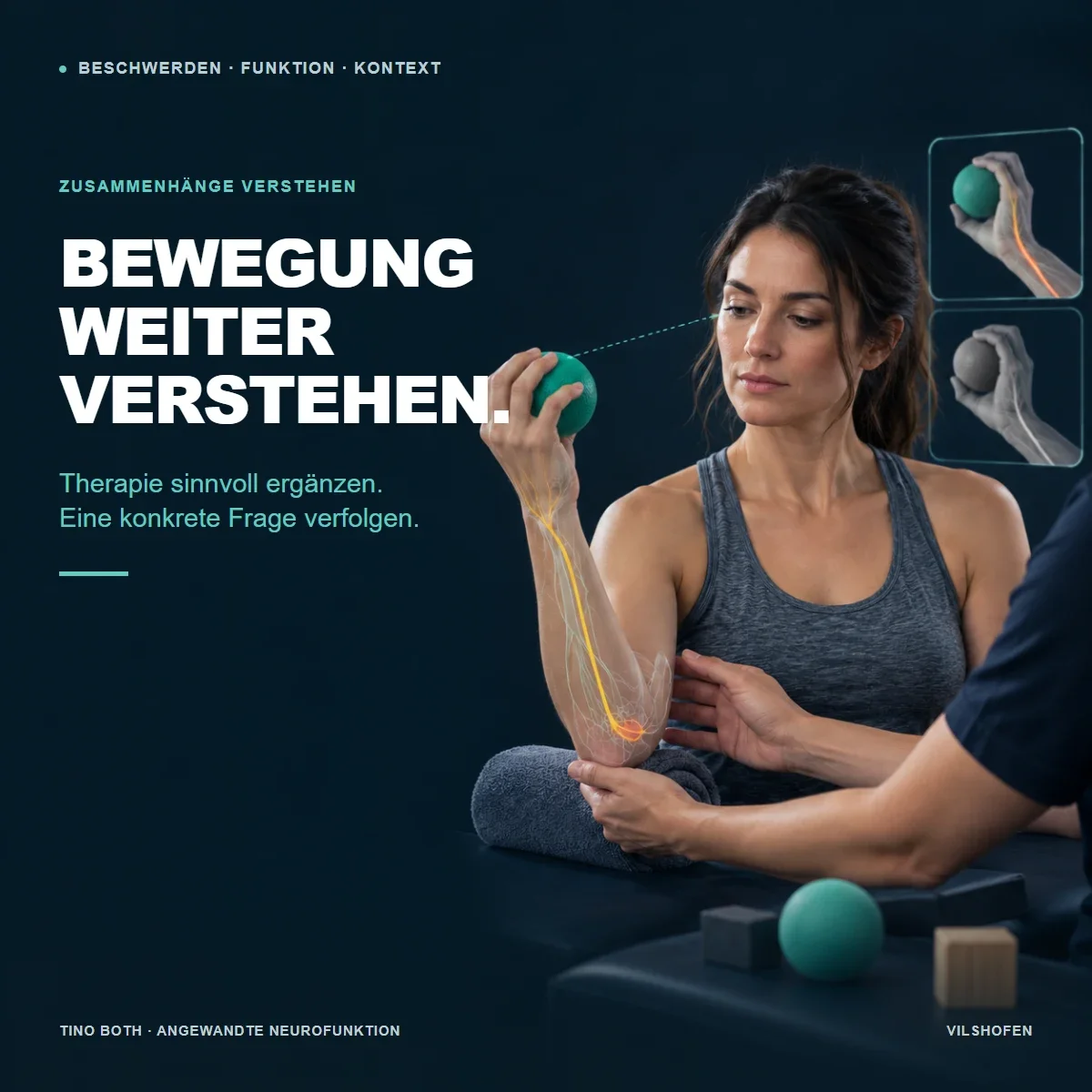
Briefly explained: If symptoms remain despite physiotherapy, this does not mean all the previous work was wrong. Further coordination and an additional look at perception, movement control and loading can provide new starting points.
Your exercises help, but a particular problem remains?In the free initial telephone consultation, you describe your situation and what matters to you. Together, we clarify whether my Angewandte Neurofunktion in Vilshofen could be a sensible next step for you.
Arrange a free initial telephone consultation →
Arrange a free initial telephone consultation →
You do the exercises – and still find yourself at the same point
A treatment temporarily frees your neck. You follow the exercises. The same tension still returns when you work at a screen. The wish for an ‘alternative to physiotherapy’ is then understandable. The more helpful question is often: what should be added or reconsidered together?
Physiotherapy has long involved more than local treatment: active rehabilitation, increasing load tolerance, understanding pain and, depending on the specialism, vestibular or neurological approaches too. My work with Angewandte Neurofunktion is a supplementary offer with its own focus on differentiated assessment of function and stimuli.
What a recurring symptom can tell us
A short-term improvement is an observation, rather than a complete explanation. Perhaps the dose does not yet fit everyday life. Perhaps the load becomes very high again afterwards. Perhaps an additional demanding task involving vision, orientation or perception contributes. These possibilities can be considered in turn.
A description that is as specific as possible helps: is lifting the arm difficult on its own, or only with a weight? Does the neck tense while sitting quietly or when shifting gaze between two monitors? Does walking become unsteady only with head movement? Such differences make the next assessment more precise.
My method: one question with several distinguishable pathways
I begin with your goal and a well-tolerated starting marker. This may be a movement, a visual task or a comparison of body awareness. Sensory information forms the input; its processing and the particular task influence which output can be observed.
A skin stimulus, a tendon response, mechanical stress on a nerve and a question of autonomic regulation are not interchangeable. Mental relationships may also be relevant when a specific situation or experience changes the bodily response. I keep the questions separate, rather than assessing as much as possible at once.
A possible assessment approach: moving the arm – without using the painful shoulder as the test muscle
Starting situationYou would like to lift your arm higher, but beyond a certain point the shoulder tightens. We record height, speed and sensation. For an additional contact-based assessment, I choose an indicator muscle that can be tested well and without pain. This means the shoulder does not have to work against resistance again for every individual question.
Make targeted distinctionsWithin my contact-based testing system, questions can be followed separately: for example, mechanical stimuli at a muscle, tendon, nerve or blood vessel. For vascular mechanics, the shoulder region is combined as a reference with the assigned contact points. If the muscle response changes reproducibly, I assess which additional contact or functional stimulus normalises this response. This is a different question from circulation or autonomic regulation.
Compare againAfter the integration step, the original assessment is repeated first, followed by lifting the arm again. What matters to you is whether reach, effort or pain changes. I can coordinate this possible approach with your existing exercise programme and progression of loading.
What you can bring from your experience so far
Which intervention helped you – and with which task? How long did the change last? What has been medically assessed? Which exercises do you tolerate well? This information is more valuable than the longest possible list of unsuccessful methods.
If you are still receiving physiotherapy, additional steps should fit the existing plan. New stimuli do not need to be piled on top of an already full programme. Sometimes less, but more targeted and readily assessable work, is useful initially.
Self-funded services should provide guidance, rather than pressure
My support is an additional offer. A private service is not automatically better than standard care. What matters is suitability, an understandable approach and a transparently discussed framework. In the initial consultation, we establish whether an appointment in Vilshofen appears useful for your concern.
You do not have to give up your existing care for this. A good next step may also be discussing an open medical question or load management with your current team.
Frequently asked questions
Do I have to stop my physiotherapy?No. Additional functional work should be compatible with ongoing care.
What is assessed in the first appointment?This depends on your concern. A specific, repeatable task is the starting point for targeted comparisons.
What if a stimulus changes nothing?The variation, dose or question is then adjusted. One neutral response does not determine all further possibilities.
When a further assessment matters
New paralysis, acute chest pain with breathlessness or sudden severe neurological symptoms are emergency signs: 112. Pain after an accident, new bladder or bowel problems, fever or a marked unexplained deterioration require prompt medical assessment.
Sources and further reading
Related pages and articles
Continue readingPain & functional symptoms
Book an appointment directly
Pain location and cause: why they can differ
Chronic pain: what is maintaining it today?
Functional symptoms: real and easier to understand
Understanding types of pain: tissue, nerves and processing
Pain despite an unremarkable MRI: what helps next
Book an appointment directly
Pain location and cause: why they can differ
Chronic pain: what is maintaining it today?
Functional symptoms: real and easier to understand
Understanding types of pain: tissue, nerves and processing
Pain despite an unremarkable MRI: what helps next
What would be a helpful next step for you?You do not need a ready-made explanation. A specific everyday situation and your goal are enough to begin.
Request your free initial telephone consultation here →
Request your free initial telephone consultation here →