

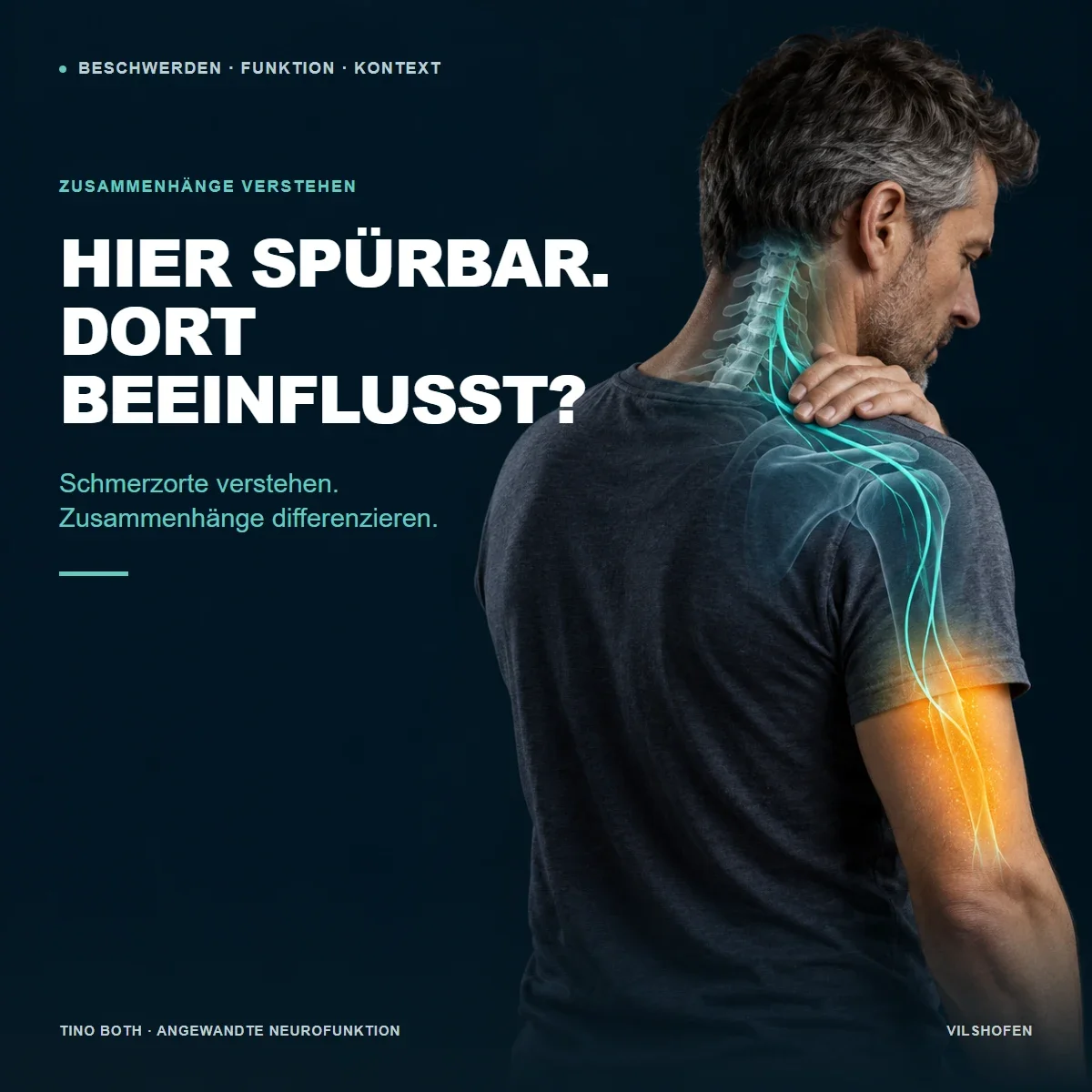
Briefly explained: The location of pain is an important clue, but not always its only starting point. Referred pain, nerve involvement and changes in load are different relationships that should be considered separately.
Does working on the same spot only ever help briefly?In the free initial telephone consultation, you describe your situation and what matters to you. Together, we clarify whether my Angewandte Neurofunktion in Vilshofen could be a sensible next step for you.
Arrange a free initial telephone consultation →
Arrange a free initial telephone consultation →
You point to one spot – the explanation may follow several routes
When the shoulder hurts, it is initially an important place to examine. Nevertheless, it can be useful to consider its relationship with the neck, arm position or a particular task. It would be a mistake both to look only at the painful spot and to dismiss it as unimportant too quickly.
Three things should remain separate: pain from local tissue, referred pain from another region and symptoms involving nerves. A similar pain location does not mean the same mechanism.
Referred pain is not the same as a sensitive nerve pathway
In referred pain, pain is felt away from its region of origin. One contributing factor is that signals from different regions meet at shared processing levels. Internal organs can also cause such pain patterns.
Radiating symptoms accompanied by tingling, numbness or new loss of strength, on the other hand, also raise questions about nerve involvement. They require an appropriate examination. The path of a line down the arm alone cannot reliably identify a cause.
Local receptors remain important
Skin, tendons, muscles, joints and surrounding tissue provide different information about contact, position and load. A movement changes not just one muscle, but also the demands on several of these structures at once.
In my functional perspective, I am interested, for example, in whether a task changes with light skin contact, a changed joint position or an adjusted arm posture. This creates questions that can be distinguished, instead of grouping everything under ‘tension’.
One possible assessment route: arm pain and different responses to nerve position
Starting situationWith recurrent arm pain that has been assessed, a small change in arm or hand position may influence a movement trial. I first compare tolerable positions. In an additional functional assessment, another muscle that works without pain can serve as an indicator.
Make targeted distinctionsWe compare the specific position with an unloaded variation and suitable control conditions. If only one variation repeatedly shows a changed muscle response, this question can be pursued further. An additional position or contact is assessed to see whether the response becomes more stable again under the same starting condition.
Compare againAfter integration, both re-tests matter: the original assessment and the arm movement that matters to you. The interesting idea is not ‘the pain is in the wrong place’, but that a change of position along a connected system may be relevant to the task.
Do not mix organ relationships, segments and autonomic questions
Medically possible referred pain from an organ and a contact-based functional organ assessment are different approaches. Where there are signs of an organ problem, medical assessment takes priority.
Within my method, local contact relationships, assigned pulse contacts at the wrist and myotome relationships can be compared. Myotomes describe muscle relationships with spinal cord segments. In this assessment system, matching responses help me pursue an assessment route more precisely. Mechanical questions concerning tissue or blood vessels are kept separate from questions about autonomic regulation.
Why changing pain locations do not provide a simple answer
Some symptoms change with load, how you feel that day or protective behaviour. This may help explain why one region is more noticeable at one time and another at a different time. A changing location, however, proves neither a central disorder nor that something is harmless.
Recurring patterns are useful: which movement comes before the pain? Does it occur with a particular posture, visual task or duration of activity? Are there new accompanying symptoms? Such details take us further than searching for a universal correspondence chart.
What I want to compare with you in practice
One relevant everyday action becomes the starting point. We then change one condition at a time. The immediate comparison helps select potential starting points; later everyday experience shows whether they hold up in practice.
The goal is not to present you with a particularly distant cause. It is to identify an understandable relationship that helps shape your next action sensibly.
Frequently asked questions
Can shoulder pain come from the neck?This is one possible medical situation. Local shoulder problems are also possible; the overall findings determine the assessment.
Does moving pain mean it is just stress?No. Its course, the load and accompanying symptoms need to be considered together.
Is an organ always tested?No. The choice follows the specific question, rather than a fixed programme for every pain.
When a further assessment matters
New paralysis, acute chest pain with breathlessness or sudden severe neurological symptoms are emergency signs: 112. Pain after an accident, new bladder or bowel problems, fever or a marked unexplained deterioration require prompt medical assessment.
Sources and further reading
Related pages and articles
Continue readingPain & functional symptoms
Book an appointment directly
Complementing physiotherapy: when symptoms persist
Chronic pain: what is maintaining it today?
Functional symptoms: real and easier to understand
Understanding types of pain: tissue, nerves and processing
Pain despite an unremarkable MRI: what helps next
Book an appointment directly
Complementing physiotherapy: when symptoms persist
Chronic pain: what is maintaining it today?
Functional symptoms: real and easier to understand
Understanding types of pain: tissue, nerves and processing
Pain despite an unremarkable MRI: what helps next
What would be a helpful next step for you?You do not need a ready-made explanation. A specific everyday situation and your goal are enough to begin.
Request your free initial telephone consultation here →
Request your free initial telephone consultation here →