

← All articles
Pain & functional symptoms
Pain despite unremarkable imaging – when to think further functionally
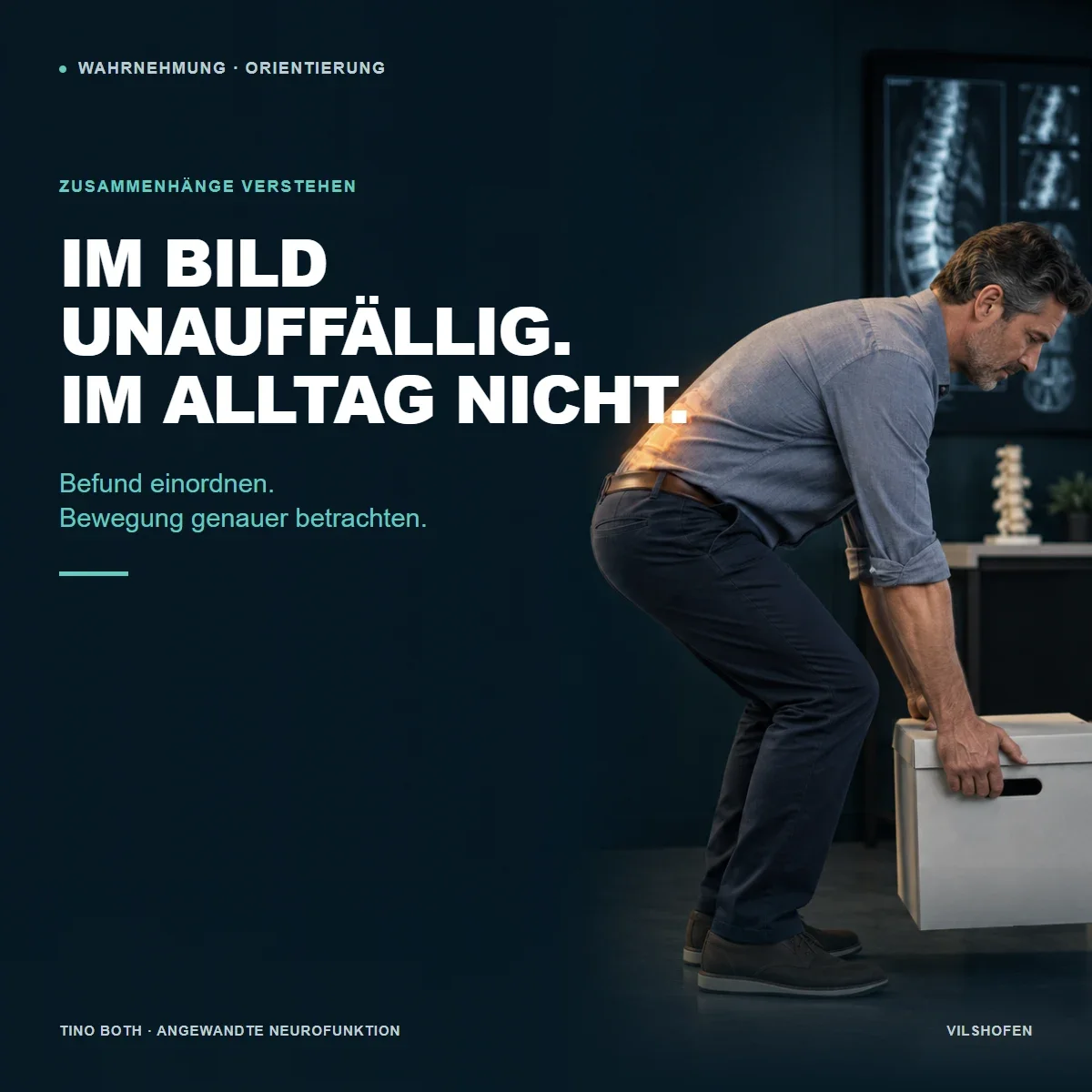
Briefly explained: An unremarkable MRI does not make pain unreal. It answers certain structural questions, but not every question about load and pain processing. The examined region, symptoms and their course are decisive.
Are your findings reassuring, but everyday life is still restricted?In the free initial telephone consultation, you describe your situation and what matters to you. Together, we clarify whether my Angewandte Neurofunktion in Vilshofen could be a sensible next step for you.
Arrange a free initial telephone consultation →
Arrange a free initial telephone consultation →
Reassuring findings and a difficult everyday life can both be true
You leave the examination with good news: the MRI shows nothing that adequately explains the symptoms. Yet pain returns when bending, sitting or raising your arm. You do not have to choose between these two experiences.
What was actually examined matters. An unremarkable image of a particular region does not rule out every conceivable illness. However, it provides important information that helps narrow down further medical and functional consideration.
What an image shows – and what a task shows
Imaging answers questions about structures. A functional assessment describes how a task works under defined conditions. The two can complement each other. Even visible changes need to fit the symptom picture; they do not automatically explain every level of pain.
During movement, speed, load, direction, repetition and context also matter. Reaching towards a shelf is more than an image of the shoulder. Orientation, coordination and previous experiences contribute to performance.
Not automatically ‘imagined’ and not automatically ‘just the nervous system’
Pain can be shaped by several factors. The nervous system processes bodily information, but that does not give a blanket explanation for all symptoms without imaging findings. A sensible approach considers tissue, load, perception and the course together.
Nociplastic pain must not be inferred from an unremarkable MRI alone either. This clinical assessment follows further features. For additional practical work, we can nevertheless already define a well-tolerated, specific starting task.
One possible assessment route: back findings are unremarkable – bending remains specifically assessable
Starting situationWe begin with an object at a height you tolerate well. You bend forwards within an agreed range; reach and effort are recorded. One condition is then changed, such as foot contact or the position of the visual target.
Make targeted distinctionsIf clearer contact through the sole of the foot influences the movement, for example, I examine this sensory question more closely. In additional testing, an indicator muscle working without pain can be compared under the selected stimulus. A potentially supportive input is first assessed in this combination and then again after integration.
Compare againFinally, the original reach towards the object follows again. An MRI image and this movement test provide different information: one assesses structures; the other shows how your task changes under defined conditions.
Which additional questions my work asks
Does the same movement differ with a stable visual target? Does movement feel different with clearer foot contact? Does a particular skin stimulus show a finding? Are arm or head positions relevant? Such differences provide specific candidates for further assessment.
Contact-based assessments can supplement direct functional observation. A suitable indicator muscle is used, rather than automatically the painful region. Different tissue questions and mental or autonomic questions are deliberately kept separate.
Why even a brief improvement can be interesting
Perhaps a movement becomes easier briefly after heat or treatment. That is an observable response. What remains open is which dose, context and build-up of load suit everyday life. A short-lived effect does not automatically prove that previous work targeted the wrong place.
We therefore follow a marker at several time points: directly in comparison, after a break and in everyday life. A small step that is repeatedly well tolerated is more helpful than an impressive one-off situation followed by overload.
What you can prepare for an initial consultation
Which examination took place, and when? Which movement remains difficult? What works well instead? Has there been a change or new accompanying symptoms? These details help narrow down the next step sensibly.
You do not need your own theory about the cause. A clear situation – such as ‘it starts after three minutes of loading the dishwasher’ – makes the work more tangible than a general statement that everything is blocked.
Frequently asked questions
Can an MRI be normal while pain is still severe?Yes. Pain intensity and visible structural change do not correspond exactly.
Does that mean I need more images immediately?That depends on the course and the doctor’s assessment question. More imaging is not automatically the best next step.
What else can be assessed?A specific movement or everyday task under altered, well-controlled conditions.
When a further assessment matters
New paralysis, bladder or bowel problems with back pain, or acute chest pain with breathlessness require immediate medical help. Fever, consequences of an accident or a marked unexplained deterioration should be assessed promptly by a doctor.
Sources and further reading
Related pages and articles
Vision, orientation and balanceTaking a functional look at pain & functional symptoms
Taking a functional look at visual disturbances and visual processing
Dizziness and balance
Book an appointment directly
Complementing physiotherapy: when symptoms persist
Pain location and cause: why they can differ
Chronic pain: what is maintaining it today?
Functional symptoms: real and easier to understand
Understanding types of pain: tissue, nerves and processing
Taking a functional look at visual disturbances and visual processing
Dizziness and balance
Book an appointment directly
Complementing physiotherapy: when symptoms persist
Pain location and cause: why they can differ
Chronic pain: what is maintaining it today?
Functional symptoms: real and easier to understand
Understanding types of pain: tissue, nerves and processing
What would be a helpful next step for you?You do not need a ready-made explanation. A specific everyday situation and your goal are enough to begin.
Request your free initial telephone consultation here →
Request your free initial telephone consultation here →
Sources and further links
- IASP – fundamentals of pain and chronic pain: https://www.iasp-pain.org/resources/toolkits/pain-management-center/chapter1
- IASP – Nociplastic Pain: https://www.iasp-pain.org/publications/pain-research-forum/papers-of-the-week/paper/the-concept-of-nociplastic-pain-where-to-from-here/
- NICE Guideline NG193 – Chronic primary pain: https://www.nice.org.uk/guidance/NG193