

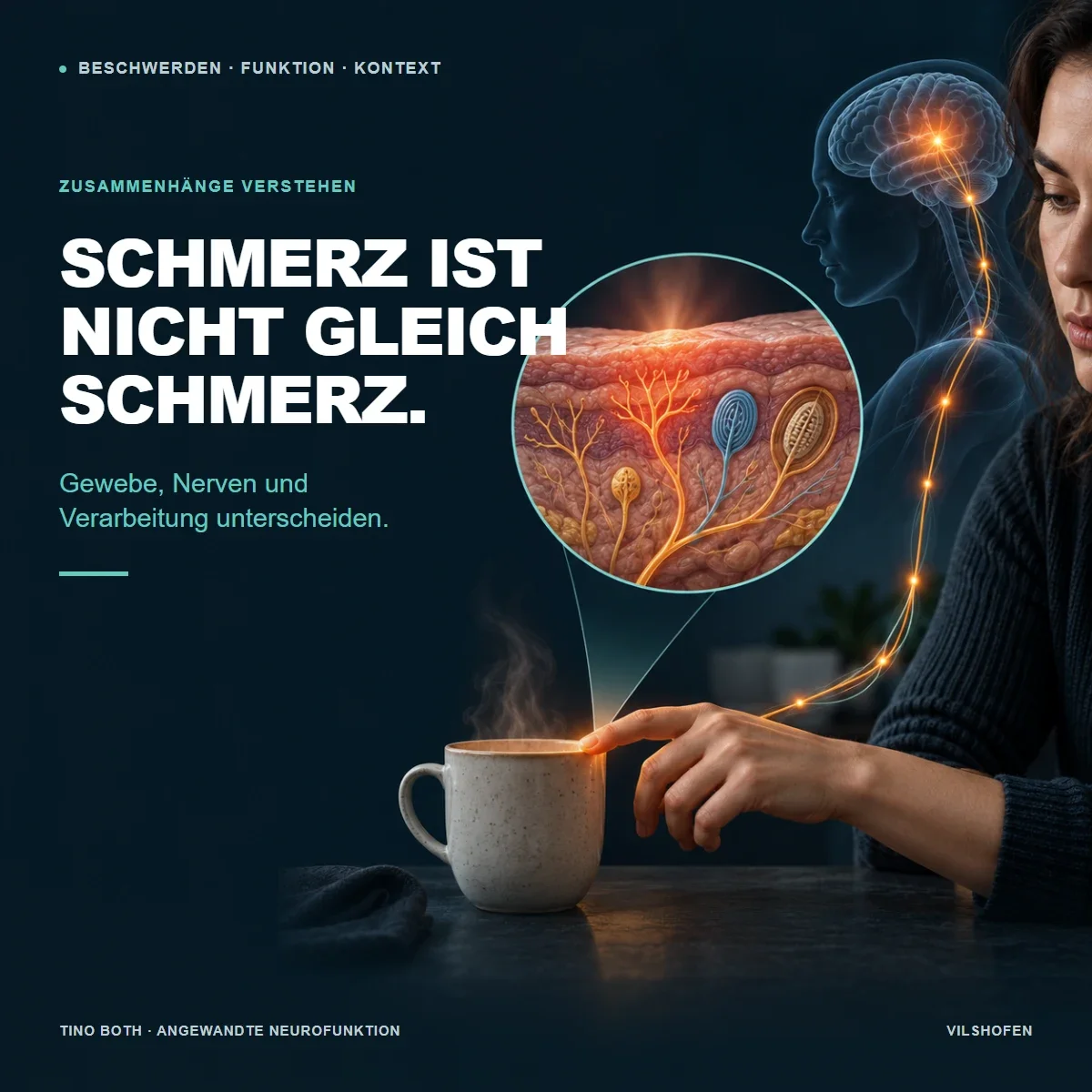
Briefly explained: Nociceptive, neuropathic and nociplastic pain describe different mechanisms. They can overlap. Pain intensity or a single muscle test is not enough to distinguish them reliably.
Would you like to understand your symptoms and possible starting points?In the free initial telephone consultation, you describe your situation and what matters to you. Together, we clarify whether my Angewandte Neurofunktion in Vilshofen could be a sensible next step for you.
Arrange a free initial telephone consultation →
Arrange a free initial telephone consultation →
Why pain intensity alone says little about the mechanism
A light touch can cause severe pain. Conversely, a visible change on an image may cause few symptoms. This is not a contradiction: pain is a personal sensory and emotional experience, rather than a directly readable damage value.
The terms nociceptive, neuropathic and nociplastic help describe different mechanisms. They are not a self-test or a ranking in which one type of pain is ‘more real’ than another.
Nociceptive: tissue gives rise to harmful or potentially harmful stimuli
Nociceptors play a role here: specialised nerve endings that detect such stimuli. A recent injury or inflammation may be an example. Nevertheless, nociception and consciously experienced pain are not identical.
Somatic pain refers to the body surface and movement system; visceral pain refers to internal organs. This is a different classification dimension from the question of mechanism. Organ pain can be diffuse and may also be felt elsewhere.
Neuropathic: disease or damage to the somatosensory system
Burning, electric or shooting symptoms and numbness may suggest a need for appropriate assessment. However, the description of the sensation alone does not prove neuropathic pain.
This concerns a lesion or disease of the nerve structures responsible for bodily sensation. It should be distinguished from a functional question about a tolerable nerve position or the influence of a movement. Not every mechanically sensitive position is already a neuropathy.
One possible assessment route: a light skin stimulus changes a movement
Starting situationSuppose bending a finger is unpleasant and a light touch feels different from the other hand. Appropriate medical assessment is needed first. In additional functional work, I then document touch sensation and a tolerable movement separately.
Make targeted distinctionsWe compare a clearly limited sensory input with the starting condition. If movement becomes easier, that provides a starting point for further observation. It does not automatically establish ‘neuropathic’, ‘nociplastic’ or a particular damaged structure.
Compare againThe practical strength lies in precise comparison: which stimulus quality, direction and dose are well tolerated? What happens during the original task and later in everyday life? Naming the pain and selecting a helpful input answer different questions.
Nociplastic: altered nociception is central
In this mechanism, neither clear tissue damage nor disease or a lesion of the somatosensory system adequately explains the symptoms. Assessment is based on clinical features, not simply on an unremarkable MRI.
Central sensitisation describes a neurophysiological mechanism and is not simply an interchangeable word for nociplastic pain. Allodynia means pain from stimuli that are normally not painful; hyperalgesia is an increased response to painful stimuli. These observations alone do not fully establish the mechanism.
Accompanying autonomic responses are another question
Temperature, skin colour, sweating and circulatory responses can play a role in certain pain syndromes. Complex regional pain syndrome, CRPS, for example, requires targeted medical assessment. It is not simply another name for ‘a lot of stress’ or general hypersensitivity.
Fibromyalgia must not be inferred from a single unusual test result either. In my functional work, I therefore separate the known medical assessment from the question of which small change influences a specific task. Vascular mechanics and autonomic regulation are different assessment routes here.
Mixed forms do not fit into a single category
Tissue loading, nerve involvement and altered processing can occur together. The useful question is therefore not always: which single type of pain do I have? Rather: what is already clarified, what needs treatment and which function relevant to everyday life can additionally be considered?
For example, I can compare touch, movement, visual demands or a context-related input separately. A contact assessment using an indicator muscle can supplement a question within the method. It does not replace the clinical classification of pain mechanisms.
Frequently asked questions
Can you identify the type of pain by how it feels?The description provides clues, but is not enough on its own for a reliable assessment.
Is nociplastic pain purely psychological?No. The term describes a pain mechanism, not imagined symptoms.
Can several mechanisms be present at the same time?Yes. That is why the course of symptoms, examination and function should be considered together.
When a further assessment matters
New paralysis, acute chest pain with breathlessness or sudden severe neurological symptoms are emergency signs: 112. Pain after an accident, new bladder or bowel problems, fever or a marked unexplained deterioration require prompt medical assessment.
Sources and further reading
Related pages and articles
Continue readingTaking a functional look at pain & functional symptoms
Book an appointment directly
Complementing physiotherapy: when symptoms persist
Pain location and cause: why they can differ
Chronic pain: what is maintaining it today?
Functional symptoms: real and easier to understand
Pain despite an unremarkable MRI: what helps next
Book an appointment directly
Complementing physiotherapy: when symptoms persist
Pain location and cause: why they can differ
Chronic pain: what is maintaining it today?
Functional symptoms: real and easier to understand
Pain despite an unremarkable MRI: what helps next
What would be a helpful next step for you?You do not need a ready-made explanation. A specific everyday situation and your goal are enough to begin.
Request your free initial telephone consultation here →
Request your free initial telephone consultation here →