

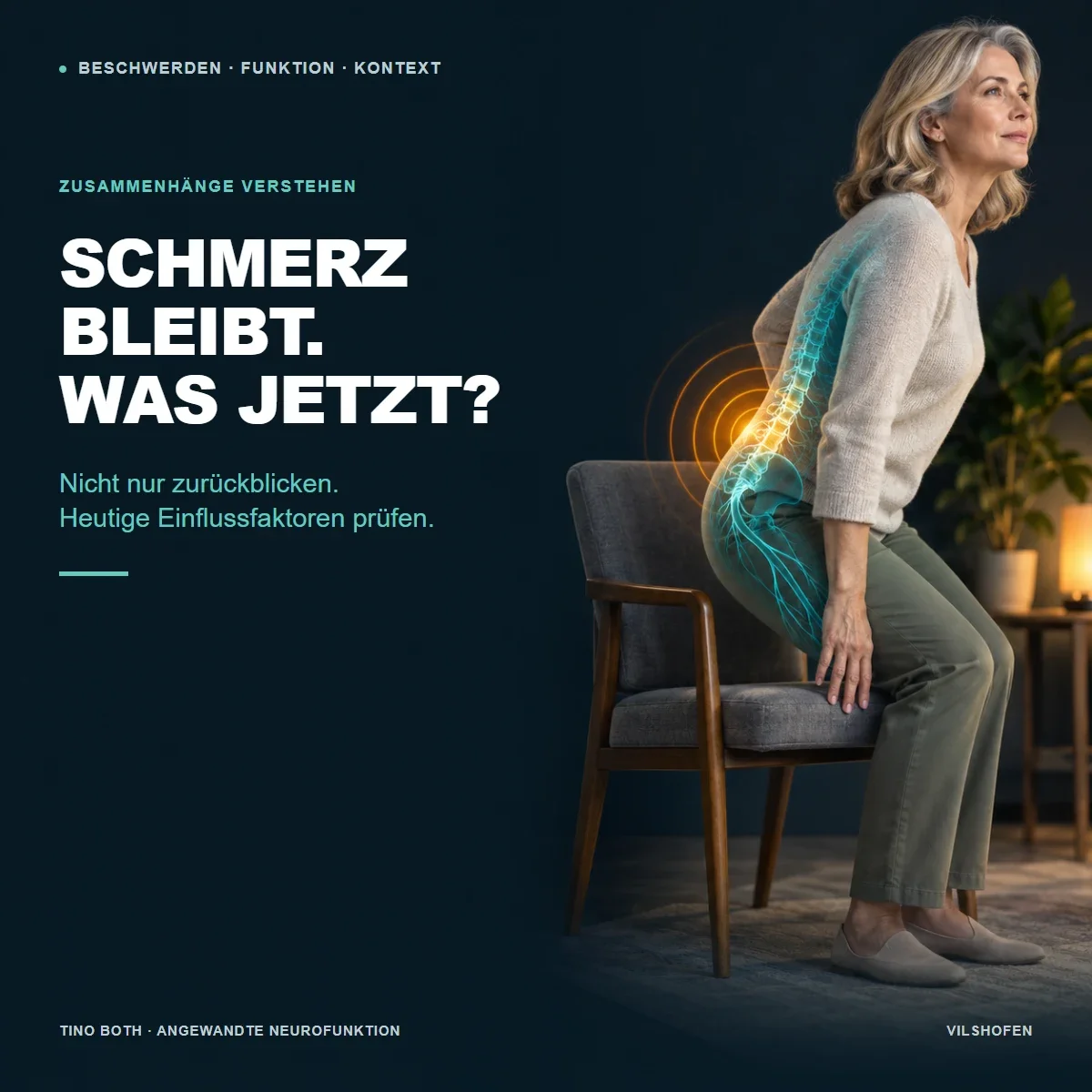
Briefly explained: With chronic pain, the original trigger and the factors involved today are not always identical. Tissue, pain processing, load, sleep and life circumstances can all be relevant together.
Do you know how your pain began, but lack a good next step?In the free initial telephone consultation, you describe your situation and what matters to you. Together, we clarify whether my Angewandte Neurofunktion in Vilshofen could be a sensible next step for you.
Arrange a free initial telephone consultation →
Arrange a free initial telephone consultation →
You know how it began – why is it still difficult?
Perhaps it all began with an injury. Perhaps the pain developed gradually. After months, you do not just want to recount its origins again; you want to understand what could help today. Both the original trigger and the factors currently involved matter for this.
Pain is usually called chronic when it persists or recurs for more than three months. This time threshold does not mean tissue must necessarily have healed completely. It highlights that its course, everyday life and other influencing factors need particular attention.
A biopsychosocial perspective takes the body seriously
Biological factors such as illness, tissue loading, sleep or recovery interact with experiences, expectations and life circumstances. This is not a division into ‘real’ physical pain and ‘unreal’ psychological pain.
When I talk about the nervous system, I am not adding a system separate from the body. Perception, movement, emotional meaning and physical regulation belong together. My work is therefore not limited to muscles and joints. Mental relationships can also be considered where appropriate and within a tolerable framework.
The stress barrel as an image – not a diagnosis
Imagine demands as different inflows: little sleep, a difficult working day, family worries, unfamiliar physical demands or taxing sensory stimuli. On one day there is room for something more; on another, even a small task becomes difficult.
The image helps us see several starting points. It does not prove which factor causes your pain. What matters is which change actually eases things in your everyday life: a more suitable dose, a break, support or a targeted functional input.
One possible assessment route: the same movement in two different contexts
Starting situationSomeone with longer-standing back pain may find it a little easier to rise from a chair during a calm conversation than when thinking about a demanding working day. I would not automatically classify this as a psychological cause. Initially, it is a question about which conditions change the specific task.
Make targeted distinctionsWe keep chair height, speed and support the same. If you wish and it is well tolerated, we compare a neutral reference with a clearly named everyday situation. Body awareness, breathing and a safe external point of orientation can each be assessed separately as supportive inputs. Distressing memories do not need to be described in detail or provoked for this.
Compare againWe then assess standing up again and agree a small everyday trial. How you feel later that day or the next day matters just as much as the immediate response. An easier attempt only becomes a helpful step through repeated experience.
When the movement system becomes more cautious
Longer-standing symptoms can change movement habits. You may hold back earlier, avoid a direction or need more preparation. Such adaptations are understandable. They need not be treated as mistakes or as the sole cause.
We can compare the conditions under which a task becomes easier again. For back pain, this might be a different starting height when bending. For neck pain, a calmer visual target. For joint symptoms, support that initially enables security and carefully dosed loading.
Why I keep different responses separate
A painful movement trial, a sensory finding and a changed response in an indicator muscle test are not the same. Depending on the question, I use direct functional comparisons or additional contact assessments. The actual everyday task is then assessed again.
Mechanical tissue stimuli, nerve positions, autonomic regulation and mental contexts remain separate questions. This turns a long list of possible factors into an understandable sequence.
Build up activity without ignoring every response
Activity and tolerance for load are important. At the same time, a programme should fit your starting situation. A better attempt during the appointment is not an instruction to do considerably more straight afterwards.
We also consider delayed responses. If low levels of activity trigger an unusually severe, longer-lasting deterioration with exhaustion and other symptoms, this needs separate medical assessment. A blanket ‘you just need to push through’ is not helpful here.
Frequently asked questions
Can pain remain after the injury has healed?Yes, other mechanisms can be involved. Whether tissue has actually healed depends on the individual findings.
Is chronic pain always psychological?No. Physical, psychological and social influences are considered together.
What is a realistic first goal?To understand an important everyday action better and find a tolerable, assessable next step.
When a further assessment matters
New paralysis, acute chest pain with breathlessness or sudden severe neurological symptoms are emergency signs: 112. Pain after an accident, new bladder or bowel problems, fever or a marked unexplained deterioration require prompt medical assessment.
Sources and further reading
Related pages and articles
Continue readingTaking a functional look at pain & functional symptoms
Book an appointment directly
Complementing physiotherapy: when symptoms persist
Pain location and cause: why they can differ
Functional symptoms: real and easier to understand
Understanding types of pain: tissue, nerves and processing
Pain despite an unremarkable MRI: what helps next
Book an appointment directly
Complementing physiotherapy: when symptoms persist
Pain location and cause: why they can differ
Functional symptoms: real and easier to understand
Understanding types of pain: tissue, nerves and processing
Pain despite an unremarkable MRI: what helps next
What would be a helpful next step for you?You do not need a ready-made explanation. A specific everyday situation and your goal are enough to begin.
Request your free initial telephone consultation here →
Request your free initial telephone consultation here →
Sources and further links
- Gatchel et al. – The biopsychosocial approach to chronic pain: https://pubmed.ncbi.nlm.nih.gov/17592957/
- Smeints et al. – Evaluating psychosocial contributions to chronic pain outcomes: https://pubmed.ncbi.nlm.nih.gov/29408484/
- Wiebking & Blechert – Stress and Alterations in the Pain Matrix: https://pubmed.ncbi.nlm.nih.gov/29670003/