

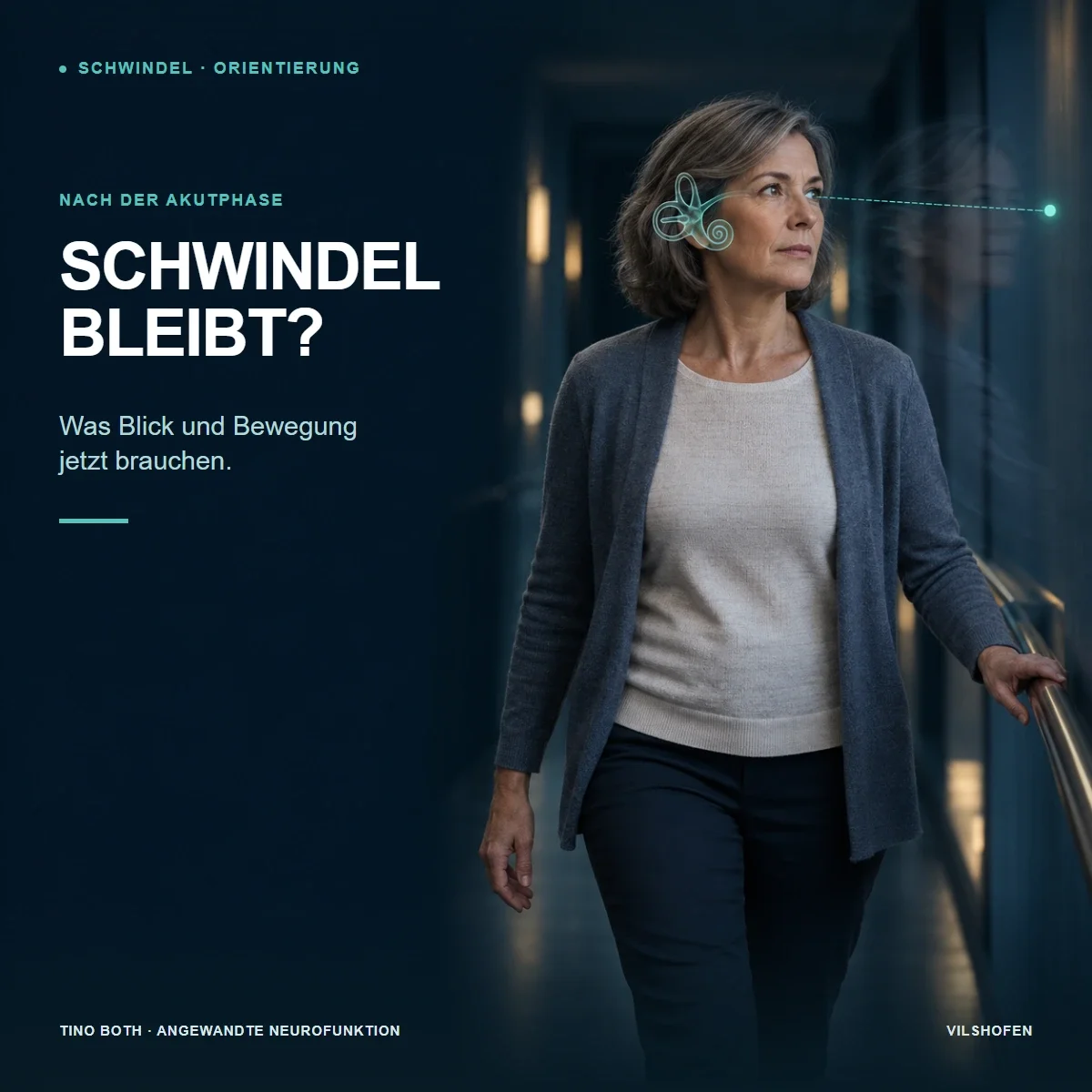
Briefly explained: After an acute phase of dizziness, unsteadiness while walking, problems with head movements or sensitivity to moving images may remain. Depending on the cause, balance and orientation need further adaptation and targeted rehabilitation. Persistent dizziness means neither automatically permanent damage nor always the same disorder.
Has severe spinning passed, but everyday life remains unsteady?Medical assessment and suitable vestibular physiotherapy or occupational therapy form the starting point. In the free initial consultation, we can clarify whether my Angewandte Neurofunktion in Vilshofen could usefully complement your existing care.
Discuss your remaining difficulties →
Discuss your remaining difficulties →
Sitting is fine. Setting off becomes difficult again.
You stand up and things no longer spin as they did initially. Yet you walk more cautiously. One glance to the side is enough to make the surroundings briefly feel unstable. In the supermarket, you want to leave quickly. Perhaps you then hear: ‘The acute episode ended ages ago.’ But in everyday life, it does not feel over yet.
This experience deserves closer consideration. The strongest symptoms of an acute illness may subside before all demands work well again. At the same time, not every new difficulty should automatically be classified as a harmless remnant of the old episode. The original cause, course and current symptom pattern matter.
What vestibular compensation means
After a balance organ loses function, the nervous system needs to handle changed information. Adaptation processes can help compensate for differences and control movement more safely again. This process is called vestibular compensation. The University Hospital Zurich describes how symptoms can change over weeks and months during this process.
This is not a fixed deadline by which everyone should be symptom-free again. Demands differ too: steady gaze while sitting is different from walking with head turns. One part of everyday life can therefore already feel normal while another situation remains clearly demanding.
Targeted rehabilitation instead of random balance exercisesThe effectiveness of targeted vestibular rehabilitation is well established for confirmed unilateral or bilateral vestibular hypofunction. The updated guideline on vestibular rehabilitation recommends care tailored to the limitations. This includes gaze stability and balance, for example, rather than automatically the same exercise for every form of dizziness.
Not every dizziness after an attack has the same explanation
Residual vestibular limitationIf gaze becomes unstable mainly during head movements or walking is difficult under particular conditions, a remaining vestibular limitation may be relevant. Professional examination helps decide which rehabilitation tasks fit.
Further brief spinning attacksBrief attacks during particular position changes may require another targeted assessment, for example for positional vertigo. Simply doing more general balance exercises is not automatically the appropriate response.
Persistent sensitivity to movement and visual activityWith symptoms on most days for at least three months, worsened by upright posture, movement and complex or moving visual stimuli, PPPD may also be considered. The Bárány criteria for PPPD describe further requirements. Not every prolonged dizziness meets them; PPPD can also coexist with other vestibular illnesses.
These possibilities are not a self-diagnosis list. They show why ‘you just need to get used to movement again’ is sometimes too vague. The next measure should fit the current problem, not just the word dizziness.
Which task brings out the unsteadiness?
In my Angewandte Neurofunktion, I break a difficult everyday situation into manageable demands. Walking through a shop combines head movement, changing gaze targets, moving people and balance at once. If everything is tested together, it remains unclear which part initially needs attention.
Three questions that distinguish the next stepDoes a target remain clear with the head still? This is a different demand from gaze stability during head movement.
What does a small head turn change? We observe not only dizziness intensity, but also gaze clarity, compensatory movements and recovery time.
What is added during standing or walking? Only when safe and appropriate do we consider the additional balance and orientation demand.
What does a small head turn change? We observe not only dizziness intensity, but also gaze clarity, compensatory movements and recovery time.
What is added during standing or walking? Only when safe and appropriate do we consider the additional balance and orientation demand.
One possible example: head movement is the decisive difference
Suppose a person has already begun vestibular rehabilitation after a medically assessed loss of function of a balance organ. A stationary target is easy to recognise while sitting. During a small head turn, it blurs and the person immediately tenses the whole upper body. When walking, they therefore avoid moving the head independently of the torso.
Simply adding harder standing exercises would not be very helpful then. I am initially interested in the combination of visual target and head movement. We keep target, lighting, distance and sitting position the same. We then change one demand, such as movement speed or the range of the head turn. Not several things at once.
The comparison determines the doseStarting point: A brief, safe task makes the difficulty understandable.
Targeted change: We choose a smaller or better-tolerated demand and observe gaze clarity and effort.
Identical re-test: The starting task is then repeated under the same conditions, insofar as it is tolerable.
Course: We consider how quickly symptoms settle and what happens later in the day. A good moment during the appointment alone does not yet determine the further programme.
Targeted change: We choose a smaller or better-tolerated demand and observe gaze clarity and effort.
Identical re-test: The starting task is then repeated under the same conditions, insofar as it is tolerable.
Course: We consider how quickly symptoms settle and what happens later in the day. A good moment during the appointment alone does not yet determine the further programme.
If instead moving images already provoke a strong response with the head still, the question shifts. Visual movement is then an element of its own, which we do not equate with gaze stabilisation during head movement. This precise difference can explain why a generally recommended exercise misses your actual problem.
What I can additionally contribute
My focus is the individual interaction of perception and movement: which condition changes the task, which addition is tolerable and what holds up in repeated comparison? Existing findings and a current therapy plan belong in this. Care that already makes sense should not become more confusing through an additional, contradictory exercise programme.
If you have not yet received physiotherapy or occupational therapy specialising in dizziness, it is worth first discussing suitable care with your treating professionals. My private support is a possible addition, not a necessary replacement for medical treatment or prescribed rehabilitation.
What you can observe yourself without continually testing yourself
Note some typical situations: quiet sitting, standing up, turning the head, walking, screens or supermarkets. Is the main problem spinning, swaying, light-headedness or unstable surroundings? How long does it last, and how long afterwards do you need to return to your usual level? These details are often more helpful than a daily maximum exertion test.
Avoid fall risks and use safe support where needed. Exercises must fit the illness and current ability. Mild, temporary symptoms can occur within professionally supervised rehabilitation. Marked or long-lasting deterioration, on the other hand, is a reason to adjust dose and selection together.
When you should not wait for further adaptation
Sudden new severe dizziness with marked inability to stand or walk, double vision, speech disturbance, paralysis or unusually severe headaches is an emergency: 112. New hearing reduction or a clear change in the previous course should be assessed promptly by a doctor. A recurrence is not harmless simply because you have had dizziness before.
Frequently asked questions about dizziness after the acute phase
How long does it take for balance to return to normal?This depends on the cause, remaining function, accompanying illnesses and rehabilitation, among other things. Weeks or months can play a role in vestibular compensation. A fixed deadline does not suit everyone; lack of progress or deterioration should be discussed professionally.
Should I rest or move more?Neither permanent avoidance nor maximum exertion is a universal solution. After the acute phase, targeted, adapted activity can support rehabilitation. Which movement, how much and which breaks should fit your diagnosis and response.
Is persistent dizziness automatically psychological?No. Residual vestibular limitations and functional adaptations can be involved, as can the burden of the symptoms themselves. PPPD is not shorthand for ‘imagined’ either. Causes and contributing factors need to be differentiated.
Why does an eye exercise not automatically help?A pure gaze movement is not the same as holding gaze steady during head movement. Looking at moving patterns likewise differs from safe walking. The exercise needs to target the demand that is actually relevant.
Let us describe the difficult everyday situation more preciselyIf your symptoms have been assessed and you additionally want to understand which functions interact in everyday life, we can begin there in the initial consultation. Feel free to bring information about your existing care.
Discuss additional support →
Discuss additional support →
Related pages and articles
Understanding dizziness and its course betterSpinning, swaying or light-headedness?
Dizziness despite unremarkable findings
Why dizziness only occurs in particular situations
Dizziness despite unremarkable findings
Why dizziness only occurs in particular situations
Gaze, movement and orientationHow dizziness can be assessed functionally
When scrolling and screen movement are overwhelming
Visual disturbances and visual processing
When scrolling and screen movement are overwhelming
Visual disturbances and visual processing