

← All articles
Children, concentration & learning
Podcast recommendation: Why learning involves more than the head
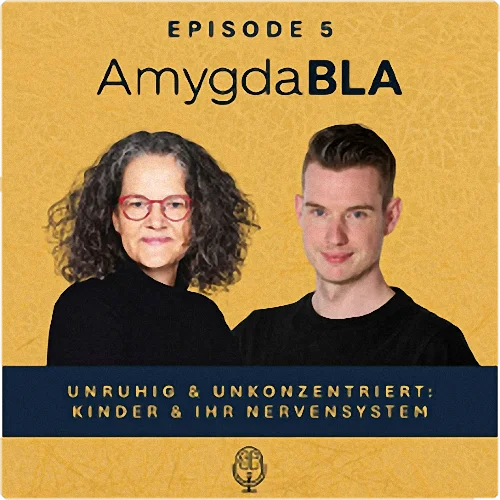
Why can movement, balance, the eyes and body awareness influence learning? The AmygdaBLA episode with Kevin Grafen and Astrid Buscher explains clearly why children learn with more than their heads — and why hasty judgements about laziness, restlessness or motivation often miss the actual problem.
A podcast episode that changes how we look at childrenThe conversation connects early childhood development, movement, perception, regulation and school learning. The attitude behind it is particularly valuable: First understand the demands a child has to manage before judging their behaviour.
Three thoughts parents can take from the episode
Learning becomes easier to understand when the body is considered part of the process.
Learning needs movement experienceTurning, supporting the body, climbing, balancing and free play provide information about the body and space that later learning tasks can build on.
The eyes and balance are involved tooReading, copying and sitting require stable control of gaze, head control and spatial orientation — even when a task initially appears purely cognitive.
Behaviour can be an attempted solutionFidgeting, withdrawal or avoidance need not simply be resistance. They can show that a child is trying to regulate overwhelm or create additional stability.
Listen directly to the podcast episode
The conversation with Kevin Grafen and Astrid Buscher is available on YouTube.
AmygdaBLA — interview with Astrid BuscherOpen the podcast episode on YouTube
Further information about the guest: Schlaukopf Institute.
Further information about the guest: Schlaukopf Institute.
The podcast episode
Kevin Grafen talks with Astrid Buscher about movement, perception, learning and children's nervous systems.
The episode is part of the podcast AmygdaBLA by Kevin Grafen and launches the interview format AmygdaBLA Hirnstammtisch.
The guest is Astrid Buscher, a graduate sports economist, children's neuro coach, director and managing director of the Schlaukopf Institute for systemic learning, scientific director of the ARTZT Institute, author, lecturer and speaker. The conversation explores why children with learning difficulties should be considered beyond school performance alone. Kevin and Astrid discuss movement, balance, the eyes, body awareness, breathing, early childhood development, reflexes, neural immaturity, ADHD, dyslexia, school, parents and children's perception.
For me, the basic idea of the episode is particularly valuable: Many children are not simply lazy, unmotivated or fidgety. Some have to work with a nervous system that uses a great deal of energy for seemingly simple things. This perspective can often bring relief to parents, because it changes the question.
Rather than: 'Why is my child making such a fuss?'
Ask: 'What makes this task so demanding for my child's nervous system?'
Why I recommend this episode
The episode shows very clearly that learning should be understood through more than motivation and practice alone.
What is worth paying attention toI recommend this episode because it makes understandable a topic often overlooked in school life: Children learn with their whole nervous system.
Of course, children need teaching, practice, structure, good support and sometimes therapeutic or educational help. But if a child repeatedly experiences difficulties, it is also worth considering the physical and neurofunctional foundations of learning.
How well can a child sense their body?
How stable is their balance?
How easily can they control eye movements?
How well can they switch between near and far?
How do they process sounds, movement and visual stimuli?
How well can they breathe, sit, write and remain attentive?
How much energy does all this use in the background?
If these foundations need a lot of energy, less capacity remains for reading, writing, arithmetic, listening or concentration. The podcast episode captures precisely this thought very well.
Of course, children need teaching, practice, structure, good support and sometimes therapeutic or educational help. But if a child repeatedly experiences difficulties, it is also worth considering the physical and neurofunctional foundations of learning.
How well can a child sense their body?
How stable is their balance?
How easily can they control eye movements?
How well can they switch between near and far?
How do they process sounds, movement and visual stimuli?
How well can they breathe, sit, write and remain attentive?
How much energy does all this use in the background?
If these foundations need a lot of energy, less capacity remains for reading, writing, arithmetic, listening or concentration. The podcast episode captures precisely this thought very well.
Movement and learning belong together
Movement is more than sport; it is an important part of childhood development.
A strong theme in the episode is the connection between movement and learning. Children develop many foundations for later learning through movement experiences. Crawling, turning, supporting the body, climbing, balancing, jumping, rolling, energetic play and free play provide the nervous system with important information. These experiences help the brain organise the body in space. They support balance, body awareness, head control, eye movements and orientation. This does not mean every learning problem is automatically solved through movement. But it does mean movement should not be treated as incidental. If a child tires quickly while sitting, tenses up when writing, loses the line when reading or seems physically restless at school, considering movement and perception can be very important. This is also central to my work with children: Looking beyond what the child is expected to achieve at school and checking which neurofunctional prerequisites are needed.
The eyes, balance and body awareness
Many school tasks need well-integrated cooperation between the eyes, body and balance.
When thinking about learning, many people first think of thought, language and attention. That is correct too. But there are further layers underneath.
When reading, the eyes need to jump precisely and fixate steadily.
When writing, the eyes, hand, shoulder and body need to work together.
When copying, the child needs to switch between the board and exercise book.
When sitting, the body needs to maintain posture without using too much energy.
When listening, sounds need to be filtered and important information highlighted.
When writing, the eyes, hand, shoulder and body need to work together.
When copying, the child needs to switch between the board and exercise book.
When sitting, the body needs to maintain posture without using too much energy.
When listening, sounds need to be filtered and important information highlighted.
For this, the nervous system needs a good connection between the eyes, balance, body awareness and regulation.
If this connection does not run easily enough, learning can become demanding. The child may then appear unfocused, slow, restless or avoidant, although they are actually capable of much more. The episode with Kevin and Astrid makes clear why it is so important to judge children beyond their behaviour alone.
A child who fidgets may be seeking stability.
A child who daydreams may be overwhelmed.
A child who writes slowly may be struggling to organise their body.
A child who avoids reading may find vision demanding.
A child who explodes after school may have been compensating all day.
A child who daydreams may be overwhelmed.
A child who writes slowly may be struggling to organise their body.
A child who avoids reading may find vision demanding.
A child who explodes after school may have been compensating all day.
This perspective changes a great deal.
Why children should not be judged hastily
Noticeable behaviour can often reflect understandable difficulties with regulation.
Important for interpretationOne statement expressing the episode's underlying attitude fits my work very well: Children should not hastily be judged lazy, fidgety or unmotivated.
Of course, children need boundaries, structure and responsibility. The aim is not to excuse every behaviour. It is to look more closely.
When a child repeatedly struggles with the same situations, there is often a pattern behind it.
Perhaps stimulus processing is overloaded.
Perhaps sitting is physically demanding.
Perhaps eye movements use a lot of energy.
Perhaps the balance system is not well integrated.
Perhaps breathing changes noticeably under stress.
Perhaps the child has difficulty switching from play mode to learning mode.
Perhaps written output is much harder than understanding spoken information.
These connections are not always visible at first glance. This is precisely why a functional perspective is worthwhile.
Of course, children need boundaries, structure and responsibility. The aim is not to excuse every behaviour. It is to look more closely.
When a child repeatedly struggles with the same situations, there is often a pattern behind it.
Perhaps stimulus processing is overloaded.
Perhaps sitting is physically demanding.
Perhaps eye movements use a lot of energy.
Perhaps the balance system is not well integrated.
Perhaps breathing changes noticeably under stress.
Perhaps the child has difficulty switching from play mode to learning mode.
Perhaps written output is much harder than understanding spoken information.
These connections are not always visible at first glance. This is precisely why a functional perspective is worthwhile.
Who may find the episode particularly interesting
The episode is particularly suitable for parents whose child has noticeable difficulties at school, with learning or with perception.
What is worth paying attention toI particularly recommend the episode to parents familiar with one or more of these issues:
The child struggles to concentrate.
Reading or writing is noticeably demanding.
Homework takes forever.
The child appears fidgety or restless.
The child seems dreamy or quickly overwhelmed.
There are concerns involving ADHD, dyslexia or reading and spelling difficulties.
The child is bright but does not demonstrate this consistently at school.
Sitting, writing or copying uses a lot of energy.
The child is unsure in their movements or avoids certain movements.
After school, the child is completely exhausted or overexcited.
Parents feel, 'There is more behind this.'
In these situations especially, the episode can help offer a fresh view of the child.
Not as a replacement for assessment.
Not as a quick solution.
But as an invitation to consider learning difficulties in neurofunctional as well as educational terms.
The child struggles to concentrate.
Reading or writing is noticeably demanding.
Homework takes forever.
The child appears fidgety or restless.
The child seems dreamy or quickly overwhelmed.
There are concerns involving ADHD, dyslexia or reading and spelling difficulties.
The child is bright but does not demonstrate this consistently at school.
Sitting, writing or copying uses a lot of energy.
The child is unsure in their movements or avoids certain movements.
After school, the child is completely exhausted or overexcited.
Parents feel, 'There is more behind this.'
In these situations especially, the episode can help offer a fresh view of the child.
Not as a replacement for assessment.
Not as a quick solution.
But as an invitation to consider learning difficulties in neurofunctional as well as educational terms.
How I translate this idea into neurofunctional practice
The general idea that 'learning needs the body' becomes a specific, checkable question for the individual child.
1. Define the real learning issueThe entire nervous system is not tested indiscriminately. The starting point is a specific difficulty, such as reading, sitting, concentration, writing or physical restlessness, paired with a short, repeatable task.
2. Change a relevant component functionEye movement, balance, body awareness, breathing or movement are assessed separately and at low doses. What matters is whether particular information reproducibly stabilises the initial output.
3. Integrate the connection foundThe helpful functional connection is integrated neurofunctionally and the original task is retested identically. Exercises are added only if transfer or tolerance subsequently still needs support.
The initial output is retested identically under the same conditions. An immediate change is a functional indication, but not proof of a diagnosis, cause, mechanism or duration of effect.
Why this process is understandable for parentsThis is where an interesting podcast idea becomes an individual working approach: Every child does not receive the same movement or eye exercises. The child's response determines which connection is pursued further.
Do you recognise your child in the podcast episode?During the free initial telephone consultation, we can clarify which specific learning or regulation issue affecting your child is suitable for a functional perspective.
Arrange a free initial telephone consultation
Arrange a free initial telephone consultation
A functional view of children, learning and the nervous system in Vilshofen and Lower Bavaria
Child-appropriate assessment, targeted NeuroFI integration and a clear, direct comparison.
I work in Vilshofen an der Donau with Applied Neurofunction and Neurofunctional Integration. For children with concerns around learning, perception and movement, I begin with the everyday situation that parents and child really want to change, rather than a standard programme.
More about the approachFocus page: Children, concentration & learning
Method — Neurofunctional Integration
Method — Neurofunctional Integration
Conclusion
The visible problem becomes clearer when its functional prerequisites are assessed.
The episode invites us to measure children by more than their visible performance. Understanding learning as an interaction between perception, the body and regulation leads to different questions — and often more precise starting points.
Frequently asked questions from parents
The main questions about learning, perception and movement — answered briefly and clearly.
Where can I listen to the podcast episode?The recommended AmygdaBLA episode with Kevin Grafen and Astrid Buscher is accessible directly through the YouTube video linked in this article.
What does movement have to do with learning?Movement provides the nervous system with information about the body, space, balance and coordination. These foundations can support school tasks, but do not automatically explain every learning problem.
How does the episode fit with Neurofunctional Integration?The episode opens a view of physical and sensory prerequisites. In my work, individual assessment then explores which specific connection changes a child's output and can be integrated.
All articles on children, concentration and learning
The complete children's series — from concentration and stimulus processing to reading, balance and neurofunctional assessment.
All children's topics at a glanceNeurofunctional assessment in children — what parents can expect
Why writing, reading and sitting are so demanding for some children
School difficulties despite intelligence — when perception and regulation use more energy
Current article: Podcast recommendation: Why learning involves more than the head
A child seems dreamy or quickly overwhelmed — understanding stimulus processing during the school day
A functional view of restlessness in children — when the nervous system does not regulate well
Balance and concentration in children — why confidence in movement can influence learning
When reading is demanding — the eyes, control of gaze and visual processing in children
Concentration difficulties in children — why motivation is not always the only issue
Why writing, reading and sitting are so demanding for some children
School difficulties despite intelligence — when perception and regulation use more energy
Current article: Podcast recommendation: Why learning involves more than the head
A child seems dreamy or quickly overwhelmed — understanding stimulus processing during the school day
A functional view of restlessness in children — when the nervous system does not regulate well
Balance and concentration in children — why confidence in movement can influence learning
When reading is demanding — the eyes, control of gaze and visual processing in children
Concentration difficulties in children — why motivation is not always the only issue
The next useful stepWould you like to move beyond observing your child's pattern and have it explored more specifically? During the free initial telephone consultation, we clarify without obligation whether my neurofunctional approach might suit your concerns.