

← All articles
Children, concentration & learning
Balance and concentration in children: Assessing connections thoughtfully
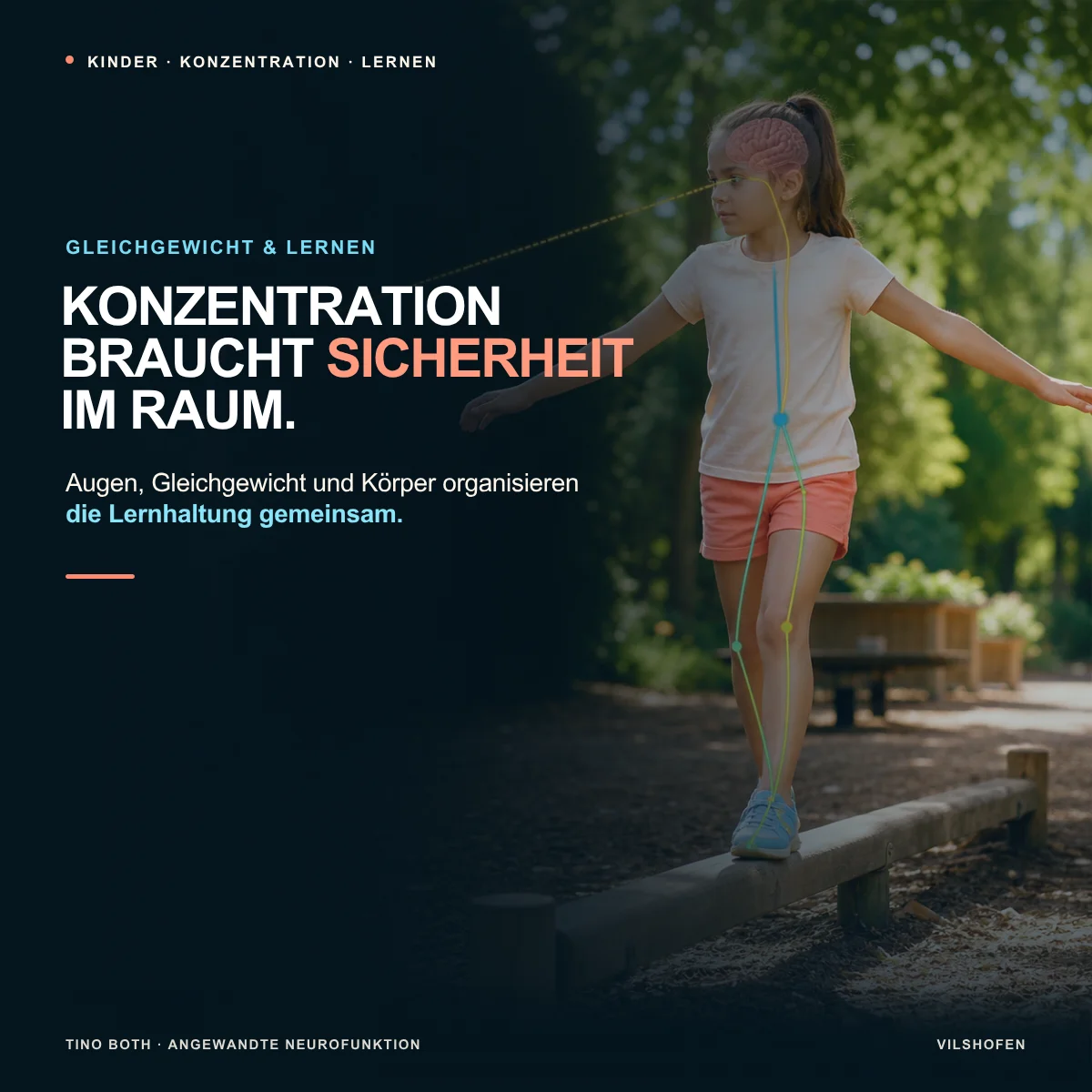
Briefly explained: Balance and concentration can relate to each other in everyday life, but are different abilities. During movement, the nervous system processes information from the eyes, inner ear and body. Whether additional movement demands also make a learning task harder can usefully be considered only in the specific situation.
Does your child seem unsteady when moving and quickly exhausted at the table?During the initial telephone consultation, we can sort through both observations. We explore whether a functional view of orientation, movement and school demands in person in Vilshofen suits your concerns.
Discuss your child's balance and learning →
The initial telephone consultation is free of charge.
Discuss your child's balance and learning →
The initial telephone consultation is free of charge.
When sitting and moving demand a lot of attention
Your child shifts around on the chair, wraps their legs around it or rests their head on their hand. It may seem as though they constantly have to reorganise their body. This can be a reason to look more closely at working position and movement demands. The observation alone, however, does not explain why homework is difficult.
Children change posture for many reasons. A long school day, boredom or an unsuitable chair can also matter. Differences are therefore particularly interesting: Is there a position in which your child works more comfortably? Is unsteadiness more noticeable with particular movements? Such observations give the functional perspective a direction.
How the body gains orientation
The balance system in the inner ear provides information about head movement and position relative to gravity. The eyes offer cues about the surroundings. Feedback from muscles, joints and skin adds information about how the body moves and where it finds support. From their interaction, the nervous system organises posture and movement. The basics are explained by NIDCD: How balance works and when assessment is important.
This cooperation faces different demands: Sitting quietly on a chair, tracking a ball and turning the head while walking are different tasks. A single balance attempt can therefore show only a small part of the picture.
Balance is more than 'standing on one leg for a long time'How well something goes also depends on the surface, visual target, task, experience and attention. In everyday life, the specific demand that produces unsteadiness matters — as well as the number of seconds a test lasts.
Where the link to learning becomes interesting
Imagine a child has to listen while carrying out an unfamiliar movement sequence. Perhaps both go well separately, but less well together. This creates a checkable question: Was the movement not yet familiar enough? Was the instruction understood? Does a simpler starting position change the situation?
Such a comparison can help adjust demands appropriately. It does not mean school becomes possible only when every movement task is performed perfectly. A physically unsteady child can also learn very attentively; their abilities and the support needed should be considered separately.
What movement can contribute to attention
Movement has value in its own right: For play, participation and physical development. Studies also examine whether movement programmes support particular cognitive abilities. A systematic review (2024): Aerobic exercise, executive functions and academic performance found favourable results for some executive functions, but rated the quality of evidence as low.
In practice, this means we can use movement as a worthwhile part of daily life while observing closely what it changes for the individual child. Whether a selected task also helps your child with homework is considered separately in everyday life.
A possible example: Understanding and safely performing a movement sequence
A child is asked to walk towards two clearly visible markers on a flat, clear surface. At first, the sequence is simple and familiar. We observe whether the target is found and the step performed safely. Only when this succeeds does a small additional demand become useful.
Perhaps movement changes when the visual target switches. I can then explore whether target position, speed or head movement makes the difference. Targeted visual or body-related input is tried at a low dose. The same starting task follows. Safety, accuracy and the child's experience matter more than speed.
Pursue two goals separatelyMovement goal: Does the selected stepping sequence become safer or more comfortable?
Everyday goal: Does an agreed activity become easier — for example, beginning a short work task after a movement break?
Both can be interesting. But they need not improve at the same time. We therefore check usefulness where you actually need it.
Everyday goal: Does an agreed activity become easier — for example, beginning a short work task after a movement break?
Both can be interesting. But they need not improve at the same time. We therefore check usefulness where you actually need it.
How I connect gaze, movement and task performance
If the observations lead to a suitable functional question, I can explore it more precisely through an additional stimulus assessment. The aim is not to collect as many unusual findings as possible. The starting point remains a demand relevant to your child.
The method's comparison remains understandableFirst, I choose an indicator muscle that can be tested reliably and without pain. A defined stimulus or suitable contacts relate the assessment to the selected question, such as the interaction between gaze and movement demands.
If inhibition considered unusual under the criteria of this procedure appears, I look for additional solution input. I repeatedly compare the original stimulus alone with the stimulus plus solution input. After integration, the original stimulus is tested again without this addition.
We then repeat the chosen movement task. What matters for further support is whether the child can use the change and whether it also appears in suitable everyday demands.
If inhibition considered unusual under the criteria of this procedure appears, I look for additional solution input. I repeatedly compare the original stimulus alone with the stimulus plus solution input. After integration, the original stimulus is tested again without this addition.
We then repeat the chosen movement task. What matters for further support is whether the child can use the change and whether it also appears in suitable everyday demands.
What parents can observe without setting up a test course
Pay attention to activities that happen anyway. Does your child avoid certain movement games? Is looking around while walking difficult? Does a simple task become markedly harder when movement is added? Equally important: Which movements are enjoyable and happen naturally?
At the desk, a comfortable, stable starting position is worth considering first. Suitable foot support can be tried if the feet otherwise hang freely. Short, enjoyable movement breaks are one option. Afterwards, ask how your child feels and whether returning to the task works, rather than making movement another compulsory task.
A wobble cushion or balance board increases the demands. It is therefore not automatically a better seat. If your child is mainly occupied with stabilising themselves on it, a steady surface may be more useful for the learning task. Rapid spinning or balancing with closed eyes is not needed for these everyday observations.
When balance problems should be assessed
Repeated falls, marked unsteadiness, dizziness, changes in hearing or unusual movement development should be assessed by a paediatrician. Sudden severe unsteadiness when walking, new neurological signs or loss of previously secure abilities need prompt medical assessment.
For longer-standing coordination difficulties, physiotherapy or occupational therapy can be important partners. The overall picture determines which support fits. Here too, a question is more helpful than a label: Which everyday activity is not yet sufficiently safe?
Frequently asked questions about balance and concentration in children
Does balancing automatically improve my child's concentration?No. A balance exercise initially trains the particular movement demand. Any additional benefit for a learning task should be observed separately.
Is rocking on a chair a sign of a balance disorder?This cannot be inferred from that alone. Seating, task duration, habit or the need for movement can also play a part. Recurring unsteadiness during movement deserves a closer look.
What movement is useful before homework?A safe, enjoyable activity that is not exhausting is a good starting point. What matters is whether your child returns well to the task afterwards. There is no universal compulsory exercise for all children.
Do we need to improve balance before learning can work?No. School learning and suitable movement experiences can take place alongside each other. It makes sense to shape the individual demands so your child can participate and make progress.
Move more safely — and check usefulness in everyday life
Balance is one possible part of the picture, rather than the explanation for every learning difficulty. The interesting step lies in comparison: Which demand changes something, and what does that mean for your child? This turns a general recommendation into an individually understandable decision.
Would you like to consider confidence in movement and learning together?Describe a typical situation during the free initial telephone consultation. We sort out what has already been clarified and whether my functional approach can offer a useful next step.
Initial consultation about balance and concentration →
The initial telephone consultation is free of charge.
Initial consultation about balance and concentration →
The initial telephone consultation is free of charge.
Related pages and articles
All children's topics at a glanceConcentration difficulties: Starting, staying with a task and finding your way back
Restlessness in children: Looking at behaviour functionally
Dreamy or quickly overwhelmed: Stimulus processing during the school day
When reading is demanding: The eyes and control of gaze
Writing, reading and sitting: Understanding effort more precisely
School difficulties despite intelligence: Ability and performance
Balance and concentration: Movement and learning — this article
Neurofunctional assessment: What parents can expect
Neuroathletic training for children and adolescents
Podcast recommendation: Learning involves more than the head
Restlessness in children: Looking at behaviour functionally
Dreamy or quickly overwhelmed: Stimulus processing during the school day
When reading is demanding: The eyes and control of gaze
Writing, reading and sitting: Understanding effort more precisely
School difficulties despite intelligence: Ability and performance
Balance and concentration: Movement and learning — this article
Neurofunctional assessment: What parents can expect
Neuroathletic training for children and adolescents
Podcast recommendation: Learning involves more than the head
Relevant areas of focus and how I workWhen school is difficult: Concentration and learning in Vilshofen
Vision and visual processing
Dizziness and balance
Angewandte Neurofunktion: How I work
Vision and visual processing
Dizziness and balance
Angewandte Neurofunktion: How I work
Sources and further reading
NIDCD: How balance works and when assessment is important
Systematic review (2024): Aerobic exercise, executive functions and academic performance
NHS: Developmental coordination disorder in children
Systematic review (2024): Aerobic exercise, executive functions and academic performance
NHS: Developmental coordination disorder in children